

Adorno, Theodor W. [1903 - 1969]
Baudrillard, Jean [1929 - 2007]
Benedict, Ruth Fulton [1887 - 1948]
Berger, Peter L. and Luckmann, Thomas
Bourdieu, Pierre [1930 - 2002]
Coleman, James S. [1926 - 1995]
Cooley, Charles Horton [1864 - 1929]
Crompton, Rosemary [1942 - 2011]
Dahrendorf, Ralf [1929 - 2009]
Du Bois, William Edward Burghardt [1868 - 1963]
Foucault, Michel [1926 - 1984]
Garfinkel, Harold [1917 - 2011]
Geertz, Clifford [1926 - 2006]
Goudsblom, Joop / Johan [1932]
Gouldner, Alvin W. [1920 - 1980]
Gramsci, Antonio [1891 - 1937]
Halbwachs, Maurice [1877 - 1945]
Homans, George, C. [1910 - 1989]
Lévi-Strauss, Claude Gustav [1908 - 2009]
Malinowski, Bronislaw [1884 - 1942]
Marcuse, Herbert [1898 - 1979]
Martineau, Harriet [1802 - 1876]
McLuhan, Marschall [1911 - 1980]
Mead, George Herbert [1863 - 1931]
Merton, Robert King [1910 - 2003]
Mills, Charles Wright [1916 - 1962]
Moreno, Jacob Levy [1889 - 1974]
Morgan, Lewis H. [1818 - 1881]
Pareto, Vilfredo [1848 - 1923]
Park, Robert Ezra [1864 - 1944]
Parsons, Talcott [1902 - 1979]
Popper, Karl Reimund [1902 - 1994]
Rousseau, Jean-Jacques [1712 - 1778]
Sorokin, Pitirim Aleksandrovič [1889 - 1968]
Spencer, Herbert [1820 - 1903]
Sumner, William Graham [1840 - 1910]
Taylor, Frederick Winslow [1856 - 1915]
Thomas, William Isaac [1863 - 1947]
Tocqueville, Alexis de [1805 - 1859]
Tönnies, Ferdinand [1855 - 1936]
Unger, Roberto Mangabeira [1947]
Veblen, Thorstein [1857 - 1929]
Ward, Lester Frank [1841 - 1913]

Addams, Jane [1860-1935]
Biography
Jane Addams was one of the vice presidents of the Chicago Liberty Meeting that led to the formation of the Central Anti-Imperialist League in Chicago. She later served as a vice president of the national Anti-Imperialist League (1904-1919).
In 1889, Addams co-founded Hull House, one of America’s first settlement houses. She was later a co-founder and first president of the Women’s International League for Peace and Freedom (1919-1935). She is also remembered as the first American Woman to receive the Nobel Peace Price.
-
- Biography
From: Marshall W. Fischwick [1968] Illustrious American: Jane Adams. Morristown, NJ: Silver Burdett Company.
From: Mary Jo Deegan [1985] Jane Addams and the Men of the Chicago School, 1892-1018. New Brunswick NJ: Transaction Books. - Women in History: Jane Addams
- Jane Addams (1890-1935)
Bolender Initiatives, LLC. - Wikipedia: Jane_Addams
- Biography
- Jane Addams Hull-House Museum
Includes a biography and chronology, works by and about Addams. - Hull-House Maps and Papers
- [1998] Ethical Survivals in Municipal Corruption
In: International Journal of Ethics, 8(3), April 1898, pp. 273-291. - [1899] Trades Unions and Public Duty
In: The American Journal of Sociology, 4(4), January 1899, pp. 448-462. - [1899] The Subtle Problems of Charity
In: The Atlantic Montly, 83(496), April 1899, pp. 162-79. - [1899] Democracy or Militarism
Address before the Chicago Liberty Meeting, April 30, 1899. - [1902] Democracy and Social Ethics
Mcmillan Co. - [1905] Problems of Municipal Administration
In: The American Journal of Sociology, 10(4), January 1905, pp. 425-44. - [1905] Child Labor Legislation - A Requisite for Industiral Efficiency (Harvard Univ. Library) or from JSTOR
In: The Annals of the Academy of Political and Social Science, 25(3), June 1905, pp. 128-37 - [1906] An International Patriotism
In: The Public 9, April 21, 1906.
At the age of twelve Jane Addams learned from her father that international patriotism is not a contradictory expression. She obtained “a sense of the genuine relationship which may exist between men who share large hopes and like desires, even though they differ in nationality, language and creed.” - [1907a] Newer Ideals of Peace (Google Books)
New York: Macmillan. - [1907b] National Protection for Children
In: Child Labor and the Republic (New York: National Child Labor Committee, 1907). - [1909] The Spirit of Youth and the City Streets (Google Books) or Harvard Library
New York: Macmillan. - [1910] Twenty Years at Hull-House
New York: MacMillan Co., 1910. - [1916] The Long Road of Woman’s Memory
New York: Macmillan. - [1922] Peace and Bread in Time of War (Harvard Library)
G.K. Hall & Co., 1960 (originally published by The Women’s International League for Peace and Freedom, 1922-1945). Mirror at BoondocksNet - [1923] A New Conscience and Ancient Evil (Harvard Library)
New York: Macmillan.
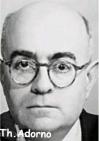
Adorno, Theodor W. [1903 - 1969]
By Adorno
- [1930/1964] Chaplin Times Two
The first essay appeared under the title “Kierkegaard prophesies Chaplin” in the Frankfurter Zeitung, May 22, 1930; the second as “Chaplin in Malibu” in Neue Rundschau, Vol. 3, 75th year, 1964; they first appeared together under the present title in the volume Ohne Leitbild (Frankfurt am Main: Suhrkamp, 1969), 89-93. - [1944] Le Prix du Progrès (with Max Horkheimer)
From: The Dialectic of Enlightenment. New York: Continuum, 1993. Originally published as “Dialektik der Aufklärung”, 1944. - [1944] The Culture Industry: Enlightment as Mass Deception (with Max Horkheimer)
From: The Dialectic of Enlightenment. New York: Continuum, 1993. Originally published as “Dialektik der Aufklärung”, 1944. - [1951] Minima moralia. Reflections from damaged life [mirror] (First published in German in 1951). Translation: Dennis Redmond (2005)
“Dialectic thought is an attempt to break through the coercion of logic by its own means.”
Imaginative excesses (unpublished piece intended for Minima Moralia). . - [1956] Music and Language: A Fragment
From: Quasi una Fantasia. Essays on Modern Music. London/New York: Verso. - [1964] Jargon der Eigentlichkeit. Zur deutschen Ideologie
- [1966] Education After Auschwitz
- [1968] Late Capitalism or Industrial Society?
Opening Adress to the 16th German Sociological Congress. Translation: Dennis Redmond (2001) - [1970/2001] Negative Dialectics | Wikipedia
Translated by Dennis Redmond. - [1991] Culture Industry Reconsidered
From: The Culture Industry: Selected Essays on Mass Culture. London: Routledge, 1991.
Adorno Live (videos)
- About Music [1:41] (with English annotation)
Adorno speaks about popular music, Joan Baez and the idiotism of singing songs against war. - Über die zwischenmenschliche Kälte [3:10]
- [1956] Erziehung zur Mündigkeit, part 1 [9:58], 2 [10:04], 3 [10:01], 4 [9:49], 5 [7:24]
- About Beckett and the deformed subject [0:36]
Adorno speaks in a TV talk show about the plays of Beckett and the necessary reduction of the plays because of blunted human beings and deformed subjects. Translated in English he says: “Everyone says Beckett is a reduction of tecnique to the extreme, I said that myself and it is nothing special about it to say that. But this reduction is what the world makes out of us, to talk with Karl Kraus. This is what the world is doing to us. These human stubs. These humans that lost their ‘I’ - they are the products of the world they live in.” - [2003] Der Bürger als Revolutionär [55:46]
A film by Meinhard Prill and Kurt Schneider. - [2003] Wer denkt, ist nicht wütend... [58:24]
A film by Meinhard Prill and Kurt Schneider.
Bibliographies
- T.W. Adorno: A bibliography [2007] - Lambert Zuidervaart
In: Stanford Encyclopdedia of Philosophy. - Theodor Wiesengrund-Adorno: une biographie sommaire
A short French biography and overview. Includes a bibliography for French material. Presented by Dialectique. - Theodor Adorno - Stanford Encyclopedia of Philosophy
Written by Lambert Zuidervaart (2003) - Theodor Adorno on PhilWeb
- Theodor W. Adorno Archiv - Institut für Sozialforschung, Frankfurt
On Adorno
- Bowman, Curtis [1997]
Odysseus and the Siren Call of Reason: The Frankfurt School Critique of Enlightenment
In: Other Voices 1(1). - Bronner, Stephen
Dialectics at a Standstill: A Methodological Inquiry Into the Philosophy of Theodor W. Adorno
In: Illuminations. - Gelder, Frederik van
- [2002] Adorno’s Hamlet
In: Programmheft Nr. 22, Schauspiel, Frankfurt am Main. (Hamlet production by Gottfried Greiffenhagen, Schauspiel Frankfurt, premiere of 21 Sept. 2002) - [2002] Adorno - Werk und Wirkung. Zum 100. Geburtstag
- [2004] Adorno’s concept of dialectics - a paradigm for the present?
In: Die Zukunft der Vernunft. Zur Aktualität von Theodor W. Adorno (ed. Gunzelin Schmid-Noerr and Kurt Schmidts). Congress Paper, Goethe Institut and University of Cluj-Napoca, Romania. - [2013] Adorno’s Minima Morala - filosofie in moeilijke tijden. English original: Immediacy and its vicissitudes
- [2002] Adorno’s Hamlet
- Cohen, Hart K. [1998]
The nightmare that haunts the Frankfurt School: Re-rationalisation of media use
In: Continuum 1(2): 100-9. - Dumain, Ralph [2003]
Adorno contra Husserl - Gannon, Thomas C. [1998-07]
Theodor Adorno and Heavy Metal - Kaufmann, David [1995]
Adorno and the Name of God
Why did Adorno - aberrant Marxist, Left Hegelian par excellence, and follower of Nietzsche - insist on using blatantly religious tropes? - Kogawa, Tetsuo [1980-1]
Adorno’s “Strategy of Hibernation”
A critical explanation of Adorno’s remark: “All culture after Auschwitz, including its urgent critique, is garbage.” - Larsen, Neil [1992]
Metadorno
In: Postmodern Culture 2(2). - Lindsey, Jack [1981]
Adornohttp://www.autodidactproject.org/other/lindsay6-adorno.html and the Frankfurt School
In: Lindsay, Jack [1981] The Crisis in Marxism (Totowa, NJ: Barnes & Noble Books, 1981), Chapter 5, Adorno and the Frankfurt School, pp. 63-80, 164-166. - O’Brien, Eugene [1968]
‘What ish my nation?’: Towards a negative definition of identity - Welty, Gordon [1984]
Theodor Adorno and the Culture Industry
Presented at the Annual Meeting of the Popular Culture Association, Toronto (March 30, 1984)
A review of Adorno’s conception of the ‘culture industry’ as it is found in three writings: ‘On Popular Music’ (1941), ‘Dialectic of Enlightenment’ (1944), and ‘Culture Industry Reconsidered’ (1963). In these writings, Adorno has provided a theory of the nature of the culture product and its valuation. The standardization and interchangeability of culture products under late capitalism leads to the interchangeability of persons in the audience. Stylization has its counterpart, the pseudo-individualization of the culture product and members of the audience. Both stylization and pseudo-individualization contribute to the possibilities of mass marketing. The consequences for the audience in late capitalism are distraction on the one hand, and on the other hand, a means of ensuring the audience’s ‘adjustment’ to its dependency. The significance of Adorno’s thought on the culture industry is becoming increasingly apparent in the present era. - Wiggersfhaus, Rolf [1995]
The Frankfurt School: Its History, Theories, and Political Significance (Translated by: Michael Robertson). - Wikipedia: Theodor Adorno
- Williams, Howard [1989]
Adorno’s Negative Dialectic
In: Williams, Howard [1989] Hegel, Heraclitus, and Marx’s Dialectic (New York: St. Martin’s Press, 1989), Chapter 9, Conclusion, pp. 220-223, 241 - Zuidervaart, Lambert [2007]
Theodor W. Adorno
In: Stanford Encyclopedia of Philosophy
Aron, Raymond [1903 - 1983]
a
By Aron
- [1935] Sociologie allemande contemporaine | German Sociology
- [1955] L’Opium des intellectuels
Pluriel: Hachette. - [1962] Guerre interétatique et guerre intraétatique
In: Paix et Geurre ente les Nations.
Paris: Calmann-Lévy. - [1963] Essai sur les libertés
- [1965] Les Étapes de la pensée sociologique / Main Currents in Sociological Thought
- [1966] Peace and War: A Theory of International Relations
Garden City, NY: Doubleday & Company.
Aron Live (videos)
- Sur mai 68 et Sartre [4.35]
- Sur sun conflit avec les intelletuels [3:26]
- L’étude du marxisme [2:45]
- Sociétés de dialogue [1:26]
Aron compares the democratic regime of our liberal societies, which he calls ‘dialogue societies’ with the system of the Soviet regime based on the refusal to trust in citizens and on the claim of a minority of oligarchs to hold the ultimate truth for themselves and for the future.
Biographies & Bibliographies
- Wikipedia: Raymond_Aron
- Encyclopædia Britannica
Aron, Raymond - Romane, Cécile [1998]
Biographie de Raymond Aron
On Aron
- Centre d’Études Sociologiques et Politiques Raymond Aron (CESPRA)
- Commentaire [table of contents + abstracts]
Journal found by Raymond Aron and headed by Jean-Clause Casanova. - Chanlat, Jean-François [1982]
Raymond Aron: l’itinéraire d’un sociologue libéral [pdf]
In: Sociologie et sociétés, 14(2): 119-33. Octobre 1982. - Elshtain, Jean Bethke [1998]
The Politics of the Possible
Review of Brian C. Anderson: Raymond Aron: The Recovery of the Political. Rowman & Littefield.
In: First Things, nov. 1998: 52-55. - Kimball, Roger [2001]
Raymond Aron and the power of ideas
From The Mew Criterion, 19(9), May 2001. - Malis, Christian
Raymond Aron et le concept de puissance
Article on Aron’s concept of power. [mirror]
Bauman, Zygmunt [1925]
By Bauman
- [1989] Modernity and the Holocaust
[Amazon]
Ithaca, N.Y.: Cornell University Press. - [1996] Alone Again - Ethics After Certainty
- [2006] Liquid Times: Living in an Age of Uncertainty
[Amazon]
Cambridge: Polity. - [2008] Culture in a Globalised City
A contribution to the issue of Occupied London. - [2011] Culture in a Liquid Modern World
[Amazon]
Cambridge: Polity.
Bauman Live (videos)
- [2009] About immigrants and wasps [10:30]
Fragment of a speech From Assimilation to...? A Brief History of European Ambitions and their Frustrations, held at the Spaces, Connections, Control Inaugural Symposium at Goldsmiths College, University of London, 28 November 2009. - [2010] Selves as Objects of Consumption, part 1 [14:51], 2 [14:21], 3 [14:48], 4 [14:45],5 [14:33], 6 [2:25], 7 [10:01], 8 [7:29]
Bauman gives a lecture Selves as Objects of Consumption in the Tolerance Center of Vilnius Gaon Jewish State Museum. The lecture was organized by Lithuanian Member of the European Parliament Prof. Leonidas Donskis, publishing house Apostrofa and Vytautas Magnus University (Kaunas, Lithuania). Thetranscript of this lecture was created by James C. - [2011] The Global Factory of Wasted Humans, part 1 [13:01], 2 [10:05], 3 [13:45]
Bauman talks about The Global Factory of Wasted Humans in a filmed conference published on the French video portal “Audiovisual Research Archive”. For Bauman the production of ‘human waste’ — or more precisely, wasted lives, the ‘superfluous’ populations of migrants, refugees and other outcasts — is an inevitable outcome of modernization. It is an unavoidable side-effect of economic progress and the quest for order which is characteristic of modernity. As long as large parts of the world remained wholly or partly unaffected by modernization, they were treated by modernizing societies as lands that were able to absorb the excess of population in the ‘developed countries’. Global solutions were sought, and temporarily found, to locally produced overpopulation problems. But as modernization has reached the furthest lands of the planet, ‘redundant population’ is produced everywhere and all localities have to bear the consequences of modernity’s global triumph. They are now confronted with the need to seek local solutions to globally produced problems. The global spread of the modernity has given rise to growing quantities of human beings who are deprived of adequate means of survival, but the planet is fast running out of places to put them. Hence the new anxieties about ‘immigrants’ and ‘asylum seekers’ and the growing role played by diffuse ‘security fears’ on the contemporary political agenda. See his book Wasted Lives: Modernity and Its Outcasts [2004].
On Bauman
- Bunting, Madeleine [2003]
Passion and pessimism
Interview and profile of Bauman from The Guardian. - Cummings, Dolan [2004]
The trouble with being human these days - Identity - Edemariam, Aida [2007]
Professor with a past, in: The Guardian April 28, 2007. - Europe of Strangers [pdf]
Oxford University Transnational Communities Programme Working Paper. - Galecki, Lukasz [2005]
The unwinnable war: an interview with Zygmunt Bauman - Majchrzak, Kamil [2007]
Was ist so schlimm daran?
Article about the anticommunist legislation in Poland and lies about Zygmunt Bauman. - Vásques Rocco, Adolfo [2008]
Modernidad líquida y fragilidad humana; de Zygmunt Bauman a Sloterdijk - Wikipedia: Zigmunt_Bauman
Baudrillard, Jean [1929 - 2007]
By Baudrillard
- [1981] On the Murderous Capacity of Images
Excerpt from Jean Baudrillard, The Evil Demon of Images and the Precession of Simulacra, in: Thomas Docherty (ed.) [1993] Postmodernism: A Reader New York: Columbia Univ. Press - [1986] America
Excerpts compiled by Chris Turner from the original in French, Americe - [1991] The Seismic Order
- [1992] Hystericizing the Millennium
Originally published in French as part of Jean Braudillard, L’Illusion de la fin: ou La greve des evenements. Paris: Galilee, 1992. Translated by Charles Dudas (York University). - [1992] Reversion of History
Originally published in French as part of Jean Braudillard, L’Illusion de la fin: ou La greve des evenements. Paris: Galilee, 1992. Translated by Charles Dudas (York University). - [1992] Rise of the Void towards the Periphery
Originally published in French as part of Jean Braudillard, L’Illusion de la fin: ou La greve des evenements. Paris: Galilee, 1992. Translated by Charles Dudas (York University). - [1992] Thawing of the East
Originally published in French as part of Jean Braudillard, L’Illusion de la fin: ou La greve des evenements. Paris: Galilee, 1992. Translated by Charles Dudas (York University). - [1992] Strike of Events
Originally published in French as part of Jean Braudillard, L’Illusion de la fin: ou La greve des evenements. Paris: Galilee, 1992. Translated by Charles Dudas (York University). - [1993] Pataphysics of Year 2000
Originally published in French as part of Jean Braudillard, L’Illusion de la fin: ou La greve des evenements. Paris: Galilee, 1992. Translated by Charles Dudas (York University). - [1994] Radical Thought
Translation of Jean Baudrillard’s La Pensee Radicale, published in Sens /Tonka (eds.) [1994] Collection Morsure, Paris. - [1994] Plastic Surgery for the Other
This article first appeared in Jean Baudrillard / Marc Guillaume [1994] Figures de l’alterite. Paris: Descartes et Cie. - [1994] No Reprieve for Serajevo
Published in Liberation, January 8, 1994. Translated by Patrice Riemens. - [1995] Vivisecting the 90s: An Interview with Jean Baudrillard
An interview by Caroline Bayard and Graham Knight (Mc Master University, Hamiltion, Canada. Published in Research in Semiotic Inquiry 16(1/2), Spring 1996. - [1996] Disneyworld Company
An essay. - [1996] Baudrillard on the New Technologies
An interview with Claude Thibaut in Cybersphere
Originally published in Style 29:314-27. - [1997] A Conjuration of Imbeciles
This article originallly appeared as “La conjuration des imbeciles” in Liberation on May 7, 1997. Translated by François Debrix. - [1997] The End of the Millennium or the Countdown
- [1997] Global Debt and Parallel Universe
Published in French by Liberation, Paris. Translated by François Debrix. - [2003] The Violence of the Global
Initially publishad als “La Violence du Mondial”, in Braudrillard [2002] Power Inferno. Paris: Galilée, pp. 63-83.
Terrorism is analysed as a contemporary partner of globalization.
Baudrillard Live
- The Murder of the Real, part 1 [9:05], 2 [9:08], 3 [9:06], 4 [9:07], 5 [7:35], 6 [4:01]
Audio recording of a 1999 lecture given at Wellek Library of University of California, Irvine. - Violence of the image, part 1 [9:57], 2 [10:01], 3 [10:00], 4 [9:56], 5 [9:47], 6 [9:59], 7[9:48], 8 [8:09], 9 [9:12]
Baudrillard talking about the violence of the image, the violence to the image, aggression, oppression, transgression, regression, effects and causes of violence, violence of the virtual, 3d, virtual reality, transparency, psychological and imaginary. Open Lecture given by Baudrillard after his seminar for the students at the European Graduate School, EGS Media and Communication Program Studies Department, Saas-Fee, Switzerland, Europe, in 2004.
On Baudrillard
- Attias, Ben
The World of Baudrillard
(Department of Speech Communication, School of Arts, Media, and Communication California State University Northridge, USA). - Nunes, Mark [1995] (DeKalb College)
Baudrillard in Cyberspace: Internet, Virtuality, and Postmodernity - O’Farrell, Clase [1993]
Review of Julian Pefanis, Heterology and the Postmodern: Bataille, Baudrillard, and Lyotard
Originally published in Thesis Eleven, 34 (1993), 202-5.
The book of Pefanis can be read at Google Books - S(t)imulacrum(b)
An extensive Baudrillard page with annotated bibliography and text selections. Editor: Ben Attias (California State University Norhridge). You have to be cautious: “Objects in Mirror are closer than they appear”.
Bi(blio)graphy
- Baudrillard on the Web
A list of links to works about and by Baudrillard, compiled by Alan Taylor. - Contemporary Philosophy, Critical Theory and Postmodern Thought
Links to sites on Baudrillard. - Extensive Bibliography (foucault.info)
A chronological bibliography by Machiel Karskens.
Becker, Howard S. [1928]
- Howie’s Home Page
A living sociologist who created this page primarily to make things he has written and published in obscure places available to anyone who wants them. - [1991] Children’s Conceptions of Money: Concepts and Social Organization
In: David Maines [1991] Social Organization and Social Process. Aldine Publishing Co. pp. 45-47. - [1993] New Directions in the Sociology of Art
Paper given at the meeting of the European Sociological Association, Section on the Sociology of Art, Paris, April 2003. - [1993] Making Sociology Relevant to Society
Lecture given at the meeting of The European Sociological Association in Murcia, Spain, 2003. - [1994b] Professionalism in the Sociology: The Case of C. Wright Mills
In: Ray Rist (ed.) [1994] The Democratic Imagination: Dialogues on the Work of Irving Louis Horowitz. New Brunswick: Transaction Books. - [1995] A New Art Form: Hypertext Fiction
In: M. Lourdes Lima dos Santos, Cultura & Economia, Lisbon: Edicões do Instituto de Ciências Sociais. - [1999] The Chicago School So-Called
In: Qualitative Sociology 22(1), 1999, p. 3-12. - [2001a] Drugs: What Are They?
Published in French as “Les drogues: que sont-elles?”, pp. 11-20 in Howard S. Becker, ed., Qu’est-ce qu’une drogue?, (Anglet:Atlantica, 2001). - [2001b] The Politics of Presentation: Goffman and Total Institutions
In: Charles Amourous / Alain Blanc (eds.) [2001] La politique de la présentation: Goffman et les institutions totales. Paris: L’Harmattan. pp. 59-77. - [2002] Studying the New Media
In: Qualitative Sociology 25(3), 2002, pp. 337-43. - [2003a] Making Sociology Relevant to Society
Lecture at the meeting of The European Sociological Association in Murcia, Spain. - [2003b] New Directions in the Sociology of Art
Paper given at the meeting of the European Sociological Associatoin, Section on the Sociology of Art, Paris, April 2003. - [2004a] Jazz Places
In: Andy Bennet / Richard A. Peterson (eds.) [2004] Music Scenes: Local, Translocal, and Virtual. Nashville: Vanderbil University Press. - [2004b] How Much is Enough?
Vlhelm Aubert Memorial Lecture. University of Oslo, October 2004. - [2004c] Hans Ulrich Obrist Interview with Howard Becker
To appear in The Welfare Show, edited by Ariane Beyn.
An interview about the use of interviews in sociological studies. Paris, October 20, 2004. - [2005] Making it up as you go along: How I Wrote Art Worlds
Published as “Inventer chemin faisant: comment j’ai écrit Les mondes de l’art”, in: Daniel Mercure (ed.) [2005] L’analyse du social: Les modes d’explication. Quebec: Les Presses de l’Université Laval. - [2006] The Lay Referral System: The Problem of Professional Power
In: Knowledge, Work and Society, 4: 65–76. - [2008] Interaction: Some Ideas
- [2009] Learning to observe in Chicago
In: Jean Peneff [2009] La goũt de l’observation. Paris: La Découverte, pp. 60-61, 76-77 and 126-27. - [2009] The Craft of Sociology
A recording of a two hour public event that took place in London in November, 2009, where Becker was the guest of the Goldsmiths College Sociology Department. The other voice belongs to Les Back. - [2013] Background Knowledge and the Universality of Sociological Work
In: Socio 1: 109-19. - Wikipedia: Howard_S._Becker
Bell, Daniel [1919 - 2011]
By Bell
- [1950] Notes on Authoritarian and Democratic Leadership
In: Alvin W. Gouldner (ed.) [1950], Studies in Leadership: Leadership and Democratic Action. New York: Harper & Brothers, pp. 395-408. - [1960] The End of Ideology
Chapter 13: The Mood of Three Generations.
A modern classical in which Bell argues that the older humanistic ideologies derived from the 19th and 20th centuries were exhausted, and that new parochial ideologies would arise. - [1968] Directions: American society at the crossroads
Speech by Daniel Bell on March 22, 1968, discussing the new character of American life. From the University of Alabama’s Emphasis Symposium on Contemporary Issues. - [1973] The Coming of Post-Industrial Society
New York: Basic Books. - [2002] Athens and Jerusalem: The Twin Foundations of Western Civilization
On Bell
- Perlstein, Rick [1996]
The Prophet Motive - Daniel Bell’s Take on Capitalism, 20 Years Later
Posted in Slate, Nov. 20, 1996. - Lind, Michael [1999]
Why Daniel Bell Keeps Getting it Right
New America Foundation. - Wikipedia: Daniel Bell
Benedict, Ruth Fulton [1887 - 1948]
- Guide to the Ruth Fulton Benedict Papers
- [1931] Tales of the Cochiti Indians
Bureau of American Ethnology Bulletin no. 98. - [1945/2005] The Chrysanthemum and the Sword
Cleveland: Maridian Books. - [1950] Échantillons de civilisation
- Hochman, Susan K.: Ruth Fulton Benedict
A short but informative biography. You will learn that Benedict emphasizes the power of custom and learning as an argument against nature and of the infinite capacity of human beings to change. Benedict believed that an individual could succesfully alter the conditions of her social life and in doing so, transforms society. - Mead, Margaret [1949] Ruth Benedict’s obituary
In: American Anthropologist 51(3):457-468. - Wikipedia: Ruth_Fulton_Benedict
Berger, Peter L. and Luckmann, Thomas
- [1963] Invitation to Sociology. A Humanistic Perspective
New York, Anchor Books, Doubley & Company, Inc.
An invitation to understand society in a disciplined way for people who are naturally interested in the events that engage people’s ultimate beliefs, their moments of tragedy and grandeur and ecstasy, but who are also fascinated by the commonplace, the everyday. Social reality has many layers of meaning. The discovery of each new layer changes the perceptions of the whole The fascination of sociology lies in the fact that its perspective makes us see in a new light the very world in which we have lived all our lives.- Chapter 1: Sociology as an individual pastime
In the first chapter [pp. 1-24] of his Invitation to Sociology Berger presents his humanistic answers to the question “why study sociology?” In Why Study Sociology?his main arguments are -gender modified- summarized. - Chapter 6: Sociological Perspective: Society as Drama
- [1963] Outline of Invitation to Sociology
An excellent introduction to sociology. Although some material is unavoidably dated, the sociological insights aren’t dated in the least.
- Chapter 1: Sociology as an individual pastime
- [1966] Society as a Human Product
From: Peter L. Berger and Thomas Luckmann. [1966] The Social Construction of Reality: A Treatise in the Sociology of Knowledge. Garden City, New York: Anchor Books, pp. 51-55, 59-61.
In these fragments the autors explain what it means that man produces himself, i.e. the homo socius. They also argue that the causes of the emergence, maintenance and transmission of a social order can only be understood when you analyse the orgins, functions and processes of institutionalization. The origin of institutionalization is explained by the argument that all human activity is subject to habitualization. This processes of baibualization precede any institutionalization. Institutionalization itself is defined as a reciprocal typication of habitualized actions by types of actors. - [1990] Reflections of an Ecclesiastical Expatriate
In: The Christian Century, October 24, 1990, pp. 964-9. - [1997] Epistemological Modesty: An Interview with Peter Berger
In: The Christian Century, October 29, 1997, pp. 972-8.
Berger explains why the modern challenges is how to live with uncertainty. “The basic fault lines today are not between people with different beliefs but between people who hold these beliefs with an element of uncertainty and people who hold these beliefs with a pretense of certitude. There is a middle ground between fanatism and relativism.” That’s what is ment by “epistemomogical modesty”, you can belief certain things, but you are modest about these claims. - [1998] Protestantism and the Quest for Certainty
In: The Christian Century, August 26-September 2, 1998, pp. 782-796.
Berger explains a big mistake he made in his career as a sociologist. He once believed that modernity necessarily leads to a decline in religion. But he also explains one big insight: pluralism undermines the taken-for-granted of beliefs and values. In the article the mistake and the insight are related. - Kessel, David H.
Berger’s Motifs of Sociological Consiousness
Kessel explains his fascination for a classic in sociology, Berger’s Invitation to Sociology. In a few word he stresses the importance of Berger’s ideas about how to think sociologically...especially critically. The four motifs or themes of “sociological consiousness” are illustrated from Berger’s book. - Peter L. Berger Room
A listing of online publications on Peter Berger.
Bhaskar, Roy [1944 - 2014]
- Rob Bhaskar
Includes an extensive bibliography. - Info on Bhaskar - From: Spoon Collective.
- [1975] A Realist Theory of Science [Preface & Introduction] || Amazon
- Roy Bhaskar Interviewed
by: Chris Norris. Published in The Philosophers’ Magazine (TPM).
Bhaskar explains why the most important problem facing mankind was that of world poverty. From thereon he explains his philosophical perspective on critical realism. - The Web Site for Critical Realism (WSCR)
An independent space for the study and promotion of critical realist methods and analyses. Presented by the Centre for Critical Realism (CCR). - Gorman, David [1996]
Critical Unrealism
Review of Roy Bhaskar (ed.) A Meeting of Minds: Socialists discuss philosophy - towards a new symposium (London: Socialist Society, 1991).
In: Radical Chains, 1(4). - Wikipedia: Roy_Bhasker

Blau, Peter [1918 - 2002]
- Social Exchange
From: Peter Blau [1964] Exchange and Power in Social Life. New York: Wiley, pp. 88-97. - [1970] A Formal Theory of Differentiation in Organizations [Summary]
In: American Sociological Review 25: 201-18. - [1993] Putting Coleman's Transition Right-Side Up
In: Analyse & Kritik, 15(1): 3-10. - Scott, W. Richard / Calhoun, Craig [2002]
Peter Michael Blau
A biographical memoir presented by The National Academies Press. - Wikipedia: Peter_Blau
Blumer, Herbert [1900 - 1987]
- [1933] Movies and conduct: Some remarkts on method
New York: Macmillan & Company, 192-200 - [1973] Der methodologische Standort des symbolischen Interaktionismus[pdf]
In: Allagswissen, Interaction und gesellschaftliche Wirklichkeit, Band I. - Arbeitsgruppe Bielefelder Soziologen (Hg.). Reinbek bei Hamburg: Rowohlt, 1973. pp. 80-101. - Harris, C. Dodd [1996]
Symbolic Interactionism as defined by Herbert Blumer - Wikipedia: Herbert_Blumer
Boltanski, Luc [1940]
- [1989] Justesse et Justice dans le travail [pdf]
Introduction of Luc Boltanski & Laurent Thévenot [1989] “Justesse et justice dans le travail”. Cahier du centre d’études et de l’emploi. Paris: PUF, 33, p. V-VII. - [1991] De la justification [pdf]
Preface of Luc Boltanski & Laurent Thévenot [1991] “De la justification. Les économies de la grandeur”. Paris: Gallimard, p. 6-39. It explains how the book has been written. - La sociologie politique & morale de Luc Boltanski
A site dedicated to the sociology of Luc Boltanksi, created by A. Rousseau and P. Wright, students of the IEP in Toulouse. It offers analysis of his work, a biography and bibliograhpy, and links to online texts. - Juhem, Philippe [1994] Un nouveau paradigme sociologique?
In: Cahier de sociologie politique de Nanterre, vol 1, 1994, p. 82-106.
Article on the importance of the work of Luc Boltanksi and Laurent Thévenot. - Wikipedia: Luc_Boltanski
Boudon, Raymond [1934-2013]
- Raymond Boudon (Académie des Sciences Morales et Politiques)
- [1982] Dictionnaire critique de la sociologie / A critical dictionary of sociology - with François Bourricaud
- [1990] Les causes de l’inégalité des chances scolaires
- [1998] A “satisfying” theory of social knowledge
Why do people believe in fragile and false ideas? Boudon identifies three classical theories on this subject. He uses Herbert Simon’s “satisficing” theory of decision to explain the magical beliefs. - [1999] The origin of values
A critical discussion of relativistic theories of values. Boudon argues that rationalist theories of axiological feelings are scientifically much more valid and promising than culturalist or naturalist theories. - [2002] Déclin de la morale, déclin des valeurs
Paris: PUF. - Sperber, Dan [1997]
Individualisme méthodologique et cognitivisme
In: Boudon, Raymond / Chazel, François / Bouvier, Alban (eds.) [1997] Cognition et sciences sociales. Paris: Presse Universitaires de France. - Wikipedia: Raymond_Boudon [french]
Bourdieu, Pierre [1930 - 2002]
- Bourdieu Google Group
A forum for the discussion and debate inspired by the philosophical and sociological thought of Pierre Bourdieu and his work in all its aspects: aesthetic, artistic, cultural, scientific, social, philosophical and political. - Champs
A mailing list for the exchange of information about the ideas of Pierre Bourdieu. Moderated by Raphaël Desanti. - Pierre Bourdieu - sociologue énervant
A portal on Bourdieu, presented by Le Magazine de l’ Homme Moderne. The site presents many original texts of Bourdieu.
By Bourdieu
- [1977] Outline of a Theory of Practice | Amazon
Cambridge: Cambridge Univ. Press. 1977, chs. 2 (‘Structures and the Habitus’), 4 (‘Structures, Habitus, Power: Basis for a Theory of Symbolic Power’). - [1983] Distinction: A Social Critique of the Judgement of Taste
[Amazon]
Translated by Richard Nice and with an introduction by Tony Bennet.
London/New York: Routledge
See also: “Classes and Classifications” [selected from pp. 466-484). - [1987] The Biographical Illusion
In: Working Papers and Proceedings of the Center for Psychosocial Studies, (Chicago), 14:1-7. - [1988] Of Interest and the Relative Autonomy of Symbolic Power
In: Working Papers and Proceedings of the Center for Psychosocial Studies, (Chicago), 20:1-11. - [June, 1991] Espíritus de Estado. Génesis y estructura del campo burocrático
Spanish translation of Esprits d’État. Genèse et structure du champ bureaucratique. A lecture on a conference in Amsterdam, 29 June 1991. Published in Actes RSS, nr. 96/97:49-62. Reprinted in Razones prácticas. Sobre la teoría de la acción. Barcelona: Anagrama, 1997. - [1995] Combattre la technocratie sur son terrain
Discours aux cheminots grevistes - Paris, Gare de Lyon, 12 decembre 1995. - [1996] Was bin Ich? or French translation: Que sui-je?
Interview with Pierre Bourdieu of Isabelle Graw. In: The Thing (Vienna, Switzerland). - [April, 1996] La télévision peut-elle critiquer la tétélevision?
Le Monde Diplomatique. - [Oct., 1996] Sociologie et démocratie
Tribune Libre, 3 (1996). - [June 1997] La dominación masculina
(The male domination)
In: La Ventana Revista de estudios de género, nr. 3. Translation of: La domination masculine. Paris: Seuil. - [July 1997] Der Beitrag der Intellektuellen
(The contribution of Intellectuals) - [Mai, 1998] The Essence of Neoliberalism | L’essence du néolibéralisme
Le Monde Diplomatique. - [Aug., 1998] De la domination masculine
Le Monde Diplomatique, nr. 533. - [June, 1999] Pour un mouvement social européen
Le Monde Diplomatique. - [Jan, 2001] Pour un savoir engagé
Le Monde Diplomatique.

Bibliographies
- HyperBourdieu
A comprehensive, contextual and referential bibliography and mediography of Bourdieu’s works and public statements. Created by Ingo Mörth and Gerhard Fröhlich (Johannes Kepler University Linz, Austria). - Des textes de Pierre Bourdieu
- Wikipedia: Pierre_Bourdieu
Bourdieu Live (videos)
- Sociolgy is a Martial Art, part 1 | 2 | 3 | 4 | 5 | 6 | 7 (YouTube)
A documentary about Bourdieu’s life. Filmed over three years, director Pierre Carles’ camera follows Bourdieu as he lectures, attends political rallies, travels, meets with his students, staff, and research team in Paris, and includes Bourdieu having a conversation with Günter Grass. The title of the film stresses the degree of Bourdieu’s political engagement. He took on the mantle of Emile Zola and Jean-Paul Sartre in French public life, slugging it out with politicians because he considered those lucky enough to have spent their lives studying the social world could not be indifferent to the struggle for justice. It is a vital documentary that is useful in various courses in social sciences. - Sur la domination masculine [8:13]
- Les jugements de goût [10:58]
- Une proposition pour l’enseignement du futur [10.5.1985]
- Pierrie Bourdieu, part 1 [15:00] | 2 [15:00] | 3 [18:46]
Dominique Bollinger interviews Pierre Bourdieu [1991]
On Bourdieu
- Beasley-Murray, Jon [1995]
Value and Capital in Bourdieu and Marx
Papers in the Marxism Archive (Spoons Collective): presented at ‘Pierre Bourdieu - fieldwork in philosophy conference’, Duke University, 21-23 April 1995. A revised version of this essay is published in Nicholas Brown & Imre Szeman (ed.) [2000] Pierre Bourdieu: Fieldwork in Culture. Lanham, MD: Rowman and Littlefield. pp. 100-19. - Beck, Ulrich [1997]
Mißverstehen als Fortschrift - Europäische Intellektuele im Zeitalter der Globalisierung
Laudatio by the Ernst-Bloch prize. - Jacobs, Dirk [1993]
Het structurisme als synthese van handelings- en systeemtheorie
In: Tijdschrift voor Sociologie, 14:335-360 - Fowler, Bridget (University of Glasgow)
Pierre Bourdieu and La Domination Masculine
In her critical review of La Domination Masculine [Seuil 1998] Fowler discusses Bourdieu’s theory of gender relations. - Krauss, Hartmut [2001]
Zwischen Subjektivismus und Objektivismus. Zum Erkenntnisgehalt der theoretischen Konzeption Pierre Bourdieus
Glasnost-archiv. - Lawley, Elizabeth Lane [1994]
The Sociology of Culture in Computer-Mediated Communication. An Initial Exploration. - Loesberg, Jonathan [1993]
Bourdieu and the Sociology of Aesthetics
In:ELH 60(4):1033-1056. - Mex, Bernd [2000]
Störenfeind in der linken Idylle?
In: Forum Wissenschaft / Linksnet.de - Weill, Nocolas [2001]
Pierre Bourdieu, sujet du dernier cours de Pierre Bourdieu
In: Le Monde, 29.3.01.
In his last lecture on the Collège de France, Bourdieu spoke on himself as a sociological object. Weill summarizes some important notions he presented. - Wacquant, Loïc [2002] (Univ. of California, Berkeley, USA)
Blues, boxe et sociologie
In: Le Nouvel Observateur, januari 2002, no. 1943.
Castells, Manuel [1942]
By Castells
- Official website
- [1998] The Education of City Planners in the Information Age
In: Berkeley Planning Journal 12 (1998): 25-31 - [2000] The Information Age: Economy, Society and Culture
- The Rise of the Network Society (Volume 1)
[Amazon]
- The Power of Identity (Volume II)
[Amazon]
- End of Millennium (Volume III)
[Amazon]
- The Rise of the Network Society (Volume 1)
- [2001] The Internet Galaxy: Reflections on the Internet, Business, and Society
[Amazon] |Wikipedia
Oxford: Oxford University Press. - [2007] Communication, Power and Counter-power in the Network Society
In: International Journal of Communication, 1, 238-266 - [2007] CalArts International Initiatives: Art as a Global Cultural Bridge
- [2009] Communication Power
[Amazon]
Oxford University Press.
Castells Live
- [2003] Conversations with History [58:18]
Interview by Harry Kreisler. - [2008] The Internet and Society [1:35:32]
Presented by USC Annenberg - [2008] Communication technology as material culture: Internet and autonomy building in the network society [1:20:49]
Presented by USC Annenberg - [2009] Changing the System [4:42]
- [2009] Internet and social movement [4:27]
- [2009] Cities and Development, part 1 [15:04], 2 [14:57], 3 [14:55], Q&A;_2 [15:01], Q&A;_3 [14:55], Q&A;_4 [6:26]
A lecture delivered by Manuel Castells at the University of Cape Town in 2009 - [2010] Introduction to Seminar on Network Theory [11:30]
Presented by USC Annenberg - [2010] Network Theories of Power [1:06:00]
Presented by USC Annenberg - [2011] WikiLeaks to Wiki-Revolutions: Internet and the Culture of Freedom [1:33:13]
- [2012] Ciencia y Tecnología en el nuevo modelo de desarrollo informacional [1:26:19]
- [2015] Communication, Technology and Society [4:19]
Bi(bli)ography
On Castells
- Anderson, William R., Jr. [2000]
Manuel Castells and the Decline of Twentieth-Century Sociology
In: The Quarterly Journal of Austrian Economics, 3(4): 77-89. - Chen, Yu-Fen [2009]
Manuel Castells in my research of cyberactivism
In: Masters of Media, University of Amsterdam - Dijk, Jan A.G.M. van Dijk
The One-dimensional Network Society of Manuel Castells
In: The Chronicle - Fuchs, Christian [2009]
Some Reflections on Manuel Castells’ Book “Communication Power” - Lefort, Fene [1999]
Manuel Castells: The Citizen Versus The Machine
In: UNESCO Courier, october 1999 - Oosterbaan, Warna [1997]
“We hebben een machine gemaakt die door niemand beheerst wordt”
In: NRC, 6 november 1997 - Valtanen, Markku [2007]
Identity, Structure and Ideology: Mamuel Castells’ contribution to the identity policy discussion
Coleman, James S. [1926 - 1995]
- Biography of James S. Coleman
In: Encyclopedia Britannica. - [1992] The Vision of Foundations of Social Theory
In: Analyse & Kritik, 14(2): 117-128. - Bornmann, Lutz (Kiel, German)
Grundbegriffe und leitende Annahmen der Sozialtheorie James S. Coleman
A short article on the fundamental concepts and propositions of Coleman’s social theory. - Marsden, Peter V. [2005]
The Sociology of James S. Coleman
In: Annual Review of Sociology, 31: 1-24. - James S. Colemans Foundations of Social Theory (’92-2), (’93-1) & (’93-2)
In: Analyse & Kritik, Zeischrift für Sozialtheorie. Eds.: Michael Naurmann & Anton Leist. - Wikipedia: James_Samuel_Coleman
Collins, Randall [1941]
- Homepage of Collins at the Sociology Department of the University of Pennsylvania
- The Sociological Eye - The blog of Collins.
“The sociological eye holds up a periscope above the tides of political and intellectual partisanship, spying out the patterns of social life in every direction.” - Wikipedia: Randall_Collins
- [1974] The Basics of Conflict Theory
From: Randall Collins [1974] Conflict Sociology. New York: Academic Press, pp.56-61. - [1975] Outline of Organizations in Conflict Sociology
From: Randall Collins [1975] “Organizations” in Conflict Sociology: Toward an Explanatory Science. New York: Academic Press. - [1979] The Late Twentieth-Century Credential Crisis
From: Randall Collins [1979] The Credential Society. New York: Academic Press, pp. 191-204. - [1984] The Role of Emotion in Social Structure
In: Ekman, Paul / Scherer, Klaus R. / Erlbaum, Lawrence [1984] Approaches to Emotion, Chapter 18
New Jersey London: Lawrence Erlbaum. - [1992] Weber’s Last Theory of Capitalism: A Systematization
In: Granovetter, Mark / Swedberg, Richard [1992] The Sociology of Economic Life, Chapter 3.
Westview Press. - [1992] Foreword
In: Hilbert, Richard A. [1992] The Classical Roots of Ethnomethodology: Durkheim, Weber and Garfinkel.
University of North Carolina Press. - [1993] Liberals and Conservatives, Religious and Political: A Conjuncture of Modern History
In: Sociology of Religion 54(2):127. - [1994] Four Sociological Traditions
New York/Oxford: Oxford University Press. - [1998] The Multiple Fronts of Economic Sociology --> [MOVED TO ?}
Editorial essay in the Economic Sociology Section of the ASA. - [2000] Waller, David V.: Predictions of Geopolitical Theory and the Modern World-System
In: Derluguian, Georgi M. / Greer, Scott, L.: Questioning Geopolitics: Political Projects in a Changing World-System, Chapter 4.
Westport/London: Praeger. - [2000] Interview with Randall Collins conducted by Alair Maclean & James Yocom
- [2005] Interaction Ritual Chains
[Amazon]
Princeton University Press
Collins presents a theory that attempts to develop a »radical microsociology«. Successful rituals create symbols of group membership and pump up individuals with emotional energy, while failed rituals drain emotional energy. Each person flows from situation to situation, drawn to those interactions where their cultural capital gives them the best emotional energy payoff. Thinking, too, can be explained by the internalization of conversations within the flow of situations; individual selves are thoroughly and continually social, constructed from the outside in.
The first half of this book is based on the classic analyses of Durkheim, Mead, and Goffman and draws on micro-sociological research on conversation, bodily rhythms, emotions, and intellectual creativity. The second half discusses how such activities as sex, smoking, and social stratification are shaped by interaction ritual chains. Collins addresses the emotional and symbolic nature of sexual exchanges of all sorts: from hand-holding to masturbation to sexual relationships with prostitutes. - [2005] The Sociology of Almost Everything
Four Questions to Randall Collins about Interaction Ritual Chains.
In: Canadian Journal of Sociology Online, January-February 2005. - [2009] Violence: A Micro-sociological Theory
[Amazon]
Collins gives a comprehensive explanation of violence and its dynamics, drawing upon video footage, cutting-edge forensics, and ethnography to examine violent situations up close as they actually happen. Violence comes neither easily nor automatically. Antagonists are by nature tense and fearful, and their confrontational anxieties put up a powerful emotional barrier against violence. We are guided into the disturbing worlds of human discord: domestic abuse, schoolyard bullying, muggings, violent sports, and armed conflicts. The fog of war pervades all violent encounters, limiting people mostly to bluster and bluff, and making violence, when it does occur, largely incompetent, often injuring someone other than its intended target. Violence can be triggered only when pathways around this emotional barrier are presented. Collins explains why violence typically comes in the form of atrocities against the weak, ritualized exhibitions before audiences, or clandestine acts of terrorism and murder — and why a small number of individuals are competent at violence. - [2011] Emotional energy and the cult of free will
In: The Sociological Eye, January 8, 2011 - [2011] Interaction Rituals and the New Electronic Media
In: The Sociological Eye, January 25, 2011 - [2013] Material interest are ambigious motives: Social interaction ritual focus is better predictor of political behavior
In: The Sociological Eye, October 1, 2013 - [2013] Goffman and Garfinkel in the intellectual life of the 20th century
In: The Sociological Eye, October 29, 2015 - [2015] Why does sexual oppression exist?
In: The Sociological Eye, February 15, 2015 - Soziologische Klassiker / Collins, Randall (in wikibooks)
Comte, Auguste [1798 - 1857]
By Comte
- [1818-22] La science sociale
- [1822] Plan des traveaux scientifiques nécessaires pour réorganiser la société
The text that founded sociology. - [1924] Lettre d’Auguste Comte à M. Vallet (A letter from Comte to his friend Valat)
- [1830-1843] Cours de philosophie positive
- [1842] Discours sur l’esprit positif
- [1848] Discours sur l’Ensemble du Positivisme / A General View of Positivism (Google Books) | A General View of Positivism(OpenLibrary)
- [1849-57] Lettres inédites á de Blignières
- [1851-4] Système de Politique Positive ou Traité de Sociologie
English translation: System of Positive Polity [1852]
Translated by Frederic Harrison. - [1852] Catéchisme positiviste / The catechism of positive religion (translated by Richard Congreve)
- [1854] On the Positivistic Approach to Society [extract]
From: Auguste Come, The Positive Philosophy of Auguste Comte. Freely translated and condensed by Harriet Martineau. NY: Calvin Blanchard. Vol. 2: 68-74 and 95-110. - L’Oeuvre d’Auguste Comte présentée par lui-même
Auguste Comte Works as Presented by Himself.
On Comte
- Kreis, Steven [1998-9]
The Age of Ideologies (3): The World of Auguste Comte - Landow, George P. / Everett, Glenn
Auguste Comte, Positivism, and the Religion of Humanity
In: The Victorian Web - Mill, John Stuart [1891]
Auguste Comte and Positivism
Ann Arbor: University of Michigan Press. - Kropotkin, Peter [1903]
Auguste Comte’s Attempt to build up a Synthetic Philosophy
Bibliography
- Auguste Comte and Positivism
Part of the Clotilde project of the “International Positivist Society”. It includes: Comte’s choosen texts, Comte’s mottos, a complete bibliography of comtean positivism, bio-bibliographies of disciples, and much more. - Works of Auguste Comte
- Standford Encyclopedia of Philosophy: Auguste Comte [2014]
- Wikipedia: Auguste_Comte
Cooley, Charles Horton [1864 - 1929]
- [1891] The Social Significance of Street Railways (abstract)
Publications of the American Economic Association 6 (1891): 71-3. - [1894a] The Theory of Transportation
Sociological Theorie and Social Research: Being Selected Papers of Charles Horton Cooley, pp. 17-118. Originally published in Publications of the American Economic Association 9 (1894). - [1994b] Personal Competition: Its Place in the Social Order and Effect Upon Individuals; With Some Considerations on Success
Sociological Theory and Social Research: Being Selected Papers of Charles Horton Cooley, pp. 163-226. Originally published in Economic Studies 4 No. 2. (1894). - [1896] ‘Nature versus Norture’ in the Making of Social Careers
Proceedings of the 23rd Conference of Charities and Corrections (1896): 399-405. - [1897a] The Process of Social Change
Political Science Quarterly 12: 63-81. - [1897b] Genius, Fame and the Comparison of Races
Sociological Theory and Social Research: Being Selected Papers of Charles Horton Cooley, pp. 121-59. Originally published in The Annals of the American Academy of Political and Social Science 9 (1897): 1-42. - [1902] Human Nature and the Social Order (Revised edition, 1922) - idem from OpenLibrary
New York: Charles Scribner’s Sons. - [1902] The Looking Glass Self
From: Charles Horton Cooley [1902] Human Nature and the Social Order. New York: Scribner’s, pp.179-85. - [1904] Discussion of Franklin H. Giddings “A Theory of Social Causation”
Publications of the American Economic Association, Third Series, 5 (1904): 426-431. - [1908] A Study of the early use of self words by a child
Psychological Review 15 (1908): 339-57. - [1909] Social Consciousness
Proceedings of the American Sociological Society 1 (1907): 97-109. - [1909] Social Organization: A Study of the Larger Mind
New York: Charles Schribner’s Sons. - [1909] On Primary Groups
From: Charles Horton Cooley [1909] Social Organization: A Study of the Larger Mind. New York: CharlesScribner’s Sons, pp. 25-31. - [1909] A Builder of Democracy
Survey, Mai 1, 1909: 210-3. - [1912a] Discussion of Simon Patten’s “The Background of Economic Theories”
Publications of the American Sociological Society 7, (1912): 132. - [1912b] Valuation as a Social Process
The Psychological Bulletin, Vol. IX. No. 12 Decembter 15, 1912. Also published as part of Social Process, pp. 283-92. - [1913a] The Institutional Character of Pecuniary Valuation
American Journal of Sociology, 18: 543-555. Also published as part of Social Process, pp. 293-308. - [1913b] The Sphere of Pecuniary Valuation [mirror]
American Journal of Sociology, 19: 188-203. - [1913c] The Progress of Pecuniary Valuation
Quarterly Journal of Economics, 30: 1-21. Also published as part of Social Process (1918), pp. 329-48. - [1916] A Builder of Democracy
Survey 36 (1916): 116. - [1917] Social Control in International Relations
Publications of the American Sociological Society 12, (1917): 207-16. - [1918a] Social Process | idem from OpenLibrary
New York: Charles Scribner’s Sons. - [1918b] A Primary Culture For Democracy
Publications of the American Sociological Society 13, (1918): 1-10. - [1918c] Political Economy and Social Process
Sociological Theory and Social Research: Being Selected Papers of Charles Horton Cooley, pp 251-59. Originally published in The Journal of Political Economy, 25 (1918): 366-74. - [1920] Reflections upon the Sociology of Herbert Spencer
American Journal of Sociology, 26: 129-45. - [1924] Now and Then
Sociological Theory and Social Research: Being Selected Papers of Charles Horton Cooley, pp. 283-85. Originally a paper read at the Annual Dinner of the American Sociological Society at the 1923 meeting. It was first published in Journal of Applied Sociology 8 (1924): 259-62. - [1926a] The Roots of Social Knowledge
American Journal of Sociology 32 (1926-27): 59-79. - [1926b] Heredity or Environment
Journal of Applied Sociology 10, (1926): 303-7. - [1928a] Sumner and Methodology
Sociological Theory and Social Research: Being Selected Papers of Charles Horton Cooley, pp. 325-7. Originally a paper read at the Annual Dinner of the American Sociological Society at the 1927 meeting. It was first published in Sociology and Social Research 12 (1928): 303-6. - [1928a] Case Study of Small Institutions As a Method of Research
Sociological Theory and Social Research: Being Selected Papers of Charles Horton Cooley, pp 313-22.. Originally a paper read at the Annual Meeting of the American Sociological Society in 1927. It was first published in Publications and Proceedings (1928): 181-91. - [1929] The Life-Study Method As Applied to Rural Social Research
Sociological Theory and Social Research: Being Selected Papers of Charles Horton Cooley, pp 331-9. Originally a paper read at the Annual Meeting of the American Sociological Society in1928. It was published in Papers and Publications of the American Sociological Society (1929): 248-254. - [1929] The Development of Sociology at Michigan
Sociological Theory and Social Research: Being Selected Papers of Charles Horton Cooley, pp 3-14. - Bibliography of Charles Horton Cooley
- Wikipedia: Charles_Cooley
Coser, Lewis [1913 - 2003]
- Functions of Social Conflict
From: Lewis Coser [1956] The Functions of Social Conflict. Glencoe, IL: Free Press, pp. 151-7. - Max Weber on bureaucracy
- Rationalization and disenchantment
- Rule, James B. [2003] Lewis Coser: 1913-2003
- Wikipedia: Lewis_Coser
Crompton, Rosemary [1942 - 2011]
- Biographical Journey in Sociology
- Books written by Crompton
- Books written or edited by Rosemary Crompton[AddALL]
- [2006] Employment and the family: the reconfiguration of work and family
- [2008] Family, class and gender ‘strategies’ in mothers’ employment and childcare (with Clare Lyonette)
GeNet Working Paper No. 34 December 2008 - [2008] Class and Stratification
Cambridge: Polity Press.

Crozier, Michel [1922 -2013]
- C.V. de Michel Crozier
Information in French. - [1973] Western Europe
In: Michel Crozier / Samual P. Hutington / Joji Watanuki [1973] The Crisis of Democracy. New York: New York University Press. pp. 11-57 - [1991] La sociologie du travail dans le discours sociologique: les paradoxes de la marginalisation et de l’éclatement [pdf]
(The Sociology of Work in Sociological Discourse: the Paradoxes of Marginalisation and Rupture)
Sociologie et sociétés 23(2): 57-60. - Crozier_Tabacs.flv [3:41]
Crozier speaks about his survey in the factories of SEITA. - Kaplan, Buck [1995]
Four Accounts of Sociological Rationality
A comparison of the treatment given to rationality and irrationality by Weber, Simon, Crozier, and DiMaggio and Powell. The author demonstrates how rationality is socially contstructed in an organizational setting. - Wikipedia: Michel_Crozier
Dahrendorf, Ralf [1929 - 2009]
By Dahrendorf
- [1959] Class and Class Conflict in Industrial Society
Stanford CA: Stanford University Press. - [1959] Classes in Post-Capitalist Society [extract]
From: Ralf Dahrendorf [1959] Class and Class Conflict in Industrial Society. Stanford, CA: Stanford University Press, pp. 241-8. - [1968] Gibt es noch Klassen? - Die Begriffe der “sozialen Schicht” und “sozialen Klasse” in der Sozialanalyse der Gegenwart [pdf] or html
In: Seidel, B. / Jenkner, S. [1968] Klassenbildung und Sozialschichtung. Darmstadt, pp. 279-96.
Dahrendorf Live
- [1989] Reflections from a Life in Science and Politics [50:31]
Dahrendorf talks with UC Berkeley’s Harry Kreisler about his formative experiences and the ideas that have shaped in career in the academy and in public service. Recorded April 4, 1989. - [2008] 50 Jahre für die Freiheit
Die Friedrich-Naumann-Stiftung für die Freiheit feierte am 19. Mai 2008 ihren 50. Geburtstag mit einem Festakt in Bonn.
On Dahrendorf
- Schnellenbach, Jan [2005]
The Dahrendorf hypothesis and its implications for (the theory of) economic policy-making
In: Cambridge Journal of Economics, 29(6): 997-1009.
According to Dahrendorf, a principal commitment to the market order and to an open society protecting individual liberties is largely undisputed today, at least in the western hemisphere. This, however, does not result in a convergence of economic policies towards some common ideal model. This hypothesis is difficult to reconcile with orthodox economic approaches to economic policy-making. Schellenbach argues that if the scope of analysis is extended to epistemological problems, then a decentralised experimentation with policies can be reasonable. Given the fact that selection mechanisms are imperfect and that diversity can be sustained, a dilemma may occur for neoclassical economics: if individuals internalise preferences for inefficient policy measures, a decision between the sovereignty of individual preferences and efficiency may have to be made. - Wikipedia: Ralf_Dahrendorf
Du Bois, William Edward Burghardt [1868 - 1963]
By Du Bois
- [1896] The Suppression of the African Slave Trade to the United Stats of America(Gutenberg)
New York: Longmans, Green and Co. - [1897] The Conservation of Races | including comments of Robert W. Williams
In: The American Negro Academy Occational Papers, no. 2. - [1897] Strivings of the Negro People
In: Atlantic Monthly 80: 194-8. - [1898] The Study of the Negro Problems
In: The Annals of the American Academy of Political and Social Science, vol. xi, January 1898, pp. 1-23. - [1899] A Negro Schoolmaster in the New South
In: Atlantic Monthly 83: 99-104. - [1901] The Freedman’s Bureau
In: Atlantic Monthly 87: 354-65. - [1902] Of the Training of Black Men
In: Atlantic Monthly 90: 289-97. - [1903a] The Souls of Black Folks
- [1903b] The Laboratory in Sociology at Atlanta University
In: The Annals of the American Academy of Political and Social Science, 21 (May 1903). - [1903c] The Talented Tenth
In: Booker T. Washington et al. [1903] The Negro Problem. pp. 8-30. New York. - [1911] The Quest of the Silver Fleece (novel)
- [1913] Socialism and the Negro Problem
In: The New Review. A Weekly Review of International Socialism, 1 February 1913. - [1915a] The African Roots of the War
In: The Atlantic, May 1915. - [1915b] The Negro
New York: Holt. - [1920] Darkwater - Voices From Within The Veil
New York: Harcourt, Brace and Company. - [1925] The Black Man Brings His Gifts
In: The Survey Graphic Harlem Number (March 1925). - [1926] Criteria of Negro Art
In: The Crisis. Speach at a celebration for the recipient of the 12th Spingarn Medal, Carter Godwin Woodson. - [1944] Jacob and Esau
In: The Talladegan. Vol. LXII, November 1944, pp. 1-6. - Poems: Of the Sorrow Songs [1903] Credo [1904] | The Song of Smoke [1907]
Biography & Bibliography
- Biography - Thomas Hampson
- A Biographical SKetch - Gerald C. Hynes
- Du Bois central
A site is maintained by the Department of Special Collections and University Archives at University of Massachusetts Amherst to commemorate the life and legacy of the pioneering sociologist, playwright, and black civil rights campaigner W. E. B. Du Bois. It offers free access to a biography, photographs and large collection of digital materials relating to Du Bois. A particular strength is the online collection of ebooks and articles by Du Bois. These include key writings on the evolution of Negro leadership, racism in America in the 19th and early 20th centuries and the formation of black civil rights movements in the USA . - WebDuBois.org
Annotated links to online writings by and about W.E.B. Du Bois. The site includes links to works of social science, literature, biography, and political activism. Editor: Robert W. Williams. - W.E.B. Du Bois Stamp
- W.E.B. Du Bois: The Activist Life - University of Massachusetts, Amherst
An online exhibit on the life and legacy of W.E.B. Du Bois based on his papers. - W.E.B. Du Bois - Learning Center | Facebook
- Wikipedia: W.E.B._Du_Bois
On Du Bois
- Gibson, Robert A. [2002]
Booker T. Washington and W.E.B. Dubois: The Problem of Negro Leadership - Marable, Manning
- [2004] The Leadership of Du Bois
The Madison Times, December 2004. - [2005] Reconstructing the Radical Du Bois
In: Souls, 7(3-4): 1-25
- [2004] The Leadership of Du Bois
- Monteiro, Anthony
- [1997-2010] W.E.B. Du Bois: Scholar, Scientist, and Activist
- [2000] Being an African in the World: The Du Boisian Epistemology
In: The Annals of the American Academy of Political and Social Science, 568(1): 220-34. - [2003] Race and the Racialized State: A Du Boisian Interrogation
In: Socialism and Democracy, 17(1). - [2008] W.E.B. Du Bois and the Study of Black Humanity
- [2010] From Du Bois to Obama: African American Intellectuals in the Public Forum
- Wager, Jennifer [1994]
W.E.B. Du Bois: Freedom Fighter - Williams, Robert W. [2002]
W.E.B. Du Bois and His Social-Scientific Research: A Review of Online Texts
Socioation Today 3(2), Fall 2005. - Wortham, Robert, A. [2005]
Introduction to the Sociology of W.E.B. Dubois
Sociation Today 3(1), Spring 2005. - Wright, Earl [2005]
W.E.B. Du Bois and the Atlanta Sociological Laboratory
Sociation Today 3(1), Spring 2005. - Wikipedia: W._E._B._Du_Bois
Durkheim, Émile [1858 - 1917]
General Sources
- The Durkheim Pages
Devoted to the presentation of information concerning Emile Durkheim. Contents: Some full texts, a complete bibliography of Durkheim’s work, a timeline describing important events related to Durkheim and the Third French Republic, a glossary of terms and concepts, a bibliography of secondary material, news, a list of Durkheim scholars and mailing list, and Durkheimian Studies information. Editor: Robert Alun Jones (Univ. of Illinois, USA). - Emile Durkheim
An informative undergraduate source for the thought, concepts, and writings of Durkheim. Contains both secondary information and over 70 Durkheim quotes on various topics linke anomie, religion, the division of labor, suicide, and others. Editor: L. Joe Dunman (Murray State University, USA).
Biographies
- Coser, Lewis [1977] The Person
From: Lewis A. Coser [1977] Masters of Sociological Thought, pp. 143-44. - Gravitz, Madeleine [1977] Émile Durkheim, Sa vie et son oeuvre
In: idem [1996] Méthodes des sciences sociales. Dalloz. - Jones, Robert Alun [1986] Emile Durkheim: His Life and Work
Excerpts from Robert Alun Jones [1986] Emile Durkheim: An Introduction to Four Major Works. Beverly Hills. CA: Sage Publications, pp. 12-23.
Bibliographies
- A Bibliography of Works by Durkheim
A complete bibliography of Durkheim’s published works, including the original French as well as existing English translations. Editor: Robert Alun Jones. - Bibliography of Secondary Literature on Durkheim
Editor: Robert Alun Jones.
By Durkheim
- [1883] Du Rôle des Grands Hommes dans la Société or pdf
- Cahier internationaux de sociologie 43:25-32.
- [1884] Sens Lectures
- English abstract of the recently discovered transcript of Durkheim’s philosophy lectures at the Lyçée de Sens. Student lecture notes taken from Durkheim’s course on philosophy in 1883-84. Notes taken by the French philosopher, Andre Lalande. Written manuscript: Bibliothèque de la Sorbonne, Manuscript 2351. [abstract]
Warren Schmaus has written a review on Durkheim’s Sens lectures.
- English abstract of the recently discovered transcript of Durkheim’s philosophy lectures at the Lyçée de Sens. Student lecture notes taken from Durkheim’s course on philosophy in 1883-84. Notes taken by the French philosopher, Andre Lalande. Written manuscript: Bibliothèque de la Sorbonne, Manuscript 2351. [abstract]
- [1885a] Schaeffle, A, Bau und Leben des sozialen Körpers: Erster Band
- Revue philosophique 19:84-101.
- [1885b] Fouillée, A. La Propriété sociale et la démocratie
- Revue philosophique 19: 446-453.
- [1885c] Glumplowicz, Ludwig, Grundriss der Soziologie
- Revue philosophique 20:627-34.
- [1886a] Les Études de science sociale
- Revue philosophique 22: 61-80.
A review of Herbert Spencer [1885] Ecclesiastical Institutions: part 6 of Principles of Sociology, A. Regnard L’État, ses origines, sa nature et son but, A. Coste / Aug. Burgeau / Lucine Arréat [1886] Les questions sociales contemporaines, A. Schaeffle [1885] Die Quintessenz des Sozialismus.
- Revue philosophique 22: 61-80.
- [1886b] DeGreef, Guillaime, Introduction à la sociologie
- Revue philosophique 22: 658-63.
- [1887a] La Philosophie dans les universités allemandes
- Revue international de l’enseignement 13: 313-38, 423-40.
- [1887b] Guyau, M. L’Irreligion de l’avenir
- Revue philosophique 23: 299-311.
- [1887c] La Science positive de la morale en Allemagne [pdf]
- Revue philosophique 24: 33-58, 113-42, 275-84.
Review essay on Wagner, Schmoller, Schaeffle, Ihering, Wundt and Post.
- Revue philosophique 24: 33-58, 113-42, 275-84.
- [1887d] Nécrologie d’Hommay
- In: Victor Hommay: hommage à une chère mémoire, pp. 23-48.
- [1888a] Cours de science sociale: leçon d’ouverture
- Revue international de l’enseignement 15: 23-48.
Opening lecture of Durkheim’s first course, “La Solidarité,” given at the University of Bordeaux in 1887-88.
- Revue international de l’enseignement 15: 23-48.
- [1888b] Le Programme économique de M. Schaeffle
- Revue d’économie politique 11:3-7.
- [1888c] Introduction à la sociologie de la famille
- Annales de la Faculté des Lettres de Bordeaux 257-81.
Opening lecture of the 1888-89 course entitled “La Famille: origins, types principaux.”
- Annales de la Faculté des Lettres de Bordeaux 257-81.
- [1893] The Division of Labor in Society
- Complete English Version
Published by The Free Press in 1947, and presented on the web by questia. Translated by George Simpson. - De la division du travail social or from Bristol University UK
The complete French version. - Excerpt from Robert Alun Jones, Emile Durkheim: An Introduction to Four Major Works. Beverly Hills. CA: Sage Publications, Inc. 1986, pp. 24-59.
- On the Division of Labor - From: Emile Durkheim [1947] The Division of Labor in Society (Translated by George Simpson). New York: The Free Press.
- Complete English Version
- [1895] The Rules of Sociological Method
- Excerpt from Robert Alun Jones, Emile Durkheim: An Introduction to Four Major Works. Beverly Hills. CA: Sage Publications, Inc. 1986, pp. 60-81.
- Rules for the Explanation of Social Facts
From: Emile Durkheim [1982] The Rules of the Sociological Method (Ed. by Steven Lukes; trans. by W.D. Halls). New York: Free Press, chapter V. - Les règles de la méthode sociologique
- [1897] Suicide
- Excerpt from Robert Alun Joines, Emile Durkheim: An Introduction to Four Major Works. Beverly Hills. CA: Sage Publications, Inc. 1986, pp. 82-114.
- Types of Suicide - TS, pp. 213-18.
- Anomic Suicide - TS, pp. 916-29.
- On the Normality of Crime - pp. 872-75 in: Theories of Society, edited by Talcott Parsons, Edward Shils, Kaspar D. Naegele, and Jesse R. Pitts. New York: Free Press.
- [1912] The Elementary Forms of the Religious Life
- Complete Version
Published by The Free Press, New York. Translated from the French by Joseph Ward Swain. - Excerpt from Robert Alun Jones, Emile Durkheim: An Introduction to Four Major Works. Beverly Hills. CA: Sage Publications, Inc. 1986, pp. 115-155.
- Complete Version
- [1914] Pragmatism & the Question of Truth
Pragmatism is much less of an undertaking to encourage action than an attack on pure speculation and theoretical thought. Durkheim discusses the pragmatist doctrines (such as everything is reducable to a purely logical construction) and establishes a parallel between pragmatism and sociology. - [1921] The conjugal family [pdf]
In: On Institutional Analysis. Chicago/London: Univ. of Chicago Press, 1978, p.229-30; originally published in Revue philosophique 90:1-4. - [1950] Leçons de sociologie: physique des moeurs et du droit.
Istanbul: L'Université d'Istanbul.
English translation: Professional ethics and civic morals [1958]. Translated by Cornelia Brookfield. Glencoe Ill.: Free Press. - [1858-1917] Emile Durkheim - A Collection of Essays, with Translations and a Bibliography
Editor: Kurt H. Wolff. Published in 1960 by the Ohio State Universty Press. - [1900] Emil Durkheim - Texts of Durkheim chosen by Georges Davy.
Paris: Louis-Michaud
On Durkheim
- Gans, Eric [2000]
The Sacred and the Social: Defining Durkheim’s Anthropological Legacy
In: Anthropoetics 6(1). - Lehmann, Jennifer M. [1994]
Durkheim and Women - Pickering, W.S.F. [2003] Durkheim Today
New York: Berghahn Books. - Schwartz, Barry [1991]
Mourning and the Making of a Sacred Symbol: Durkheim and the Lincoln Assassination
In: Social Forces 70(2): 343-65 - Wikipedia: Émile_Durkheim
Elias, Norbert [1897 - 1990]
- HyperElias@WordCatalogue
A comprehensive bibliography and mediagraphy of the works and public statements by Elias. - Elias Papers in Marbach am Neckar
The unpublished papers of Norbert Elias are available for research purposes. - Processes of State formation and Nation Building - Elias’ 1970 ISA paper.
- Elias Interview: ‘We have not learnt to control nature and ourselves enough.’
By: Aafke Steenhuis. Originally: De Groene Amsterdammer 16.5.1984, pp. 10-11. - Blackburn, David [1996]
Norbert Elias: Au lit, comment faites-vous
In: La Pépublique des Lettres. - Bornmann, Lutz (Kiel, Germany)
Die Soziologie Norbert Elias - Krieken, Robert van (University of Sydney)
Norbert Elias
London: Routledge.
A book about the live and work of N. Elias. Table of contents and chapter 1 are online. Review by Thomas Kemple, in: CJS Online, November 1999. - Krieken, Robert van [2001]
Norbert Elias and Process Sociology
In: George Ritzer / Barry Smart [2001] The Handbook of Social Theory. London:Sage. 353-67. - Mastenbroek, Willem
- Wesseling, Klaus-Gunther [2003] Leben und Werk von Elias
In: Biographisch-Bibliographisches KirchenLexikon (Verlag Traugott Bautz). - The Task of Sociologists
- Wikipedia: Norbert Elias

Elster, Jon [1940]
- Jon Elster Homepage - Norway
An overview of all the works of Jon Elster (articles, books, reviews, debates). Some of his articles are full-text. Editor: Hans O. Melberg. - [1990] Mertons’s Functionalism and the Unintended Consequences of Action
In: Jon Clark / Celia Mogdil / Sohan Modgil (eds.) Robert Merton: Consensus and Controversy. London /New York: Falmer Press, pp. 129-35. - [1993] Some Unresolved Problems in the Theory of Rational Behavior
In: Acta Sociologica 36(3): 179-90. - [1997] More Than Enough
Review of Gary S. Becker (1966) Accounting for Tastes, The University of Chicago Law Review 62(2): 749-64. - [1998] A plea for mechanisms
In: Peter Hedstrøm and Richard Swedberg (eds.) Social Mechanism: An Analytical Approach to Social Theory.
Cambridge: Cambridge University Press. Ch. 3 (pp. 45-73). - [2000] Ulysses Unbound - Studies in Rationality, Precommitment, and Constraints
- [2008] When the lottery is fairer than rational choice
A video interview by Forent Guénard & Hélène Landemore [text and video]. - [2010] Justice, Truth, Peace [YouTube]
Video Abstract of the lecture at the Max Weber Programme on the 21st of April 2010. - Wikipedia: Jon_Elster
Etzioni, Amitai [1929]
By Etzioni
- Amitai Etzioni
Information about and by Etzioni, including links to his online available works. Presented by The Communitarian Network. - Amitai Etzioni - Homepage
- [1958] Industrial Sociology: The Study of Economic Organizations
In: Social Research, 25(3): 303-324. Reprinted in Thomas Moranian, David Grunewald and Richard Reidenbach (eds.) [1965], Business Policy and Its Environment. - [1968] Mobilization as a Macro-Sociological Conception
In: The British Journal of Sociology, 19(3): 243-253. - [1983] Towards a Political Psychology of Economics
In: Political Psychology, 4(1): 77-86. - [1985] The Political Economy of Imperfect Competition
In: Journal of Public Policy, 5(2): 169-186. - [1986] The Case for a Multiple-Utility Conception
In: Economics and Philosophy, 2(2): 159-183.
Etzioni criticizes the monoutility conception of the neoclassical economists in which utility is reduced to rational utility maximization. He argues that individuals pursue at least two irreducible sources of value or utility: pleasure and morality. - [1991] Socio-Economics Revisited
In: Sociological Inquiry, 61(1): 68-73. - [1995] Communitarian Solutions/What Communitarians Think
In: The Journal of State Government, 65(1): 9-11.
Etzioni argues that the essence of the communitarian position is that strong rights entail strong responsabilities. - [1995] The Socio-Economics of Work
In: Frederick C. Gamst (Ed.) [1995] Meanings of Work, Considerations for the Twenty-First Century. Albany: SUNY Press, pp. 251-260. - [1995] Too Many Rights, Too Few Responsibilities
In: Michael Walzer (Ed.) [1995] Toward A Global Civil Society. Providence, RI: Berghahn Books, pp. 99-105. - [1999] Less Privacy is Good for Us (And You) Privacy Journal, pp. 3-5.
- [1999] A Contemporary Conception of Privacy
In: Telecommunications and Space Journal, 6: 81-114.
“Good societies carefully balance individual rights and social responsibilities, autonomy and the common good, privacy and concerns for public safety and public health, rather than allow one value or principle, to dominate.” - [2000] Social Norms: Internalization, Persuasion, and History
In: Law & Society Review, 34(1): 157-178. - [2003] Toward a New Socio-Economic Paradigm
In: Socio-Economic Review, 1(1): 105-118. - [2003] Are Virtual and Democratic Communities Feasible?
In: Henry Jenkins & David Thorburn (eds.) [2003] Democracy and New Media. Massachusetts Institute of Technology,pp. 85-100.
Can communities and democracy thrive in cyberspace? Etzioni argues that the virtual democracy is quite feasible. - [2005] A Communitarian Perspective on Sex and Sexuality
In: International Review of Sociology, 15(2): 215-241. - [2006] Communitarianism
In: Bryan S. Turner (eds.) [2006] The Cambridge Dictionary of Socioloy. Cambridge University Press, pp. 81-83. - [2007] Social Analysis and Social Action
In: Samir Dasgupta & Robyn Driskell (eds.) [2007] Discourse on Applied Sociology: Volume I Theoretical Perspectives. New York: Anthem Press, pp. 157-164. - [2008] The Spirit of Community [YouTube 6:27]
Etizioni discusses the foundations of communitarianism and finding a balance between individual rights and the responsibilities of community. - [2010] Behavioral Economics: A Methodological Note
In: Journal of Economic Psychology 31(1): 51-54. - [2010] Life: The Most Basic Human Right
In: Human Rights Journal 9(1):100-110. - [2010] The Great Entitlement Raid
Society, 47(4): 281-285.
On Etzioni
- Welty, Gordon A. [1991]
Moral y Koncurencia [ Social and Economic Philosophy]
In: Nove Vreme, 12: 30-38.
A critique on Amatai Etzioni’s “Socio-Economics” in light of the social thought of Adam Smith. - Wikipedia: Amitai_Etzioni
Ferguson, Adam [1723 - 1816]
By Ferguson
- [1757] The morality of stage-plays seriously considered
- [1767] An Essay on the History of Civil Society [Mcmaster] | [Archive.org | [Constitution Society] | [Gutenberg]
London: Millar/Cadell e.o.
German version: Abhandlung über die Geschichte der bürgerlichen Gesellschaft [1904]
French version: Essay sur l'histoire de la société civile
Paris: Desaint - [1776] Remarks on Dr. Price's Observations on the nature of civil liberty
London: Kearsley - [1783] The History of the Progress and Termination of the Roman Republic (Archive.org)
Philadelphia: T. Wardle.
On Ferguson
- Infantino, Lorenzo [1999]
La Lezione di Ferguson - Méndez, Francisco Vega
La Sociedad Civil en la Concepción de Adam Ferguson [pdf]
Bi(bl)iography
Foucault, Michel [1926 - 1984]
Biography / Bibliography
- Foucault Pages at CSUN
A site dedicated to exploring the work of Foucault. It contains a genealogy of Foucault, discussion lists, links and online essays. Editor: Ben Attias. - Michel Foucault Forum
- Foucault Resources
Provides a variety of resources relating to the work of Michel Foucault. Editor: Clare O’Farrell. - Foucault.Info
- Foucault Studies
An electronic, refereed, international journal. - Foucauldian Reflections
Texts and resources for the studying of Michel Foucault. Presented by Ali Rizvi. - Introduction to Michel Foucault (www.theory.org.uk)
- Foucault Site
Printed and Web Resources on Foucault. Compiled by Gen Nakayama. - A few references to Michel Foucault
Gathered by Jennings, Patrick (Canada). - Stanford Encyclopedia of Philosophy: Michel Foucault
- Wikipedia: Michel Foucault
By Foucault
- [1967/84] Of other Spaces: Heterotopias [English and French version]
From: Dits et écrits 1984: 46-9. Translated from the French by Jay Miskowiec. - [1969] The Archaeology of Knowledge
Introduction and first three chapters: The Unities of Discourse; Discursive Formations and The Formation of Objects. - [1973] I, Pierre Riviere, having slaughtered my mother, my sister, and my brother: A Case of Parricide in the 19th Century
[Amazon] - Google Books
See also the interview (1976) with Foucault on this book.
To free his father and himself from his mother's tyranny, Pierre Rivière decided to kill her. On June 3,1835, he went inside his small Normandy house with a pruning hook and cut to death his mother, his eighteen-year-old sister, and his seven-year-old brother. Then, in jail, he wrote a memoir to justify the whole gruesome tale. Michel Foucault collected the relevant documents of the case, including medical and legal testimony, police records, and Rivière’s memoir. The Rivière case occurred at a time when many professions were contending for status and power. Medical authority was challenging law, branches of government were vying. Foucault’s reconstruction of the case is a brilliant exploration of the roots of our contemporary views of madness, justice, and crime. - [1974] Truth and Judicial Forms [Excerpt}
In: Power: Essential Works of Foucault, 1954-1984: Volume Three. Translated by Robert Hurley. The New York Press. - [1974] The Crisis of Medicine or the Crisis of Antimedicine?
Foucault Studies, 1:5-19, December 2004.
Translated by Edgar C. Knowlton, Jr., William J. King, and Clare O’Farrell.
The first lecture given by Foucault on social medicine in Oktober 1974 at the Institute of Social Medicine, Biomedical Center, of the State University of Rio de Janeiro, Brazil. Originally published in Portuguese translation as “Crisis de un modelo en la medicina?”, Revista centroamericana de Ciencas de la Salud, 3, January-April 1976, pp. 197-209; and in Spanish as “La crisis de la medicina o la crisis de la antimedicina”, Educacion Medica y Salud, 10(2), 1976, pp. 152-70. The version in Dits et écrits, (Paris, Gallimard), vol. III, pp. 40-58 is a retranslation of the Portuguese back into French. - [1975/7] Discipline and Punish: III. Panopticism (Surveiller et Punir)
A chapter from Foucault’s Discipline & Punish: The Birth of the Prison.
New York: Vintage Books. - [1975] Body/Power
Interview from “Power/Knowledge, Selected Interviews and Other Writings 1972-1977”. Interviewers: editorial collective of Quel Corps? - [1977] What is an Author? [Excerpt]
In: Donald F. Bouchard (ed.) Language, Counter-Memory, Practice. New York: Cornell University Press, 1977, pp. 124-7. - [1978] What is Enlightenment? | Qu’est-ce que les Lumières ?
Translation of Qu’est-ce que les Lumières? by Methew Hensen.
In: P. Rabinow (ed.) The Foucault Reader. New York: Pantheon Books, pp. 32.50. - [1980] Howison Lectures: Truth and Subjectivity [audiofiles]
October 20-21, 1980 - [1981] Omnes et Singulatim: Towards a Criticism of Political Reason
In: The Tanner Lectures on Human Values, edited by Sterling McMurrin, pp. 225-254. Vol. II. Salt Lake City: University of Utah Press, 1981 - [1982] Retrospective
Dictionaire des philosophes 1984, pp. 942-4. - [1982] Technologies of the Self
Lecture at Vermont University in October 1982. - [1983] The Subject and Power
In: Michel Foucault: Beyond Structuralism and Hermeneutics, edited by H. Dreyfus and P. Rabinow, pp. 208-226. 2nd ed. Chicago: The University of Chicago Press. - [1983] Rabinow Seminars & Recordings
May 5-11-21, 1983 - [1983] The Culture of the Self [audiofiles]
Listen to the discourses and discussions recorded on 12 th and 19th April at the Berkeley Language Center. - [1983] Self Writing
In: Dits et écrits, 4: 415-430. - [1983/1999] Discourse and Truth: the Problematization of Parrhesia
6 lectures given by Michel Foucault at the University of California at Berkeley, Oct-Nov. 1983 - [1984] Polemics, Politics and Problematizations
An interview conducted by Paul Rabinow in May 1984.
In: Essential Works of Foucault, edited by Paul Rabinow. Vol. 1: Ethics. The New Press, 1998. - [1984] History of Sexuality Vol. 2, Introduction
In: History of Sexuality Vol. 2: The Use of Pleasure, edited by Robert Hurley. Vintage Books, 1990. - [1984] The Courage of Truth: The Government of Self and Others II - First Lecture
In: Lectures at the Coll`ge de France, edited by Graham Burchell. Picador, 1984. - [1984] What is Enlightment?
In: P. Rabinow (ed.) The Foucault Reader, New York, Pantheon Books, 1984, pp. 32-50. - [1994] The Order of Things, Preface
In: An Archaeology of the Human Sciences. Vintage Books. - [2002] Attention Foucault!
Radio programs broadcasted during January 2002 by France Culture. You can listen some of the courses by Michel Foucault and other interviews. - [2004] Michel Foucault
Interview by Sylvain Bourmeau (6 november, 2004). - [2006] Madness, the absence of an œuvre
In: Jean Khalfa (ed.) [2006] History of Madness. Routledge. - [2008] This is Not a Pipe
Translated & edited by James Harkness. University of California Press. Translation of: Ceci n’est pas une pipe.
Foucault Live
On Foucault
- Delobel, Olivier [1966]
Exposé: La classification dans Les mots et les choses - Farrel, Francis
Some thoughts on Foucault and Zen - Foti, Veronique M. [1996]
Representation Represented: Foucault, Velazquez, Descartes
Postmodern Culture 7(1) September, 1996. - Francis, James A. [1993]
The Roots of Western Sexuality
Notes on the conceptual scheme in M. Foucault The Use of Pleasure (History of Sexualityvol. 2). - Harrer, Sebastian [2005]
The Theme of Subjectivity in Foucault’s Lecture Series L’Herméneutigque du Sujet
Foucault Studies 2:75-96, May 2005. - Miller, James / Lilla, Mark [1995]
La Passion Foucault - Miller, Paul Allen [2005]
The Art of Self-Fashioning, or Foucault on Plato and Derrida
Foucault STudies, 2:54-74, May 2005. - O’Farrell, Clare [1989]
A New Generation of Thinkers
From: Clare O’Farrell [1989] Foucault: Historian or Philosopher? London: Macmillan. pp. 1-19. - O’Farrell, Clare [1994]
Foucault: The Legacy. A Conference Report
It discusses the reception of Foucault’s work outside of France. - Ojankangas, Mika [2005]
Impossible Dialogue on Bio-power: Agamben and Foucault Discussion 1 - 2 - 3]
Foucault Studies, 2: 5-28, May 2005. - Olivier, Lawrence / Noël, Roger [1993]
Michel Foucault: problématique pour une histoire de l’homosexualité
In: Revue sexuologique / Sexological Review 2(1).
The history of homosexuality has primarily focused on two aspects: the process of repression/liberation and the problematic of the historical development of homosexuality. By emphasizing the oppression experienced by the gay community and by studying homosexuality as part of a larger history of sexuality, both approaches have neglected significant elements of the specific history of homosexuality. Foucault’s work on homosexuality enables us to rethink the way this history has been presented by demonstrating that repression has not been the mechanism through which “perverse” sexuality has been controlled in western societies. Foucault also suggests that the concept of friendship emerging in the West during the 17th and 18th centuries may prove to be an auspicious avenue to explore when seeking a fuller history of homosexuality. Lastly, Foucault opens new perspectives on political practices. In contrast with the politics of liberation, he suggests putting liberty at the center of one’s sexuality (homosexuality), an alternative that seeks to create new social relationships, a new culture. - Reeth, Adèle van [2014]
- [16.06.2014] Que faire de Foucault aujoudh’hui> 1/4: J’écris pur des utilisateurs[49:00]
- [17.06.2014] Que faire de Foucault aujoudh’hui> 2/4: Réflexions sur le genre [49:00]
- [18.06.2014] Que faire de Foucault aujoudh’hui> 3/4: Foucault, complice du néolibéralisme? [49:00]
- [20.06.2014] Que faire de Foucault aujoudh’hui> 4/4: Actualité philosophique: François Caillat à propos du documentaire [49:00]
- Shawver, Louis [1999]
Dictionary for the Study of the Works of Michel Foucault - Shepherdson, Charles [1995]
History and the Real: Foucault with Lacan
Postmodern Culture 5(2) January, 1995. - Walker, John V. [1994]
Seizing Power: Decadence and Transgression in Foucault and Paglia
Postmodern Culture, 5(1) September, 1994. - Zine, Mohammed Chaouki
Fromm, Erich [1900 - 1980]
By Fromm
- [1939] Selfishness and Self-Love [pdf]
- [1942] Character and the Social Process
Appendix to Fear of Freedom. - [1944] Individual and Social Origins of Neurosis [pdf]
In: American Sociological Review, ix(4), August 1944. - [1957] The Humanistic Science of Man
Fromm outlines the program of a new institute for the science of man. - [1958] The Influence of Social Factors in Child Development(German version)
- [1959] Freedom in the Work Situation
In: Michael Harrington and Paul Jacobs (eds.) [1959] Labor in a Free Society, pp. 1-16.
Fromm explains why the only alternative to the danger of robotism is humanistic communitarianism. “Changes in ownership must be made to the extent necessary to create a community of work, and to prevent the profit motive from directing production into socially harmful directions. Income must be equalized to the extent of giving everybody the material basis for a dignified life and thus preventing economic differences from creating a fundamentally different experience of life among various social classes. Man must be reinstituted in his supreme place in society - never a means, never a thing to be used by others or by himself.” - [1962] Erich Fromm’s Humanist Credo (German version)
In: Erich Fromm [1962] Beyond the Chains of Illusions New York: Simon and Schuster, pp. 174-82.
Fromm explains what he believes in. “I believe in freedom, in men’s right to be himself, to assert himself and to fight all those who try to prevent him from being himself. But freedom is more thant the absense of violent oppression. It is more than ‘freedom from’. It is ‘freedom to’ - the freedom to become independent; the freedom to be much, rather than to have much, or to use things and people.” - [1974] Die Zukunft des Menschen und die Frage der Destruktivität [pdf]
Interview by Robert Jungk on Fromm’s contribution to the question of human agression. - Internationale Erich Fromm Gesellschaft
A site from Germany that includes a biography, a bibliography, online reading, and a Fromm forum. Some of the articles are original writings by Fromm some of which were published here for the first time. The collection of secondary literature about Fromm comprises papers previously published in the “Yearbooks of the Erich Fromm Society“ or that were printed in the “Fromm Forum”. The best place to start. In German and English language.
Fromm Live
- [1958] Interview by Mike Wallace, part 1 [9:59], 2 [9:44], 3 [8:68]
Fromm to talks to Wallace about society, materialism, relationships, government, religion, and happiness. Televised at 5.25.1958 - [1977] Über den angepaßten Menschen [2:10]
- [1977] Über Glück und Freude [2.69]
- Psychoanalyse des Faschismus, part 1 [9:55]. 2 [7:54], 3 [8:09]
Moderator:Renate Schneider-Sittel - Leben durch Geschichte, part 1 [10:02], 2 [4:24]
A documentation created by Rainer Otte.
On Fromm
- McLaughlin, Neil [1999] (Department of Sociology, McMaster University, Canada) Origin Myths in the Social Sciences: Fromm, the Frankfurt School and the Emergence of Critical Theory
Canadian Journal of Sociology 24(1): 109-39. - Wikipedia: Erich_Fromm
Garfinkel, Harold [1917 - 2011]
- Harold Garfinkel Papers - Online Archive of California, Los Angeles
- [1967] Some essential features of common understandings(summary)
From: Harold Garfinkel [1967/84] Studies in Ethnomethodology.Englewood Cliffs, NJ: Prentice-Hall, pp. 38-44, 75.
Garfinkel demonstrates why common understandings cannot possibly consist of a measured amount of shared agreement among persons on certain topics. In many matters we can understand each other in a conversation although we don’t mention the specific matters. We can understand certain matters on the basis of not only of what was actually said but what was left unspoken. Garfinkel explains how this is possible and how professional sociologists can rediscover common sense knowledge and common sense activities. - [1967] Studies of the Routine Grounds of Everyday Activities (summary)
From: Harold Garfinkel [1967] Studies in Ethnomethodology. Polity Press, ch. 2.
When you examine the exchange that takes place in a conversation between two people, you realize soon that there are many things that are understood between these people than are actually mentioned (especially when these people have a standing relationship). We can understand matters on the basis of what was unspoken. This points to underlying properties of conversational exchange and the rules which govern them in daily live. The rule governed activities of everyday life constitute the moral order of society. To test his hypotheses, Garfinkel sent forth a legion of students to conduct conversational breaching experiments. Students were instructed to question everything they were being told by asking what was meant. One of the conclusions of these experiments was that background knowledge is important and is understood as such when it is shared. However, the possibility of common understanding does not consist in demonstrated measures of shared knowledge of social structure, but consists instead and entirely in the enforceable character of actions in compliance with the exigencies of everyday life as a morality. Common sense knowledge of the facts of social life for the members of the society is institutionalized knowledge of the real world. - [2007] Four releations between literatures of the social scientific movement and their specific ethnomethodological alternates
In: Stephen Hester / David Francis (eds.) [2007] Orders of Ordinary Action - Respecifying Sociological Knowledge. - Ethnomethodology (SocioSite)
- Obituary in UCLA [28.4.2011] | ASA | New York Times [3.5.2011] | Guardian [13.6.2011]
- Wikipedia: Harold_Garfinkel
Geertz, Clifford [1926 - 2006]
- YouTube: Interview with Clifford Geertz, part 1 | part 2
Filmed in May 2004 in Cambridge. - HyperGeertz - WorldCatalogue
A comprehensive, contextual and referential bibliography and mediagraphy of the works and public statements by one of the most important social scientists of our time, Clifford Geertz. Presented by Ingo Mörth and Gerhard Fröhlich (Johannes Kepler Universität Linz, Austria). - [1964] Ideology as a Cultural System
In: Apter, David Ernest (ed.) [1964] Ideology and discontent. New York: Glencoe. pp. 47-76. - [1973] Emphasizing Interpretation
From: C. Geertz [1973] The Interpretation of Cultures. - [1973] Thick Description: Toward an Interpretive Theory of Culture
In: Geertz [1973] The Interpretation of cultures: selected essays. New York: Basis Books. pp. 3-30.
Man is an animal suspended in webs of significance he himself has spun. Geertz’s concept of culture is -in the good old tradition of Max Weber- is essentially a semiotic one. Culture is a complex web of significance, and therefor its analysis is no a matter of experimental science in search of law, but an interpretive science in search of meaning. Geertz borrows the notion of ‘thick description’ from Gilbert Ryle to grasp the meaning(s) of culture(s). - [1976] Art as a Cultural System
In: Modern Language Notes 91(6): 1473-99. - [1991] Clifford Geertz on ethnography and social construction
Interview by Gary A. Olson, in Journal of Advanced Composition. 11(2): 245-68.
Why is Geertz’s work so eminently appealing to many of us? It might be because his preoccupation with seeing science and scholarship as rethorical, as socially constructed. - [1999] A Life of Learning
Charles Homer Haskins Lectur for 1999. American Council of Learned Societies, Occasional Paper No. 45.
In the course of patching together his scholarly career Geertz has learned at least one thing: it all depends on the timing. In his improvised life he discovered that the study of cultures involves discovering who they think they are, what they think they are doing, and to what end they think that they are doing it. Therefore it is necessary to gain a working familiarity with the frames of meaning whitin which they enacht their lives. - [2000] Passage and Accident: A Life of Learning
Chapter I of “Available Light: Anthropological Reflections on Philosophical Topics” - [2000, May] Indonesia: Starting Over
In: The New York Review of Books, May 11, 2000. - [2000] I don’t do systems
Interview with Geertz by Arun Micheelsen. - [2001] Life Among the Anthros
A review of “Darkness in Eldorado: How Scientists and Journalists Devastated the Amazon”, by Patrick Tierney. In: The New York Review of Books, February 8, 2001. - [2004] Frazer Lecture [video]
- [2006] The interpretation of cultures: selected essays
- Windschuttle, Keith [2002]
The ethnocentrism of Clifford Geertz
In: The New Criterion, 21(2)
Article on Geertz’ Available Light: Anthropological Reflections on Philosophical Topics. He discusses Geertz’ concept of thick description: human gestures often have multiple layers of meaning that can only be described through the symbols used by a culture. Together with sharp descriptions of all his other contributions, it is an intellectual portrait of Geertz. - Yarrow, Andres L. [2006]
Clifford Geertz, Cultural Anthropologist, Is Dead at 80
New York Times, november 1, 2006. - Wikipedia: Clifford Geertz
Geiger, Theodor [1891 - 1952]
Biography & Bibliopgraphy
- Biographie | Bibliografie
In: 50 Klassiker der Soziologie. - Literatur from and about Theodor Geiger
In: Katalog der Deutschen Nationalbibliothek. - Wikipedia: Theodor_Geiger [en]
- Wikipedia: Theodor_Geiger [de]
By Geiger
- [1930] Erziehung als Gegenstand der Soziologie
In: Die Erziehung. Monatsschrift für den Zusammmenhang von Kultur und Erziehung in Wissenschaft und Leben, 5(7). Leipzig: Verlag Quelle und Meyer, pp. 405-27. - [1955] Theorie der Sozialen Schichtung [pdf]
In: Theodor Geiger [1962] Arbeiten zur Soziologie. Neuwied, Teil II, Chap. 10: 186-205.
On Geiger
- Geißler, Rainer
Die Schichtungstheorie von Theodor Geiger
On Geiger’s theory of social stratification.
In: Kölner Zeitschrift für Soziologie und Sozialpsychologie (KZFSS) 37: 387-410.
Giddens, Anthony [1938]
By Giddens
- [1973] Capitalism and Modern Social Theory: An Analysis of the Writings of Marx, Durkheim and Max Weber
Cambridge University Press - [1982] Classes, Power, And Conflict- Classical and Contemporary Debates (edited with David Held)
Berkeley: University of California Press - [1982] Class Structuration and Class Consciousness
In: A. Giddens / D. Held (eds. [1982] Classes, Power, And Conflict, pp. 157-174 - [1984] The Constitution of Society: Outline of the Theory of Structuration (Google Books) | Amazon
Berkeley: University of California Press - Extracts and Annotations by G.R. Thursby. - [1990] The consequences of modernity | Amazon
Stanford: Stanford University Press - [1990] A Comparison of Conceptions of “Post-Modernity”(PM) and “Radicalised Modernity” (RM)
In: Consequences of Modernity, p. 151. - [1991] ‘Living in the World’: Dilemmas of the Self
From: Anthony Giddens [1991] Modernity and Self-Identity: Self and Society in the Late Modern Age, Stanford, CA: Stanford University Press, pp. 187-201. - [1991] The Concept of “Pure Relationship”
From: Anthony Giddens [1991] Modernity and Self-Identity: Self and Society in the Late Modern Age, Stanford,CA: Stanford University Press, pp. 187-201. - [1999] Runaway World - Globalization, Risk, Tradition, Family, and Democracy
Five BBC lectures of Anthony Giddens. All lectures are available in text, audio and video. In an interviewGiddgens explains the background of his BBC Reith Lectures. - [2005] Essentials of Sociology
(Fourth Edition) - With Michael Duneier & Richard Appelbaum
- [2009] Sociology (with Philip W. Sutton) | Amazon
The online compagnon for using the 4th edition of Giddens’ book. The site offers textbook and reader information, a sociology resource centre, wider reading and FAQs, lectures on key topics, new articles and an interview with Anthony Giddens. - An interview with Anthony Giddens
Giddens talks about his own inspiration and about the nature and value of studying sociology today. Presented by Polity Press. - The Second Globalization Debate
A talk with Anthony Giddens by John Brockman.
In: Edge - The Third Culture.
The driving force of the new globalization is the communications revolution, Beyond its effects on the individual, this revolution is fundamentally altering the way public institutions interact. Risk is an essential component of this future-oriented environment. Scientific innovation explores “the edge between the positive and negative sides of risk.” Risk management, then, becomes a necessary a field of analysis.


Giddens Live
- [2008] Globalization and Communication [1:10:31]
- [2008] Marx’s Theory [2:35]
Preview clip from the Online Classroom DVD “Making Sense of Sociological Theory”. - [2009] Why Culture Matters: Climate Change is Cultural Change, part 1 [10:00], 2 [5:19]
- [2009] Interview [3:12]
Interview with Giddens in Essen June 2009 after presenting his new book at the Mercator foundation. - [2012] Understanding Society - A Sociologist's Perspective [44:33]
Center for Research in the Arts, Social Sciences and Humanities, University of Cambridge. 16 October 2012. - [2012] The Politics of Climate Change [1:19:43]
Durham Castle Lecture Series. 31 October 2012. - [2013] Turbulent and Mighty Continent: What Future for Europe? [38:58]
Brussels, Belgium - 25 November 2013
On Giddens
- Elwell, Frank W. Anthony Giddens’ Structuration - Resource Page
- Mestrovic, Stjepan [2000]
Review of The Last Modernist
In: Canadian Journal of Sociology Online, March - April 2000. - Rammert, Werner [1997]
Relations that constitute technology and media that make differences - Toward a social pragmatic theory of tehcnicisation - Theory.org [2002]
Anthony Giddens
An introduction to Giddens’ general ‘structuration theory’ plus more detail on his ideas about self, gender and identity in modern societies. Written by David Gauntlett. - Wiering, Frank [1999]
DNW interview met Anthony Giddens
Bi(bli)ography
- Articles (FindArticles)
- Major Books by Anthony Giddens (Frank Elwell)
- Wikipedia: Anthony_ Giddens | Structuration_theory
Goffman, Erving [1922 - 1982]
The Presentation of Self in Everyday Life
By: Erving Goffman
New York: Doubleday, 1956, pp. 22-30, 70-76.
Front
I have been using the term “performance” to refer to all the activity of an individual which occurs during a period marked by his continuous presence before a particular set of observers and which has some influence on the observers. It will be convenient to label as “front” that part of the individual’s performance which regularly functions in a general and fixed fashion to define the situation for those who observe the performance. Front, then, is the expressive equipment of a standard kind intentionally or unwittingly employed by the individual during his performance. For preliminary purposes, it will be convenient to distinguish and label what seem to be the standard parts of front.
First, there is the “setting,” involving furniture, decor physical layout, and other background items which supply the scenery and stage props for the spate of human action played out before, within, or upon it. A setting tends to stay put, geographically speaking, so that those who would use a particular setting as part of their performance cannot begin their act until they have brought themselves to the appropriate place and must terminate their performance when they leave it. It is only in exceptional circumstances that the setting follows along with the performers; we see this in the funeral cortege, the civic parade, and the dream like processions that kings and queens are made of. In the main, these exceptions seem to offer some kind of extra protection for performers who are, or who have momentarily become, highly sacred. These worthies are to be distinguished, of course, from quite profane performers of the peddler class who move their place of work between performances, often being forced to do so. In the matter of having one fixed place for one’s setting, a ruler may be too sacred, a peddler too profane.
In thinking about the scenic aspects of front, we tend to think of the living room in a particular house and the small number of performers who can thoroughly identify themselves with it. We have given insufficient attention to assemblages of sign-equipment which large numbers of performers can call their own for short periods of time. It is characteristic of Western European countries, and no doubt a source of stability for them, that a large number of luxurious settings are available for hire to anyone of the right kind who can afford them. One illustration of this may be cited from a study of the higher civil servant in Britain:
- The question how far the men who rise to the top in the Civil Service take on the “tone” or “color” of a class other than that to which they belong by birth is delicate and difficult. The only definite information bearing on the question is the figures relating to the membership of the great London clubs. More than three-quarters of our high administrative officials belong to one or more clubs of high status and considerable luxury, where the entrance fee might be twenty guineas or more, and the annual subscription from twelve to twenty guineas. These institutions are of the upper class (not even of the upper-middle) in their premises, their equipment, the style of living practiced there, their whole atmosphere. Though many of the members would not be described as wealthy, only a wealthy man would unaided provide for himself and his family space, food and drink, service, and other amenities of life to the same standard as he will find at the Union, the Travellers’, or the Reform.
Another example can be found in the recent development of the medical profession where we find that it is increasingly important for a doctor to have access to the elaborate scientific stage provided by large hospitals, so that fewer and fewer doctors are able to feel that their setting is a place that they can lock up at night.
If we take the term “setting” to refer to the scenic parts of expressive equipment, one may take the term “personal front” to refer to the other items of expressive equipment, the items that we most intimately identify with the performer himself and that we naturally expect will follow the performer wherever he goes. As part of personal front we may include: insignia of office or rank; clothing; sex, age, and racial characteristics; size and looks; posture; speech patterns; facial expressions; bodily gestures; and the like. Some of these vehicles for conveying signs, such as racial characteristics, are relatively fixed and over a span of time do not vary for the individual from one situation to another. On the other hand, some of these sign vehicles are relatively mobile or transitory, such as facial expression, and can vary; during a performance from one moment to the next.
It is sometimes convenient to divide the stimuli which make up personal front into “appearance” and “manner,” according to the function performed by the information that these stimuli convey. “Appearance” may be taken to refer to those stimuli which function at the time to tell us of the performer’s social statuses. These stimuli also tell us of the individual’s temporary ritual state, that is, whether he is engaging in formal social activity, work, or informal recreation, whether or not he is celebrating a new phase in the season cycle or in his life-cycle. “Manner” may be taken to refer to those stimuli which function at the time to warn us of the interaction role the performer will expect to play in the oncoming situation. Thus a haughty, aggressive manner may give the impression that the performer expects to be the one who will initiate the verbal interaction and direct its course. A meek, apologetic manner may give the impression that the performer expects to follow the lead of others, or at least that he can be led to do so.
We often expect, of course, a confirming consistency between appearance and manner; we expect that the differences in social statuses among the interactants will be expressed in some way by congruent differences in the indications that are made of an expected interaction role. This type of coherence of front may be illustrated by the following description of the procession of a mandarin through a Chinese city:
- Coming closely behind ... the luxurious chair of the mandarin, carried by eight bearers, fills the vacant space in the street. He is mayor of the town, and for all practical purposes the supreme power in it. He is an ideal-looking official, for he is large and massive in appearance, whilst he has that stern and uncompromising look that is supposed to be necessary in any magistrate who would hope to keep his subjects in order. He has astern and forbidding aspect, as though he were on his way to the execution ground to have some criminal decapitated. This is the kind of air that the mandarins put on when they appear in public. In the course of many years’ experience, I have never once seen any of them, from the highest to the lowest, with a smile on his face or a look of sympathy for the people whilst he was being carried officially through the streets.
But, of course, appearance and manner may tend to contradict each other, as when a performer who appears to be of higher estate than his audience acts in a manner that is unexpectedly equalitarian, or intimate, or apologetic, or when a performer dressed in the garments of a high position presents himself to an individual of even higher status.
In addition to the expected consistency between appearance and manner, we expect, of course, some coherence among setting, appearance, and manner. Such coherence represents an ideal type that provides us with a means of stimulating our attention to and interest in exceptions. In this the student is assisted by the journalist, for exceptions to expected consistency among setting, appearance, and manner provide the piquancy and glamor of many careers and the salable appeal of many magazine articles. For example, a New Yorker profile on Roger Stevens (the reale state agent who engineered the sale of the Empire State Building) comments on the startling fact that Stevens has a small house, a meager office, and no letterhead stationery.
In order to explore more fully the relations among the several parts of social front, it will be convenient to consider here a significant characteristic of the information conveyed by front, namely, its abstractness and generality.
However specialized and unique a routine is, its social front, with certain exceptions, will tend to claim facts that can be equally claimed and asserted of other, somewhat different routines. For example, many service occupations offer their clients a performance that is illuminated with dramatic expressions of cleanliness, modernity, competence, and integrity. While in fact these abstract standards have a different significance in different occupational performances, the observer is encouraged to stress the abstract similarities. For the observer this is a wonderful, though sometimes disastrous, convenience. Instead of having to maintain a different pattern of expectation and responsive treatment for each slightly different performer and performance, he can place the situation in abroad category around which it is easy for him to mobilize his past experience and stereo-typical thinking. Observers then need only be familiar with a small and hence manageable vocabulary of fronts and know how to respond to them, in order to orient themselves in a wide variety of situations. Thus in London the current tendency for chimney sweeps and perfume clerks to wear white lab coats tends to provide the client with an understanding that the delicate tasks performed by these persons will be performed in what has become a standardized, clinical, confidential manner.
There are grounds for believing that the tendency for a large number of different acts to be presented from behind a small number of fronts is a natural development in social organization. Radcliffe-Brown has suggested this in his claim that a “descriptive” kinship system which gives each person a unique place may work for very small communities, but, as the number of persons becomes large, clan segmentation becomes necessary as a means of providing a less complicated system of identifications and treatments.
We see this tendency illustrated in factories, barracks, and other large social establishments. Those who organize these establishments find it impossible to provide a special cafeteria, special modes of payment, special vacation rights, and special sanitary facilities for every line and staff status category in the organization, and at the sametime they feel that persons of dissimilar status ought not to be indiscriminately thrown together or classified together. As a compromise, the full range of diversity is cut at a few crucial points, and all those within a given bracket are allowed or obliged to maintain the same social front in certain situations.
In addition to the fact that different routines may employ thesame front, it is to be noted that a given social front tends to become institutionalized in terms of the abstract stereotyped expectations to which it gives rise, and tends to take on a meaning and stability apart from the specific tasks which happen at the time to be performed in its name. The front becomes a “collective representation” and a fact in its own right.
When an actor takes on an established social role, usually he finds that a particular front has already been established for it. Whether his acquisition of the role was primarily motivated by a desire to perform the given task or by a desire to maintain the corresponding front, the actor will find that he must do both.
Further, if the individual takes on a task that is not only new to him but also unestablished in the society, or if he attempts to change the light in which his task is viewed, he is likely to find that there are already several well-established fronts among which he must choose. Thus, when a task is given a new front we seldom find that the front it is given is itself new.
Since fronts tend to be selected, not created, we may expect trouble to arise when those who perform a given task are forced to select a suitable front for themselves from among several quite dissimilar ones. Thus, in military organizations, tasks are always developing which (it is felt) require too much authority and skill to be carried out behind the front maintained by one grade of personnel and too little authority and skill to be carried out behind the front maintained by the next grade in the hierarchy. Since there are relatively large jumps between grades, the task will come to “carry too much rank” or to carry too little.
An interesting illustration of the dilemma of selecting an appropriate front from several not quite fitting ones may be found today in American medical organizations with respect to the task of administering anesthesia. In some hospitals anesthesia is still administered by nurses behind the front that nurses are allowed to have in hospitals regardless of the tasks they perform — a front involving ceremonial subordination to doctors and a relatively low rate of pay. In order to establish an esthesiology as a speciality for graduate medical doctors, interested practitioners have had to advocate strongly the idea that administering anesthesia is a sufficiently complex and vital task to justify giving to those who perform it the ceremonial and financial reward given to doctors. The difference between the front maintained by a nurse and the front maintained by a doctor is great; many things that are acceptable for nurses are infra dignitatem for doctors. Some medical people have felt that a nurse “under-ranked” for the task of administering anesthesia and that doctors “over-ranked”; were there I an established status midway between nurse and doctor, an easier solution to the problem could perhaps be found. Similarly, had the Canadian Army had a rank halfway between lieutenant and captain, two and a half pips instead of two or three, then Dental Corps captains, many of them of a low ethnic origin, could have been given a rank that would perhaps have been more suitable in the eyes of the Army than the captaincies they were actually given.
I do not mean here to stress the point of view of a formal organization or a society; the individual, as someone who possesses a limited range of sign-equipment, must also make unhappy choices. Thus, in the crofting community studied by the writer, hosts often marked the visit of a friend by offering him a shot of hard liquor, a glass of wine, some home-made brew, or a cup of tea. The higher the rank or temporary ceremonial status of the visitor, the more likely he was to receive an offering near the liquor end of the continuum. Now one problem associated with this range of sign-equipment was that some crofters could not afford to keep a bottle of hard liquor, so that wine tended to be the most indulgent gesture they could employ. But perhaps a more common difficulty was the fact that certain visitors, given their permanent and temporary status at the time, outranked one potable and under-ranked the next one in line. There was often a danger that the visitor would feel just a little affronted or, on the other hand, that the host’s costly and limited sign-equipment would be misused. In our middle classes a similar situation arises when a hostess has to decide whether or not to use the good silver, or which would be the more appropriate to wear, her best afternoon dress or her plainest evening gown.
I have suggested that social front can be divided into traditional parts, such as setting, appearance, and manner, and that (since different routines may be presented from behind the same front) we may not find a perfect fit between the specific character of a performance and the general socialized guise in which it appears to us. These two facts, taken together, lead one to appreciate that items in the social front of a particular routine are not only found in the social fronts of a whole range of routines but also that the whole range of routines in which one item of sign-equipment is found will differ from the range of routines in which another item in the same social front will be found. Thus, a lawyer may talk to a client in a social setting that he employs only for this purpose (or for a study), but the suitable clothes he wears on such occasions he will also employ, with equal suitability, at dinner with colleagues and at the theater with his wife. Similarly, the prints that hang on his wall and the carpet on his floor may be found in domestic social establishments. Of course, in highly ceremonial occasions, setting, manner, and appearance may all be unique and specific, used only for performances of a single type of routine, but such exclusive use of sign-equipment is the exception rather than the rule.
Note:
- H. E. Dale, The Higher Civil Service of Great Britain(Oxford: Oxford University Press, 1941), p. 50.
- David Solomon, “Career Contingencies of Chicago Physicians” (unpublished Ph.D. dissertation, Department of Sociology, University of Chicago, 1952), p. 74.
- J. Macgowan, Sidelights on Chinese Life (Philadelphia: Lippincott, 1908), p. 187.
- Cf. Kenneth Burke’s comments on the “scene-act-agent ratio,“ A Grammar of Motives (New York: Prentice-Hall, 1945), pp. 6-9
- E. J. Kahn, Jr., “Closings and Openings,” The NewYorker, February 13 and 20, 1954.
- See Mervyn Jones, “White as a Sweep,’ The New Statesman and Nation, December 6, 1952.
- A. R. Radcliffe-Brown, “The Social Organization of Australian Tribes.’ Oceania, I, 440.
- See the thorough treatment of this problem in Dan C. Lortie,“Doctors without Patients: The Anesthesiologist, a New Medical Specialty” (unpublished Master’s thesis, Department of Sociology, University of Chicago, 1950). See also Mark Murphy’s three-part Profile of Dr. Rovenstine, “Anesthesiologist,” The New Yorker, October 25, November 1, and November 8, 1947.
- In some hospitals the intern and the medical student perform tasks that are beneath a doctor and above a nurse. Presumably such tasks do not require a large amount of experience and practical training, for while this intermediate status of doctor-in-training is a permanent part of hospitals, all those who hold it do so temporarily.
Reality and Contrivance
In our own Anglo-American culture there seems to be two common-sense models according to which we formulate our conceptions of behavior: the real, sincere, or honest performance; and the false one that thorough fabricators assemble for us, whether meant to be taken unseriously, as in the work of stage actors, or seriously, as in the work of confidence men. We tend to see real performances as something not purposely put together at all, being an unintentional product of the individuals unself-conscious response to the facts in his situation. And contrived performances we tend to see as something painstakingly pasted together, one false item on another, since there is no reality to which the items of behavior could be a direct response. It will be necessary to see now that these dichotomous conceptions are by way of being the ideology of honest performers, providing strength to the show they put on, but a poor analysis of it.
First, let it be said that there are many individuals who sincerely believe that the definition of the situation they habitually project is the real reality. In this report I do not mean to question their proportion in the population but rather the structural relation of their sincerity to the performances they offer. If a performance is to come off, the witnesses by and large must be able to believe that the performers are sincere. This is the structural place of sincerity in the drama of events. Performers maybe sincere —or be insincere but sincerely convinced of their own sincerity— but this kind of affection for one’s part is not necessary for its convincing performance. There are not many French cooks who are really Russian spies, and perhaps there are not many women who play the part of wife to one man and mistress to another; but these duplicities do occur, often being sustained successfully for long periods of time. This suggests that while persons usually are what they appear to be, such appearances could still have been managed. There is, then, a statistical relation between appearances and reality, not an intrinsic or necessary one. In fact, given the unanticipated threats that play upon a performance, and given the need (later to be discussed) to maintain solidarity with one’s fellow performers and some distance from the witnesses, we find that a rigid incapacity to depart from one’s inward view of reality may at times endanger one’s performance. Some performances are carried off successfully with complete dishonesty, others with complete honesty; but for performances in general neither of these extremes is essential and neither, perhaps, is dramaturgically advisable.
The implication here is that an honest, sincere, serious performance is less firmly connected with the solid world than one might first assume. And this implication will be strengthened if we look again at the distance usually placed between quite honest performances and quite contrived ones. In this connection take, for example, the remarkable phenomenon of stage acting. It does take deep skill, long training, and psychological capacity to become a good stage actor. But this fact should not blind us to another one: that almost anyone can quickly learn a script well enough to give a charitable audience some sense of realness in what is being contrived before them. And it seems this is so because ordinary social intercourse is itself put together as a scene is put together, by the exchange of dramatically inflated actions, counteractions, and terminating replies. Scripts even in the hands of unpracticed players can come to life because life itself is a dramatically enacted thing. All the world is not, of course, a stage, but the crucial ways in which it isn’t are not easy to specify.
The recent use of “psychodrama” as a therapeutic technique illustrates a further point in this regard. In these psychiatrically staged scenes patients not only act out parts with some effectiveness, but employ no script in doing so. Their own past is available to them in a form which allows them to stage a recapitulation of it. Apparently a part once played honestly and in earnest leaves the performer in a position to contrive a showing ofit later. Further, the parts that significant others played to him in the past also seem to be available, allowing him to switch from being the person that he was to being the persons that others were for him. This capacity to switch enacted roles when obliged to do so could have been predicted; everyone apparently can do it. For in learning to perform our parts in real life we guide our own productions by not too consciously maintaining an incipient familiarity with the routine of those to whom we will address ourselves. And when we come to be able properly to manage a real routine we are able to do this in part because of “anticipatory socialization,” [1] having already been schooled in the reality that is just coming to be real for us.
When the individual does move into a new position in society and obtains a new part to perform, he is not likely to be told in full detail how to conduct himself, nor will the facts of his new situation press sufficiently on him from the start to determine his conduct without his further giving thought to it. Ordinarily he will be given only a few cues, hints, and stage directions, and it will be assumed that he already has in his repertoire a large number of bits and pieces of performances that will be required in the new setting. The individual will already have a fair idea of what modesty, deference, or righteous indignation looks like, and can make a pass at playing these bits when necessary. He may even be able to play out the part of a hypnotic subject [2] or commit a “compulsive” crime [3] on the basis of models for these activities that he is already familiar with.
A theatrical performance or a staged confidence game requires a thorough scripting of the spoken content of the routine; but the vast part involving “expression given off” is often determined by meager stage directions. It is expected that the performer of illusions will already know a good deal about how to manage his voice, his face, and his body, although he —as well as any person who directs him— may find it difficult indeed to provide a detailed verbal statement of this kind of knowledge. And in this, of course, we approach the situation of the straightforward man in the street. Socialization may not so much involve a learning of the many specific details of a single concrete part — often there could not be enough time or energy for this. What does seem to be required of the individual is that he learn enough pieces of expression to be able to “fill in” and manage, more or less, any part that he is likely to be given. The legitimate performances of everyday life are not “acted” or “put on” in the sense that the performer knows in advance just what he is going to do, and does this solely because of the effect it is likely to have. The expressions it is felt he is giving off will be especially “inaccessible” to him. [4] But as in the case of less legitimate performers, the incapacity of the ordinary individual to formulate in advance the movements of his eyes and body does not mean that he will not express himself through these devices in a way that is dramatized and pre-formed in his repertoire of actions. In short, we all act better than we know how.
When we watch a television wrestler gouge, foul, and snarl at his opponent we are quite ready to see that, in spite of the dust, he is, and knows he is, merely playing at being the “heavy,” and that in another match he may be given the other role, that of clean-cut wrestler, and perform this with equal verve and proficiency. We seem less ready to see, however, that while such details as the number and character of the falls may be fixed beforehand, the details of the expressions and movements used do not come from a script but from command of an idiom, a command that is exercised from moment to moment with little calculation or forethought.
In reading of persons in the West Indies who become the “horse“ or the one possessed of a voodoo spirit, [5] it is enlightening to learn that the person possessed will be able to provide a correct portrayal of the god that has entered him because of “the knowledge and memories accumulated in a life spent visiting congregations of the cult’; [6] that the person possessed will be in just the right social relation to those who are watching; that possession occurs at just the right moment in the ceremonial undertakings, the possessed one carrying out his ritual obligations to the point of participating in a kind of skit with persons possessed at the time with other spirits. But in learning this, it is important to see that this contextual structuring of the horse’s role still allows participants in the cult to believe that possession is a real thing and that persons are possessed at random by gods whom they cannot select.
And when we observe a young American middle class girl playing dumb for the benefit of her boy friend, we are ready to point to items of guile and contrivance in her behavior. But like herself and her boy friend, we accept as an unperformed fact that this performer is a young American middle-class girl. But surely here we neglect the greater part of the performance. It is commonplace to say that different social groupings express in different ways such attributes as age, sex, territory, and class status, and that in each case these bare attributes are elaborated by means of a distinctive complex cultural configuration of proper ways of conducting oneself. To be a given kind of person, then, is not merely to possess the required attributes, but also to sustain the standards of conduct and appearance that one’s social grouping attaches thereto. The unthinking ease with which performers consistently carry off such standard-maintaining routines does not deny that a performance has occurred, merely that the participants have been aware of it.
A status, a position, a social place is not a material thing, to be possessed and then displayed; it is a pattern of appropriate conduct, coherent, embellished, and well articulated. Performed with ease or clumsiness, awareness or not, guile or good faith, it is none the less something that must be enacted and portrayed, something that must be realized. Sartre, here, provides a good illustration:
- Let us consider this waiter in the cafe. His movement is quick and forward, a little too precise, a little too rapid. He comes toward the patrons with a step a little too quick. He bends forward a little too eagerly; his voice, his eyes express an interest a little too solicitous for the order of the customer. Finally there he returns, trying to imitate in his walk the inflexible stiffness of some kind of automaton while carrying his tray with the recklessness of a tightrope-walker by putting it in a perpetually unstable, perpetually broken equilibrium which he perpetually re-establishes by a light movement of the arm and hand. All his behavior seems to us a game. He applies himself to chaining his movements as if they were mechanisms, the one regulating the other; his gestures and even his voice seem to be mechanisms; he gives himself the quickness and pitiless rapidity of things. He is playing, he is amusing himself. But what is he playing? We need not watch long before we can explain it: he is playing at being a waiter in a cafe. There is nothing there to surprise us. The game is a kind of marking out and investigation. The child plays with his body in order to explore it, to take inventory of it; the waiter in the cafe plays with his condition inorder to realize it. This obligation is not different from that which is imposed on all tradesmen. Their condition is wholly one of ceremony. The public demands of them that they realize it as a ceremony; there is the dance of the grocer, of the tailor, of the auctioneer, by which they endeavor to persuade their clientele that they are nothing but a grocer, an auctioneer, a tailor. A grocer who dreams is offensive to the buyer, because such a grocer is not wholly a grocer. Society demands that he limit himself to his function as a grocer, just as the soldier at attention makes himself into a soldier-thing with a direct regard which does not see at all, which is not longer meant to see, since it is the rule and not the interest of the moment which determines the point he must fix his eyes on (the sight “fixed at ten paces”). There are indeed many precautions to imprison a man in what he is, as if we lived in perpetual fear tha the might escape from it, that he might break away and suddenly elude his condition. [7]
Note:
1. See R. K. Merton, Social Theory and Social Structure(Glencoe: The Free Press, revised and enlarged edition, 1957), p. 265ff.
2. This view of hypnosis is neatly presented by T. R Sarbin, “Contributions to Role-Taking Theory. I: Hypnotic Behavior,” Psychological Review, 57, pp. 255-70.
3. See D. R. Cressey “The Differential Association Theory and Compulsive Crimes,” Journal of Criminal Law, Criminology and Police Science, 45, pp. 29-40.
4. This concept derives from T. R. Sarbin, “Role Theory,” in Gardner Lindzey, Handbook of Social Psychology (Cambridge: Addison-Wesley, 1954), Vol. 1, pp. 235-36.
5. See, for example, Alfred Metraux, “Dramatic Elements in Ritual Possession,” Diogenes, 11, pp. 18-36.
6. Ibid., p. 24.
7. Sartre, op. cit., p. 59.
Erving Goffman Biography
- Erving Goffman Biography
Part of The Goffman Reader, by: Charles Lemert and Ann Branaman. - Goffman Biography
by Gadi Algazi (Tel Aviv University, Israel) - Erving Goffmann by B. Diane Blackwood
Article for Magill’s Guide to the 20th Century Authors (1977) Pasadena, CA: Salem Press. - [1959] The Presentation of Self in Everyday Life | Amazon
New York: Doubleday
Goffman analyses the structures of social encounters from the perspective of the dramatic performance. He shows how people use such fixed props as houses, clothes, and job situations; how they combine in teams resembling secret societies; and, how they adopt discrepant roles and communicate out of character. Goffman takes us also backstage , into the regions where people both prepare their images and relax from them; and he demonstrates in painful detail what can happen when a performance falls flat.“Society is organized on the principle that any individual who possesses certain social characteristics has a moral right to expect that others will value and treat him in an appropriate way. Connected with this principle is a second, namely that an individual who implicitly or explicitly signifies he has certain social characteristics ought in fact to be what he claims he is” - Introduction [pp. 1-13]
- Presentation of Self [pp. 22-30, 70-76]
- The Arts of Impression Management [pp. 208-12]
- Erving Goffman’s The Presentation of Self [video]
- Wikipedia: The_Presentation_of_Self_in_Everyday_Life
- [1961] Asylums: Essays on the Social Situation of Mental Patients and Other Inmates
[Amazon]
Anchor Books - [1963] Stigma: Notes on the Management of Spoiled Identity
[Amazon]
Prentice-Hall - [1967] Interaction Ritual - Essays on Face-to-Face Behavior
[Amazon]
New York: Anchor Books - [1974] Frame Analysis: An Essay on the Organization of Experience | Amazon
New York: Harper, 1-39.


On Goffman
- Barnhart, Adam D. [1994]
Erving Goffman: The Presentation of Self in Everyday Life - Becker, Howard S. [1999]
The Politics of Presentation: Goffman and Total Institutions - Bowman, Timothy, D. [2010]
Backstage or Front Stage with Youtube
In: Ideals, 02-03-2010. - Brönnimann, Christoph [Oktober 1997]
Welchen Beitrag leistet Goffmans Interaktionstheorie bei der Analyse neuer Interaktionsformen?
Article on the contribution of Goffmans interaction theory to the analysis of computer-mediated interaction. - Freidson, Eliot [July 1983]
Celebrating Erving Goffman
In: Contemporary Sociology, 12(4): 359-362
A paper read at a memorial session for Erving Goffman at the Eastern Sociological Society meeting in Baltimore, March 4, 1983. Freidson discusses Goffman’s early work. - Missana, Sergio
The Presentation of Self in Everyday Life - Erving Goffman - Travers, Andrews [1997]
Manning, Philip: Erving Goffman and Modern Sociology [review]
Reviewing Sociology 10(1). - Young, T.R. [1987]
Hard Times and Hard Tomatoes: The Plight of Symbolic Interactional theory in a Interactionally Deficient Society - Young, T.R / Massey, Garth [1978]
The Dramaturgical Society: A Macro-Analytic Approach to Dramaturgical Analysis
The writings of Goffman have illuminated the dramaturgical components of face-to-face interaction. But the task of developing a substantive and theoretical explication of the dramaturgical society remains. Young & Massey try to expand the dramaturgical analysis to the macro-societal.
In: Qualitative Sociology, 1(2): 78-98. - Wikipedia: Erving_Goffman
Goudsblom, Joop / Johan [1932]
- Wikipedia: Johan Goudsblom
- Bibliography - by Willem Kranendonk
- [1969] Interview with Norbert Elias
In: Sociologische Gids 17(2): 133-40. - [1989] Twenty Years of Figurational Sociology in the Netherlands [1969-1989]
In: Society as Process. A Bibliography of Figurational Sociology in the Netherlands (up to 1989). Amsterdam 1990. - [1992] Fire and Civilization
[Amazon]
People became truly “human” by learning to domesticate fire and cook food. Other great transformation — the birth of agriculture and the industrial revolution — represent huge leaps forward in our relations with fire. Goudsblom examines Homer and the Hebrew Bible, the Vestal Virgins and pioneering Roman fire brigades, the role of Hell-fire in Christianity’s “civilizing campaign” and developments from the age of steam to “fire-powered” cars and nuclear fusion. Even today, bush and forest fires caused by short-sighted farming policies or sheer high spirits contribute to the disastrous international wood shortage. This work of wide-ranging scholarship both illuminates such current concerns, and makes readers look again at the whole course of human history. - Botsende beschavingen [30:01]
Anil Ramdas talks with Johan Goudsblom, Arend-Jan and Pieter Boekestijn and Pieter Pekelharing about clash of civilizations based on Samuel Huntington’s article Clash of Civilisations. In the political debate is always about mass immigration from Muslim countries and the so-called ‘Islamization’ of European culture. Where does this fear come from and does Western culture really needs protection?
Gouldner, Alvin W. [1920 - 1980]
- Bibliography - Questia
- [1950] Studies in Leadership - Leadership and Democratic Action(editor)
New York: Harper & Brothers. - [1962] Notes on Technology and the Moral Order (with Richard A. Peterson)
- [1980] The Two Marxisms: Contradictions and Anomalies in the Development of Theor
New York: Oxford University Press - [1960] The Norm of Reciprocity
From Alvin W. Gouldner [1960] “The Norm of Reciprocity: A Preliminary Statement.” American Sociological Review 25: 161-78. - [1975] Sociology of the Everyday Life
In: Coser, Lewis A. (ed.) [1975] The Idea of Social Structure: Papers in Honor of Robert K. Merton. New York: Harcourt Brace Jovanovich. pp. 417-32. - Miyahara, Kojiro [2000]
Alvin Gouldner: Studies on Bureaucracy and theNew Class Project [pdf] - Wikipedia: Alvin_Ward_Gouldner
Gramsci, Antonio [1891 - 1937]
- Bibliography of the Works of Antonio Gramsci
Publications of his writings in 27 languages. Editor: John M. Cammett. - Resources on Antonio Gramsci
An introduction to the work of Gramsci and an online search of the complet Gramsci bibliography which includes some 11,430. The site is developed and maintained by Dean Savage (Queens College-CUNY) and Jesse Reichler (University of Illinois). - International Gramsci Society (IGS)
- Fondazione Istituto Gramsci
The site contains bibliographic and archival materials concerning Antonio Gramsci’s profile and thought, the history of Italian labour and socialist movements, the history of the Italian communist party. - Bieler, Andreas / Morton, Adam David [2003]
Theoretical and Methodological Challenges of neo-Gramscian Perspectives in International Political Economy - Gill, Stephen [2003]
Gramsci, Modernity and Globalization - Kjelsberg, Ronny [2014]
Gramsci in Scandinavia – Notes On Ehnmark’s Gramsci - Rosengarten, Frank [1992]
An Introduction to Gramsci’s Life and Thought
From: Enciclopedia italiana, Roma, pp. 485-86. - San Juan, Jr. E. [2005]
Antonio Gramsci on Surrealism and the Avantgarde - Stillo, Monica
Antonio Gramsci
Information on life and work of Gramsci, merits and flaws of Gramsci’s theory, and a bibliography. - Gramsci e o Brasil
Brazilian society, culture and politics in the light of gramscian marxism. Only in Portuguese. Editor: Luiz Sérgio Henriques. - Wikipedia: Antoni_Gramsci
Habermas, Jürgen [1929]
By Habermas
- [1975] Theorems of Legitimation Crisis
From: J. Habermas [1975] Legitimation Crisis (transl. by Thomas McCarthy) Boston: Benon Press, pp. 68-75. - [1968] The Idea of the Theory of Knowledge as Social Theory
From: Knowledge and Human Interests, (Erkenntnis und Interesse, 1968), publ. Polity Press, 1987 Chapter Three. - [1991] The Second Destruction of Reason
Interview in Die Zeit nr. 20, 17 Mai 1991. - [1996] Excerpt from “Georg Simmel on Philosophy and Culture: Postscript to a collection of Essays”
In: Critical Inquiry, 22(3). Translated by Mathieu Deflem. - [1998] Communicative Ethik
In: The inclusion of the Other. Studies in Political Theory. MIT Press, parts VIII and IX of Chapter 1. - [2001] Warum braucht Europa eine Verfassung?
Public lecture, Hamburg, June 26, 2001. From: Die Zeit (June 29, 2001) and the European University Institute.
New Left Review has published a shorter version: Why Europe Needs a Constitution. - [2002] Letter to America
In: The Nation, November 26, 2002. - [2013] Democracy, Solidarity and the European Crisis
Lecture delivered on 26 April 2013 in Leuven, Belgium.
Habermas Live
- [1996] Hermeneutische und analytische Philosophie, part 1 [10.34], 2 [10:08], 3 [10:27]. 4 [9:34], 5 [9:03], 6 [7:14]
A lecture broadcast on Radio Bremen, June 1996. - [1999] Gespräch mit Prof. Müller-Doohm [9:13]
Stefan Müller-Doohm (Oldenburg) talks to Habermas on the occasion of his 70th Birthday on 18 June 1999. - [2009] Jürgen Habermas: The Man, The Philosopher, The Legend [2:50]
- [2009] Five questions to Jürgen Habermas [8:10]
- [2013] The Kantian Project of Cosmopolitan Law [9:56]
A lecture on international law given at Purdue University. Habermas discusses the challenges of political ‘realism’ to the Kantian ‘idealismְ of justice and equality. - [2013] Distinguished guest lecture by Jürgen Habermas at KU Leuven
On April 26 2013 in the Pieter De Somer Auditorium in Leuven Habermas shared his perspective on the future of a democratic Europe. The lecture was introduced by the President of the European Council, Herman Van Rompuy. The full text of the lecture is here to read. - [2014] Democracy in Europe - Why the Development of the European Union into a Transnational Democracy is Necessary and How it is Possible | video [1:05:30]
On Habermas
- Habermas Online
The most extended site with information partaining to the work of Habermas. The site offers primary texts, secondary sources, reviews and links on Habermas. - Habermas Forum
About Jürgen Habermas, news, reviews, articles, links, and events. - Amerongen, Melissa van [1997]
Kunstkijken voor gevorderden? - Habermas en Lyotard over een vooruitstrevende avant-garde en een conservatieve maatschappij
Article on the relation between modern art and the masses, from the perspective of Habermas (en Lyotard). Dutch only. - Bambach, R. [1991] (Magdeburg, Germany)
Jürgen Habermas: Person, Werk, Rezeption
In: Julian Nida-Rümelin (hrsg.) Philosophie der Gegenwart in Einzeldarstellungen,Stuttgart 1991, pp. 210-217.
Article on person, work and reception of Habermas (in German). - Bennington, Geoffrey [1996]
Ex-Communication
Paper delivered to the Social and Political Thought Seminar, University of Sussex, 4 March 1996. - Kaube,Jürgen [2014]
Dem Philosophen Jürgen Habermas zum 85zigsten [4:15]
Radio Bremen, 18.6.2014 - Dialectique
Jürgen Habermas: de la sociologie cirtique à l’éthique de la communication
A site dedicated to the Frankfurter Schule includes some biographical notes on Habermas. - Endres, Ben [1996]
Habermas and Critical Thinking
In: Philosophy of Education. - Feenberg, Andrew (San Diego State University, USA)
- [1996] Marcuse or Habermas: Two Critiques of Technology
Inquiry 39: 45-70. - From Essentialism to Constructivism: Philosophy of Technology ant the Crossroads
In: E. Higgs / D. Strong / A. Light (eds.) [2000]Technology and the Good Life. Chicago: University of Chicago Press.
- [1996] Marcuse or Habermas: Two Critiques of Technology
- Fernández, Sergio Pablo [1997]
Habermas y la Teoria Critica de la Sociedad
In: Cinta de Moebio, no.1, Septiembre 1997. - Gimmler, Antje (Univ. Bamberg)
The Discourse Ethics of Jürgen Habermas - Jay, Martin [1986]
Standing up to Paris and Bitburg
A review of Autonomy and Solidarity, Jürgen Habermas Interviews.
In: New York Times, November 9, 1986. - Leydesdorff, Loet [2000]
Luhmann, Habermas, and the Theory of Communication
In: Systems Research and Behavioral Science, 17(3): 273-88. - McGee, Michael Calvin [1998]
Phronesis in the Habermas vs. Gadamar Debate
In: John M. SLoop / James P. McDaniel (eds) [1998] Judgement Calls: Rhetoric, Politics, and Indeterminacy. Westview Press. - Müller-Doohm, Stefan [2014]
Der Philosoph Jürgen Habermas [4:18]
Radio Bremen, 18.6.2014 - Powers, Elizabeth [1995]
Habermas on the Upper West Side
In: First Things 58 (December 1995): 39-44. - Rasmussen, David M. [1998]
Liberalism Reconsidered
A review of Between Facts and Norms
In: First Things 82 (April 1998): 52-5. - Robinson, Steve (Michigan State University, USA)
The Jürgen Habermas Web Resource
A class project on the rhetorical theory of Habermas. - Rute, Christina [2014]
Habermas: A philosopher for the public
In: DW, 18.6.2014 - Schomberg, René von [1994]
The Erosion of our Value Spheres?
The ways in which society copes with scientific, moral and ethical uncertainty.
Habermas Conference, 27 January 1994, Tilburg, Netherlands.
Published in: Rene Von Schomberg (ed.) [2002] Discouse and Democracy: Essays on Habermas’s Between Facts and Norms. Strate of University Press. - Stickle, Steve
An Introduction to Jürgen Habermas - Strike, Kenneth A. [1994]
Discourse Ethics and Restructuring
In: Philosophy of Education 1994: Proceedings of the Fiftieth Annual Meeting of the Philosophy of Education Society (PES). Urbana, IL: Philosophy of Education Society, 1995. Pp. 1-14. - Strike, Kenneth, A. [1995]
Why be good? Reflections on community, moral education, and justice - Thornton, Alinta (University of Technology, Sydney, Australia)
Does Internet Create Democracy?
A thesis on whether internet creates or contributes to democracy. She relates the internet and democracy debate to American communications theory (starting with Howard Rheingold’s prediction that internet will facilitate an explosion of direct participatory democracy), and also explores some European theory, including Habermas. Thornton concludes that internet provides opportunities for limited revitalisation of the public sphere. These new opportunities are limited to privileged groups, but it is at least an increase in the activities of the public sphere, however modest.
Biography & Bibliography
- Corchia, Luca [2013]
Jürgen Habermas. A blibliograpy: works and studies (1952-2013)
Pisa: Arnus University Books - Wikipedia: Jürgen_Habermas
- Yahoo!: Habermas
A discussion group in light of, or related to Jürgen Habermas’ work or is related to genuine interest in this interests.
Halbwachs, Maurice [1877 - 1945]
- [1905-1947] Classes, besoins et genres de vie
A collection of articles published between 1905 and 1947. - [1938] Esquisse d’une psychologie des classes sociales
A study on the psychology of social classes, including class related articulations of religion, science, arts, politics and social moral. - [1938] Morphologie sociale
- [1939] La mémoire collective chez les musiciens
- [1950] La mémoire collective
A study on collective or social memory. - Grao, Frédéric / Ramognino, Nicole [1997]
Les matérialités sociales et leurs observations. Les leçons de méthode de M. Halbwachs[pdf]
In: Sociologie et sociétés, 29(2): 103-19.
A methodical approach of Halbwachs’ work that concentrates on apprehending social facts. - Lavabre, Marie-Claire
Pour une sociologie de la mémoire collective - Marce, Jean-Cristophe / Mucchielli, Laurant [1999]
Un fondement du lien social: la mémoire collective selon Maurice Halbwachs
In: Technologies, Idéologies, Pratiques. Revue d’anthropologie des connaissances, 13(2): 63-88.
A description of the evolution in the basic thinking of the French sociologist Maurice Halbwachs. - Mucchielli, Laurant [1999]
La mémoire collective selon Maurice Halbwachs’ work
A general presentation of the work of Halbwachs, with focus on collective memory.
In: Technologies, Idéologies, Pratiques. Revue d’anthropologie des connaissances, 13(2): 63-88. - Revue du Mauss
An ‘anti-utilitarist’ journal that publishes social scientific contributions from different perspectives. The tribute to Marcesl Mauss indicates that there’s a certain accent on the idea that social gift relations unite human subjects. - Sabourin, Paul [1997]
Perspective sur la mémoire sociale de Maurice Halbwachs [pdf]
In: Sociologie et sociétés, 29(2): 139-61.
A re-reading of Halbwachs work that examines the study of social memory as a contribution of note to social morphology, both from the point of view of defining problems and that of proposed solutions. His sociology of memory is a sociology of social experience. The author suggests that this sociology constitutes a theory of socialization that reveals the means of social appropriation of human experience through organizing and defining relationships among collective memories. - Topalov, Christian e.o [1999]
Maurice Halbwachs et les sciences humaines de son temps
Revue d’histoire des sciences humaines, 1. - Wikipedia: Maurice_Halbwachs
Hall, Stuart [1932 - 2014]
By Hall
- [1971] How the UK media fuelled race prejudice
- [1983] The Narrative Construction of Reality
John O’Hara interviewed Stuart Hall for the Australian Broadcasting Corporation’s Doubletake, broadcast May 5, 1983. - [1997] The local and the global: Globalization and Ethnicity
In: Anthony D. King (ed.) [1997] Culture, Globalization and the World-System: Contemporary Conditions for the Representation of Identity. University of Minnesota Press. - [2006] Stuart Hall in conversation with Pnina Werbner - March 2006.
Hall talks about diasporas in the general context of cosmopolitism. - [2007] Cultural Hallmark
Tim Adams of The Observer inverviews Stuart Hall. - [2007] Ecoding, Decoding
In: Simon During (ed.) [2007] The Cultural Studies Reader.
Hall Live
- [1983] The Spectre of Marxism [52:05] - Jason Adams
- [2006] Representation & the Media [6:34]
Hall focuses on the concept of ‘representation’ —one of the key ideas of cultural studies— and shows how reality is never experienced directly, but always through the symbolic categories made available by society. - [2006] Race, the Floating Signifier, part 1 [5:06], 2 [9:29], 3 [7:48], 4 [10:18], 5 [9:59], 6 [9:59], 7 [2:52].
Hall argues against the biological interpretation of racial difference, He asks us to pay close attention to the cultural processes by which the visible differences of appearance come to stand for natural or biological properties of human beings. Drawing upon the work of writers such as Frantz Fanon, he shows how race is a ‘discursive construct’ and, because its meaning is never fixed, can be described as a ‘floating signifier’. - [2006] Interview by Pnina Werbner [38:12]
- [2011] Stuart Hall
Stuart Hall talking to Laurie Taylor on Thinking Allowed, BBC Radio 4, 21.3.2011 [28:30] - [2012] The Saturday interview: Stuart Hall by Zoe Williams
The Guardian, 11.2.2012 - [2014] The Stuart Hall Project, 1 [14:59] | 2 [14:59].
On Hall
- Biography - Encyclopædia Britannica
- Chandler, Daniel: Marxist Media Theory
- Morley, David / Schwarz, Bill [2014]
Stuart Hall obituary
The Guardian, 10.2.2014 - Wood, Brennan [1998]
Stuart Hall’s cultural studies and the problem of hegemony
In: British Journal of Sociology 49(3): 399-414 - Wikipedia: Stuart Hall
Haraway, Donna J. [1944]
By Haraway
- Bibliography
- [1983] The Ironic Dream of a Common Language for Women in the Integrated Circuit
An early version of Haraway’s influential essay A Cyborg Manifesto: Science, Technology, and Socialist-Feminism in the Late Twentieth Century.
A cyborg is a cybernetic organism, a creature of science fiction and a creature of social reality. Haraway argues that we have all become cyborgs, mythic hybrids of machine and organism. In recent Western science and politics, the relation between organism and machine has been a border war. Haraway’s essay is an argument for pleasure in the confusion of boundaries and for responsibility in their construction. A socialist-feminist must pay particular attention to the redesign of cyborgs, i.e., to genetic engineering. - [1991] A Cyborg Manifesto: Sicence, Technology, and Socialist-Feminism in the Late Twentieth Century
In: Simians, Cyborgs, and Women: The Reinvention of Nature(New York: Routledge, 1991), pp. 149-181.
- [1992] The Promise of Monsters: A Regenerative Politics for Inapproriate/d Others
In: Lawrence Grossberg / Cary Nelson / Paula A. Treichler (eds.) [1993] Cultural Studies. New York: Routledge. pp. 295-337. - [1992] Reproducing the Future: Essays on Anthropology, Jinship and the New Reproductive Technologies
In: Marilyn Strathern [1992] Reproducing the Future. New York:Routledge, p.208. - [2000] Birth of the Kennel
A lecture held on august 2000. - [2003] Prospects for a Materialist Informatics
An Interview with Donna Haraway by Lisa Nakamura. In: Electronic Book Review. 2003. - [2007] When Have We Never Been Human, What is to be Done?
Interview by Nicholas Gane in: Theory, Culture and Society. 23. 2007.
Haraway Live
- [2003] Birth of the Kennel: Cyborgs, Dogs and Companion Species, part 1 [9:59], 2[10:01], 3 [10:01], 4 [9:54], 5 [9:54], 6 [10:01], 7 [9:49], 8 [9:42], 9 [8:33]
An open video lecture for the students and faculty of the European Graduate School EGS, Media and Communication Studies department program, Saas-Fee, Switzerland, Europe, 2000. - [2003] Biological Determinism
A lecture for the students of the European Graduate School EGS, Media and Communication Studies department Film program, Saas-Fee, Switzerland, Europe, 2003. - [2009] Staying with the Trouble: Becoming with Creatures of Empire [1:08:47]
CCA Graduate Studies Lecture Series. Recorded on October 20, 2009. Timken Lecture Hall, San Francisco campus. - [2011] Staying with the trouble: Becoming Worldly with Companion Species [1:24:34]
Haraway was a Keynote Speaker for the Women’s Studies Program 5th Annual Feminist Theory Workshop held at Duke University, March 18 & 19th.
On Haraway
- Hunzru, Hari [1997]
You Are Cyborg
In: Wired, Feb. 1997. - Ito, Mizuko [1992]
Cyborg Couplings in a Multi-User Dungeon
Paper presented at the 1994 meetings of the Society for the Social Studies of Science, New Orleans. - Ito, Mizuko [1993] Living Fictions: Extension of Cybernetic Presence
In: Intercommunication 6 (Autumn 1993: 118-23. - Ito, Mizuko [1994]
Cybernetic Fantasies: Extensions of Selfhood in a Multi-User Dungeon
Paper presented at the 1994 meetings of the American Anthropological Association, Atlanta. - Ito, Mizuko [1996]
Virtually Embodied: The Reality of Fantasy in a Multi-User Dungeon
In David Porter (ed.) [1996] Internet Culture. New York: Routledge. - Rouse, Joseph [1992]
What are Cultural Studies of Scientific Knowledge?
In: Configurations, 1992, 1.1:57-94. - Sparks, Elisa Kay
Donna Haraway Biblio - Wikipedia: Donna_Haraway
- Young, Robert M. [1992]
Science, Ideology and Donna Haraway
In Science as Culture, 15(3):165-207.
Homans, George, C. [1910 - 1989]
- [1962] Sentiments & Activities - Essays in Social Science
The Free Press of Glencoe - General Propositions
From: George C. Homans [1974] Elementary Forms of Social Behavior, (2nd Ed.), New York: Harcourt BraceJovanovich. - Wikipedia: Georges C. Homans
- Biographie: George Caspar Homans
In: 50 Klassiker der Soziologie. - Mogulof, Melvin B. /French, David G. / Bloksberg, Leonard M. /Stern, Walter F. [1964]
Homans’ Theory Of The Human Group: Applications To Problems of Administration, Policy, and Staff Training In Group Service Agencies
In: Journal of Jewish Communal Service: National Conference of Jewish Communal Service. 379-395.
Horkheimer, Max [1895 - 1973]
By Horkheimer
- [1935] Studien über Autorität und Familie
Lüneberg: Dietrich zu Klampen Verlag - [1944] The Culture Industry: Enlightment as Mass Deception (with Theodor W. Adorno)
From: Dialectic of Enlightment. New York: Continuum, 1993. Originally published as “Dialektik der Aufklärung”, 1944. - [1950] Democratic Leadership and Mass Manipulation
In: Alvin W. Gouldner (ed.) [1950], Studies in Leadership: Leadership and Democratic Action. New York: Harper & Brothers, pp. 418-38. - [1951] Minima Moralia
From: Adorno, Collected Works, Volume 4. Suhrkamp Verlag - [1963] Theism and Atheism
In: Critique of Instrumental Reason. - [1964] Feudal Lord, Customer, and Specialist - The End of the Fairy Tale of the Customer as King
In: Critique of Instrumental Reason - [1968] Late Capitalism or Industrial Society?
Opening Address to the 16th German Sociological Congress.
From: Adorno, Collected Works, Volume 5. Surhkamp Verlag - Elemente des Antisemitismus (with Theodor W. Adorno)
- [2002] Dialictic of Enlightment | pdf - with Adorno
Stanford: Stanford UP
Translation of: Dialektik der Aufklärung
Horkheimer Live
- Zu Marx und zur Kritischen Theorie [1:52]
Translation: “This sociology went beyond the critical theory of society conceived by Marx in order to reflect reality more adequately. For, one point is very important: Marx had the ideal of a society of free human beings. He believed that this capitalist society would necessarily have to be [overcome] by the solidarity spelled by the increasing immiseration of the working class. This idea is wrong. This society in which we live does not immiserate the workers but helps them to build a better life.
And apart from that, Marx did not see that freedom and justice are dialectical concepts. The more freedom, the less justice, and the more justice, the less freedom. The critical theory which I conceived later is based on the idea that one cannot determine what is good, what a good, a free society would look like in the society which we now live in. We lack the [theoretical, philosophical] means. But we can bring up the negative aspects of this society, which we want to change.” - Philosophie als Kulturkritik, part 1 [10:22], 2 [9:58], 3 [10:08], 4 [9:57], 5 [9:26], 6[9:56], 7 [9:36], 8 [4:29]
- Philosophie und Religion, part 1 [9:51], 2 [10:01], 3 [9:41],4 [10:11], 5 [8:11]
- Die Zukunft der Ehe [33:07]
- Max Horkheimeron Critical Theory - Ric Brown
- [1967] Karl Marx 1967 eine notwendige Aufklärung [40:39]
On Horkheimer
- Gur-Ze’ev, Ilan (University of Haifa, Israel)
Max Horkheimer and Philosophy of Education
In: Encyclopedia of Philosophy of Education. - Sito Web Italiano per la Filosofia: Max Horkheimer
Bi(bli)ography
Ibn Khaldun [1332-1395]
- Omar, Abdul Rahim [1996] Ibn Khaldun - Biography
- Ibn Khaldun on the Web
A comprehensive directory and guide to the 14th century Arab founder and father of sociology and sciences of history. - Ibn Khaldun - His Life and Work
A detailed biography by Mohammad Hozien. - Wikipedia: Ibn Khaldun
- Wikipedia: Muqaddimah
Khaldun’s early Muslim view on universal history. - Al-Araki, Abdel Magid [1983] - University of Oslo
Ibn Khaldun: A Forerunner for Modern Sociology
In: Discourse of the Method and Concepts of Economic Sociology. - Bliss, Frank [2000]
Vom Nomadentum zur Stadt und Staat - Braudel, Fernand [1959]
Ibn Khaldoun, précurseur médiéval de l’histoire des civilisations
In: idem, La longue, l’inépuisable duée des civilisations. - Ead, Hamed A. [1998] - Cairo University
Alchemy in Ibn Khaldun’s Muqaddimah - Frers, Lars [1999]
Ibn Khaldun and Comte - Discontinuity or Progress
Ibn Khaldun is promoted as a social theorist that could be included into an early session of a social class theory. - Göll, Edgar [2009]
Ibn Khaldun als soziologischer Geheimtipp
Bund demokratischer Wissenschaftlerinnen und Wissenschaftler (BdWi) - Kasri, Mustapha El [1999]
Ibn Khaldun: ses pérégrinations et ses ambitions [webarchive]
In: Le Temps du Maroc, nr. 174. - Kayadibi, Fahri [2001] - Istanbul University, Beyazit
Ibn Khaldun and Education - Kilcullen, R.J. [1998]- Macquarie University, Australia
Islamic political thought: Ibn Khaldun
A brief summary of Khaldun’s theories on the rise and fall of states and civilisations. Drawn primarily from Mushin Mahdi’s Ibn Khaldun’s Philosophy of History. - Matthews, EG. [1989]
Ibn Khaldun and Change
Adapted from E. G. Matthews [1989] The Rise of the Islamic World. - Plawiuk, Eugene [2006]
Ibn Khaldun: a 14yh Century Arab Libertarian [mirror] - Shamsuddín Elía, R. H. [1977]
Ibn Jaldún: El primer sociólogo de la historia [webarchive]
Inglehart, Ronald [1934]
- [1980] Culture Shift
Princeton: Princeton University Press. - [1999] Trust, well-being and democracy
In: Mark Warren (ed.) [1999] Democracy and Trust. New York/ Cambridge: Cambridge Univ. Press, pp. 88-120.
Inglehart argues that interpersonal trust is a relatively enduring characteristic of given societies and that it is conducive to stable democracy. However, democratic institutions do not necessarily produce interpersonal trust. - [2005] (with Christian Welzel and Franziska Deutsch) Social capital, voluntary associations and collective action: Which aspects of socail capital have the greatest ‘civic’ payoff?
In: Journal of Civil Society, 1 (2): 121-46. - How economic growth, democratization and social tolerance lead to happiness [5:23]
Inglehart says greater economic growth, democratization and social tolerance in 45 of 52 countries for which substantial time series data was available highlights a trend of growing happiness worldwide. - Home page of R. Inglehart
- Publications of Ronald Ingelhart
- World Values Survey
A worldwide investigation of sociocultural and political change. - Wikipedia: Ronald_Inglehart
Kanter, Rosabeth Moss [1943]
- Kanter’s Homepage
- Kanter, Rosabeth Moss
Encyclopædia article from Britannica.com. - Publications
A resource list of books and articles by and about Kanter. - [1972] Commitment and Community: Communes and Utopias in Sociological Perspective
Harvard University Press. - [1995] Corporate Communities
Transcript of a discussion with David Gergen about the ideas in her book World Class: Thriving Locally in the Global Economy. - [1997] Men and Women of the Corporation
Basic Books. - [1999] The Enduring Skills of Change Leaders
- [2002] The challenges of leadership - Interview with Rosabeth Moss Kanter
In: Strategic Direction, 20(6): 7-10 - [2011] How Great Companies Thing Different
In: Harvard Business Review - Wikipedia: Rosabeth_Moss_Kanter
Kearl, Michael C.
- The Times of Our Lives - Investigations into Socio-chronology
A sociology of time and social rythms by Michael Kearl (Trinity University, USA). A study of time and the various timetables and rhythms that shape our behaviors and thoughts. The issues are: the different meanings we give to each day of the week & months of the year; the “quality time” that working parents worry about sharing enough of with their children; the pressure we feel to be “on time” in the face of dreaded deadlines; the various social clocks whose tickings seem to govern our lives, such as the ages at which we believe we should be married, have children, or be “peaking” in our careers; the emergence of “flexitime” and four-day weeks in the world of work; and the types of time that religions impose to fortify the moralities of their members, such as eternity in heavens or hells, purgatory time, or escaping the cycle of death and rebirth. - Sociological Tour Through Cyberspace
Michael Kearl takes you on a trip through Sociology as it exists on the Net. You won’t be disappointed. He will show you that the cyberspace medium can truly be a ‘theater of ideas’. - Sociology of Death and Dying
An exploration in how death is an indicator of life. Essays, commentary, graphs and links on the death issues of our time: abortion, euthanasia, capital punishment, life expectancies of different groups, genocide and more. Also cross-national study in progress examining why belief in life after death greatest among Americans. - A Sociological Social Psychology
A sociological perspective written by Michael Kearl. A very good place to start with. - Marriage & Family Processes
- Social Gerontology
- Social Inequality
- Gender & Society
- Race & Ethnicity
- Sociology of Knowledge
- Demography
König, René [1906 - 1992]
By König
- René-König-Society
The Society informs on the life and work of René König, one of the refounders of German sociology after the second world war. - [1965] Der Mensch in der Sicht des Soziologen
In: Soziologische Orientierungen. Vorträge und Aufsätze. Köln/Berlin: Kiepenheuer & Witsch, pp. 29-44. - [1974] Die Familie der Gegenwart: Ein interkultureller Vergleich
München: C.H. Beck, pp. 6-90, 69-74, 145-57. - La Taillade
From: René König: Was nebenbei geschieht und allzu oft vergessen wird, Chapter 7. Published in RK-Nachrichten 2, pp. 30-40. - [1976] Soziologie und Moralbegründung
RK-Nachrichten 2, pp. 20-29. A radio talk with Hans G. Exenius on sociology and moral foundations.

On König
- Albert, Hans [1996]
Soziologie und soziale Ordnung. René König und die soziologischen Traditionen
RK-Nachrichten 2, pp. 9-19. - König, Oliver [1996]
Die Rolle der Familie in der Soziologie unter besonderer Berücksichtigung der Familiensoziologie René König
In: Familiendynamik 3, Juli 1996, pp. 239-67. - König, Oliver
Archivierung des Nachlasses - Lüschen, Güther [1996]
René König zum 90. Geburtstag
RK-Nachrichten 2, pp. 5-7. - Ziegler, Rolf [1993]
In memoriam René König. Für eine Soziologie in moralischer Absicht
ZA-Information, Heft 33, November 1993, pp. 145-55. - Zürcher, Markus [1994]
Der mythos der Gemeinschaft: René König als Emigrant in der Schweiz
RK-Nachrichten 1, pp. 22-33. - Wikipedia: René_König
Latour, Bruno [1947]
- Homepage
- [1996] La gauche a-t-elle besoin de Bourdieu? (Does the left need Bourdieu?)
In: Liberation 15 sept 1996. - [1997] On Recalling ANT [pdf]
Keynote speach at the ‘Actor Network and After’ Workshop, Keele University, July 1997. - [1998] Thought Experiments in Social Science: from the Social Contract to Virtual Society
Annual Public Lecture, Brunel University. - [2010] Reflections of an Actor-network theorist [48:23]
- [2014] The Affects of Capitalism [1:00:46]
Lecture at the Royal Library, The Black Diamant on 26 February 2014.
Through the work of science studies applied to the peculiar discipline of economics, a very innovative view of the ways in which the "economic infrastructure" affects people has been proposed. However, it is not always clear in what way it modifies the older ideas of capitalism and the distribution of political positions that have been generated by such concept. The lecture illustrates this new view by showing the place of economics in modern anthropology, and which redefinition of politics it entails. - Bruno Latour
Italian site on the philosophy of Bruno Latour. - Wikipedia: Bruno_Latour
Lefèbvre, Henri [1901 - 1991]
- [1972] Entretien avec Henri Lefèbvre, part 1 [9:27], 2 [9:29], 3[9:44], 4 [5:48]
- Hess, Rémi [2004]
La méthode d’Henri Lefebvre - Kelly, Michael [1992]
Henri Lefebvre
In: Radical Philosophy 60.
A biographical and critical sketch. - Monteiro, Guilhermino [1992]
Homenagem a Henri Lefebvre
Journal a Página da Educação. - O’Ruairc, Liam [2003]
The Marxist and humanist legacy of Henri Lefebvre
In: News & Letters, October 2003. - Ross, Kristen [1993-7]
Henri Lefebvre on the Situationist International - Ross, Kristen [1999]
Review of Henri Lefebvre’s The Production of Space
In: Not Bored 30, 1999. - Ross, Kristen [1996]
Review of Henri Lefebvre’s Introduction to Modernity
In: Not Bored 25, 1996. - Shields, Rob [1999]
Lefebvre, Love and Struggle: Spatial Dialectics
London: Routledge. - Shields, Rob [2002]
Henri Lefebvre: Philosopher of Everyday Life - Wikipedia: Henri_Lefebvre

Gerhard E. Lenski [1924]
- Biography - Encyclopedia of Religion and Society
- Wikipedia: Gerhard Lenski
- [1966] Power and Privilege: A Theory of Social Stratification
New York: McGraw-Hill Book Company. - [1990/2008] Human Societies: An Introduction to Macrosociology
- 11th Edition. (with Patrick Nolan)
A modern classical, uncovering the causal agents behind societal evolution and change. - Blute, Marion [2005]
Ecological-Evolutionary Theory: Principles and Applications
Canadian Journal of Sociology Online, September-October 2005 - Elwell, Frank
Lenski’s Ecological-Evolutionary Social Theory

Lévi-Strauss, Claude Gustav [1908 - 2009]
- [1958] Structural Analysis in Linguistics and in Anthropology
From: Claude Lévi-Strauss [1968] Structural Anthropology,Chapter II. Allen Lane: Penguin. - [1963] The Structural Study of Myth
From: Claude Lévi-Strauss [1963] Structural Anthropology.New York: Basic Books, pp. 202-12. - [1977] Interview [4:07]
- [1984] The Birth of Historical Societies (Hitchcock Lectures) Listen to the lecture recorded on 3rd and 4th October at the Berkeley Language Center.
- [1988] Reflexions Faites, part 1 [0:10], 2 [9:30], 3 [9:20], 4[9:30], 5 [9:30], 6 [9:22]
Conversations with Claude Lévi-Strauss, Jean-Pierre Vernant, Jacques le Goff, Pierre Bourdieu, Andre Comte-Sponville, Michel Tournier and Luc de Heusch. - [1991] Interview by Barnard Rapp [2:25]
- [2008] Interview - Ce soir ou jamais [0:59]
- Klages, Mary (U. Colorado, Boulder) [1997]
Claude Levi-Strauss: The Structural Study of Myth - Lecture notes on the essay. - Wiens, Elmer G.: Linguistic and Commodity Exchanges
An examination of the structural differences between barter and monetary commodity exchanges and oral and written linguistic exchanges. - Wikipedia: Levi-Strauss
Luhmann, Niklas [1927 - 1998]
By Luhmann
- Causality in the South
Niklas Luhmann, Soziale Systeme, 1995:1.
Policies of development using legal and monetary mechanisms have not been very successful. Resistance against modernization has been explained by factors such as “tradition”, “culture”, “mentalities“. For Luhmann these are more or less tautological explanations. He proposes to replace them by the factor “social construction of causality“. Relations between causes and effects can no longer be treated as objective aspects of the world and as a question of true or false judgment. Rather, causality is an infinity of possible combinations of causes and effects which requires highly selective attribution processes to be of any cognitive or practical value. In Luhmann’s mind causality is a medium of loosely couples possibilities which requires the selection of forms, i.e. tight couplings, of interesting causes and interesting effects. - [1995] Kausalität im Süden
In: Soziale Systeme 1(1): 7-28. - [2000] Das Medium der Religion. Eine soziologische Betrachtung über Gott und die Seelen[pfd]
In: Soziale Systeme 6(1): 39-53. - [2008] Are There Still Indispensable Norms in Our Society?
In: Soziale Systeme 14(1): 18-37. Translation of “Gibt es in unserer Gesellschaft noch onverzichtbare Normen?” (1993).
Luhmann Live
- Die Theorie sozialer Systeme / Systemtheorie [3:46]
- Kritik der Moral [2:58]
- Über Politik, Wirtschaft und Zukunftsangst [8:41]
- Gibt es in unserer Gesellschaft noch unverzichtbare Normen? [3:50]
- Liebe als Passion, part 1 [10:00], 2 [4:54]
- Der Zettelkasten [4:07]
On Luhmann
- Bornmann, Lutz (Kiel, Germany)
Glossar zu Niklas Luhmanns Theorie sozialer Systeme - Christis, Jacq [2001] (Nijmegen, Netherlands)
Luhman’s theory of knowledge: beyond realism and constructivism? [pdf]
In: Soziale Systeme 7(2): 328-49. - Heil, Ragner (Germany)
System Thinking
Editor: Ragner Heil. - Jokisch, Rodrigo (Berlin, Germany)
- [1996] Glossar der Arbeit: Logik der Distinktionen. Zur Protologik einer Theorie der Gesellschaft.
Opladen:Westdeutscher Verlag - [2001] Problems with Theory Construction of Grand Theories - Niklas Luhmann’s Theory of Social Systems, as an Example
From: SysteMexico, Special Edition: The Autopoietic Turn: Luhmann’s Recoceptualisation of the Social, Tecnológico de Monterrey - Tec - Campus Ciudead de México, 2001, p. 16-23.
- [1996] Glossar der Arbeit: Logik der Distinktionen. Zur Protologik einer Theorie der Gesellschaft.
- Jottings on Luhmann
A discussion mailing list on Luhmann. The primary goal is to encourage the discussion of and increase the visibility of Niklas Luhmann’s work outside of his native Germany, especially in the English-speaking world. The most exciting possibility is to have at our fingertips the best resource for people, interests and events. The academic fields may range from economics to physics to law to organizational systems to social sciences, and more. - Kopplin, Holger (Germany) “Liebe” aus systemtheoretischer Sicht
Article on Luhmann’s book “Liebe als Passion. Zur Codierung von Intimität”. - Lauridsen, Søren
Niklas Luhmann systemteori og grundbegreber (Danish) - Leydesdorff, Loet [1999]
Luhmann, Habermas, and the Theory of Communication
In: Systems Research and Behavioral Science. - Porr, Bernd [1997]
Systemtheorie - Provost, Wallace H.
- [1985] Contingency and Complexity in the Social Theory of Niklas Luhmann
Originaly published in the International Journal of General Systems, in 1985. This article illustrates the power of non-linear philosophy for explaining very difficult concepts in relatively simple terms Even with the obscure language used by Niklas Luhmann. - [1989] Complex Organization and Niklas Luhmann’s Sociology of Law
Published in the International Journal of General Systems, in 1989 this article uses the principles of non-linear philosophy to illustrate and expand on the brilliant approach toward the sociology of Law of Niklas Luhmann.
- [1985] Contingency and Complexity in the Social Theory of Niklas Luhmann
- Hutter, Michael [1996](Bielefeld, Germany)
Zur Diskussion gestellt: Niklas Luhmann, “Die Kunst der Gesellschaft”
In: Soziale Systeme 2(1): 153-77. - Tække, Jesper / Paulsen, Michael [2010] (Denmark)
Media Theory and Social Systems [pdf]
In: MedieKultur, 49:1-10. - Terpstra, Mike (Portland, OR, USA)
America on Luhmann - Whitaker, Randall
Autopoiesis and Enaction - Wikipedia: Niklas_Luhmann
- Luhmann Mailingliste
Malinowski, Bronislaw [1884 - 1942]
By Malinowski
- [1916] Baloma; the Spirits of the Dead in the Trobriand Islands
In: The Journal of the Royal Anthropological Institute of Great Britain and Ireland, Volume 46.
The Trobriand Islanders of the Melanesian region, as well as many other cultures in the Australian and New Guinea regions, had a belief that there was no cause and effect relationship between sexual intercourse and pregnancy. The Trobrianders believed that the Baloma, the spirits of the dead, would return from the afterlife and impregnate women when they bathed in the lagoon, thus reincarnating the dead ancestor. A classical study of one of the founders of modern ethnography. - [1921] La sexualité et sa répression dans les sociétés primitives
French translation of The sexual Life of Savages in North-Western Melanesia. - [1932] Argonauts Of The Western Pacific
- [1933] Moeurs et coutumes des Mélanésiens
Trois essais sur la vie sociale des primitifs. - [1941] Les dynamiques de l’évolution culturelle
Recherche sur les relations raciales en Afrique. - [1944] Une théorie scientifique de la culture et autres essais
- Thinking Allowed: Bronislas Malinowski
BBC Radio 4 [28:59]
Bi(bli)ography
- Papers of Bronislaw Malinowski at LSE Archives
- Malinowski’s fieldwork photographs, Trobriand Islands, 1915-1918
- Wikipedia: Bronislaw_Malinowski
On Malinowski
- Goldfarb, David A. [1994]
Argonauts of the Western Pacific: S.I. Witkiewics and Bronislaw Malinowski
Mann, Michael [1942]
- Professor Michael Mann - Department of Sociology, University of California, Los Angeles
- [1984] The Autonomous Power of the State: Its Origins, Mechanisms and Results
First published in Archives européennes de sociologie, vol. 25, 1984, pp. 185-213. - [1986] The Sources of Social Power - Vol. I, Chapter 1
A history of power from the beginning to A.D. 1760. - [1987] Ruling Class Strategies and Citizenship
In: Sociology, vol. 21, no. 3, pp. 339-54. August 1987. - [1993] The Sources of Social Power - Vol. II, Chapter 3
The rise of classes and nation-states, 1760-1914 - [1993] The Sources of Social Power - Vol. II, Chapter 20
Theoretical conclusions: Classes, states, nations, and the sources of social power. - [1997] Has globalization ended the rise of the nation-state?
In: Review of International Politica Economy, 4:3 Autumn 1997: 472-96. - [2000] Were the Perpetrators of Genocide “Ordinary Men” or “Real Nazis”?
In: Holocaust and Genocide Studies, V14, N3, Winter 200, pp. 331-66. - [2002] The Crisis of the Latin American Nation-State
Paper presented at the University of Andes, Bogotá, Colombia, to the Conference “The Political Crisis and International Conflict in Colombia”, April 10-13, 2002. - [2003] Incoherent Empire - Introduction
London: Verso. - [2005] The Dark Side of Democracy: Explaining Ethnic Cleansing
Cambridge University Press. - [2005] Interview by Alan Macfarlane
Mann describes going to Essex University in 1970 to teach sociology and the chance to read classical sociologists and philosophers, the intellectual roots of ‘The Sources of Social Power’. - Short cv of Michael Mann [pdf]
- Wikipedia: Michael_Mann
Mannheim, Karl [1893 - 1947]
- The Karl Mannheim Fundation
One of the aims of this institute of sociology and social policy is to support the preservation and publication of the ouvre of outstanding Hungarian sociologists, especially Karl Mannheim, Karl Polányi, Pál Szende and István Bibó. The Karl Mannheim Fundation is located within the Institute of Sociology and Social Policy at Eötvös Loránd University in Hungary. - [1952] Essays on the sociology of knowledge
London: Routlegde & Kegan Paul - [1954] Ideology and Utopia - An Introduction to the Sociology of Knowledge
- Encyclopædia Britannica - Karl Mannheim
- 50 Klassiker der Soziologie
Biography of Mannheim - Perdue, William D. [1986]
Karl Mannheim (1883-1947)
In: Sociological Theory: Explanation, Paradigm, and Ideology. Palo Alto, CA: Mayfield. pp. 388-93. - Gebhardt, Winfried [1993/8]
Karl Mannheim (in German)
In: Biographisch-Bibliographisches KirchenLexikon, Band V, Verlag Traugott Bautz. pp. 703-8. - Weller, Wivian [2005]
A contribuição de Karl Mannheim para a pesquisa qualitativa: aspectos teóricos e metodológicos (Karl Mannheim’s contribution to qualitative research: theoretical and methodological aspects) - Wikipedia: Karl_Mannheim
Max Weber [1864-1920]
Weber’s Texts
- Max Weber, Ausgewählte Schiften - Potsdamer Internet-Ausgabe (PIA)
- Die Protestantische Ethik und der Geist des Kapitalismus
- Gesammelte Aufsätze zur Religionssoziologie II: Hinduismus und Buddhismus
- Gesammelte Aufsätze zur Religionssoziologie III: Das antike Judentum
- Gesammelte Aufsätze zur Wissenschafstlehre
- Gesammelte Politische Schriften
- Gesammelte Aufsätze; zur Soziologie und Sozialpolitik
- Max Weber Gesamtausgabe - (German) Mohr Seibeck
Outline and rules for editing the Gesamtausgabe, Books in Print, Terms of Delivery. - Max Weber im Kontext - Gesammelte Schriften, Aufsätze und Vorträge auf CD-ROM
Collected works, articles and lectures on CD-ROM. - Basic Terms (The fundamental Concepts of Sociology) [Summary]
Max Weber, Economy and Society. Edited by Guenther Roth and Claus Wittich. New York: Bedminister Press, 1968, vol. 1., pp.3-38. - Sociology of Community
Edited by Moriyuki Abukuma. - Sociology of Religion - Edited by Moriyuki Abukuma.
- Sociology of the World Religions: Introduction
Edited by Moriyuki Abukuma. - The Rejection and the Meaning of the World
Edited by Moriyuki Abukuma. - Sociology of Rulership and Religion
Edited by Moriyuki Abukuma. - Bureaucracy (Summary)
From: Max Weber, Wirtschaft und Gesellschaft, part III, chap. 6, pp. 650-78. - Causality and Probability (Summary)
- Class, Status, and Power (Gerth/Wright Mills, p. 180-196) | Summary
The original German text: Stände und Klassen. In: Wirtschaft und Gesellschaft, Kap. IV and VII. pp. 177-180 and pp. 531-540. - The Ideal Type (Summary)
- Natural Science, Social Science, and Value Relevance (Summary)
- The Meaning and Presuppositions of Modern Capitalism
From: General Economic History. New York: Collier, 1961, chs. 22, 27-30. - Objectivity in Social Science and Social Policy
In: Edward A. Shils and Henry A. Finch (eds.) The Methodology of the Social Sciences. - [1880] Max Weber on the Road to Prague [pdf]
Transcribed and translated by Elisabeth Messer.
In: Max Weber Studies - [1913] Über einige Kategorien der verstehenden Soziologie
In: Weber, Max: Gesammelte Aufsätze zur Wissenschaftslehre. Hrsg. Johannes Winckelman. - 7. Auflage - (1988). Tübingen: Mohr. pp. 427-40. - [2015] Social Psychology of World Religions, The
In: H. H. Gerth & C. Wright Mills [1946] From Max Weber: Essays in Sociology, pp. 267-301. - [1918] Politics as a Vocation
Translation of: Politik als Beruf, Gesammelte Politische Schriften (München 1921, pp. 396-450. Originally a speech at Munich University, 1918, published in 1919 by Duncker & Humboldt, Munich. - [1918] Science as a Profession | mirror
Translation of Wissenschaft als Beruf, Gesammelte Aufsätze zur Wissenschaftslehre (Tübingen, 1922), pp. 524-55. Originally a speech at Munich University, 1918, published in 1919 by Duncker & Humboldt, Munich. - Rationalization and Disenchantment
- [1920] Protestant Ethic and the Spirit of Capitalism, The
Edited by Moriyuki Abukuma. - [1920] Protestant Ethic and Spirit of Capitalism, The
From: Max Weber, The Protestant Ethic and the Spirit of Capitalism. New York: Scribner’s Press, 1958, pp.47-78. - [1922] Wirtschaft und Gesellschaft
Tübingen: Mohr. - Legitimate Domination (Summary)
From: Economy and Society. Edited by Guenther Roth and Claus Wittich. New York: Bedminister Press, 1968, vol. 1, Conceptual Exposition, 212-54, or Types of Authority
Books & articles on Weber
- Abukuma, Moriyuki
- Benschop, Albert (Amsterdam Univ., Netherlands)
Sociale ongelijkheid en klassen - Max Weber’s bijdrage aan de theorie van sociale ongelijkheid en klassen
Max Weber’s contribution to the theory of social inequality and classes (in Dutch). - Bornmann, Lutz (Kiel, German)
Grundbegriffe und leitende Annahmen der Handlungstheorie Max Webers
A short article on the fundamental concepts and propositions of Weber’s theory of social action. - Breen, Richard
- [2001] A Weberian Approach to Class Analysis
In: Erik Olin Wright (ed.) [April 2001] Alternative Foundations of Class Analysis. Ch. 2. - [2005] Foundations of a neo-Weberian Class Analysis
In: E.O Wright (ed.) [2005] Approaches to Class Analysis. Cambridge University Press.
- [2001] A Weberian Approach to Class Analysis
- Burris, Val [1987]
The Neo-Marxist Synthesis of Marx and Weber on Class [pdf]
In: Norbert Wiley (ed.), The Marx-Weber Debate. Newbury Park, California: Sage Publications. - Chamberlain, John Martin [1999] (Nottingham University, UK)
Marx and Weber: A Comparison of Views on Industrial Society
The purpose of this paper is to discuss and compare Marx’s and Weber’s approaches to Industrial Society, and how Weber’s work can be used to both critique and enhance Marx’s analysis. In order to do this, firstly, the problematic nature of Marx’s writings in regards to comparison of his later and earlier work are analyzed and discussed to ascertain ‘the real Marx’, and lay the foundation stones on which his work can be framed for analysis in comparison with Weber. Then areas of agreement between Marx and Weber are highlighted before Weber’s critique of Marx is illustrated. - Elwell, Frank (Murray State Univ., USA)
Verstehen: Max Weber’s Home Page
An introduction for undergraduates. It discusses central weberian concepts such as social action, ideal type, bureaucracy, authority, causality, protestant ethic, olygarchy, and rationalization. - Fleissner, Peter [1995] (Vienna, Austria)
Max Webers Bürokratietheorie im Lichte elektronischer Kommunikationsmedien
Modern information and communication technologies make it necessary that traditional theories and practices of management has to tested on their efficiency and effectivity. The author is testing Weber’s theory of bureaucracy and tries to develop some new perspectives for the public management in the future. - Fry, Stephen [2015]
How do I live a good life? Max Weber on the Protestant Ethic [1:51] - Hartman, G.K. [1998]
Science as Profession. 80 Years after Max Weber’s Lecture - Hoenisch, Steve [1997-2006]
Max Weber’s View of Objectivity in Social Science
Was Weber an advocate of value-free social science? Did Weber believe that the social scientist could eliminate the influence of values from the analysis of facts? - Husain, Syed Anwar [2004]
Max Weber’s Sociology of Islam - A Critique
In: Bangladesh e-Journal of Sociology, 1(1). - Kaplan, Buck [1995] (Univ. of California, USA) with Jan Collins
Bureaucracy: Weber’s Ideal Type
Essay on the four essential characteristics of Weber’s idea type bureaucracy: hierarchy of authority, salaried careers, specialization and technical qualification, and written rules. - Kilcullen, John (Macquarie University, Sydney, Australia)
- [1996] Max Weber: On Capitalism
- [1996] Max Weber: On Bureaucracy
- Köbben, A.J.F. [1996]
Wetenschap als beroep - Kuchenbrod, Matthias
- Unternehmerethos und Asketischer Protestantismus. Max Weber (1864-1920)
A reconstruction of the argumentation and the theoretical background of the so called «Weber-Thesis», that certain parts of the Protestant theology, especially John Calvin’s (1509-1564) doctrines of vocation and predestination were the most important roots of the modern manner of entrepreneurship. - Max Weber: Die okzidentale Stadt des Mittelalters als schöpherisches Aktivitätszentrum
- Unternehmerethos und Asketischer Protestantismus. Max Weber (1864-1920)
- Lepsius, M. Reiner [2005]
Wolfgang J. Mommsen and Max Weber
Address given in commemoration at the Faculty of Philosophy, Heinrich-Heine University, 18 November, 2004. - Little, David (United States Institute of Peace)
Belief, Ethnicity, and Nationalism - Schluchter, Wolfgang [2001] (Heidelberg, Germany)
Max und Alfred Weber - zwei ungleiche Brüder
German article on the relation between Max Weber and his elderly brother Alfred. - Suzuki, Masahito [2003]
Antinomies of Conviction and Responsibility in Max Weber’s Life and Thought [pdf]
Essay on the antimony of an ethic of conviction and an ethic of responsibility in the work and everyday life of Max Weber. The analysis of these two types of political ethics concentrates on Weber’s assessments and interventions during the revolutionary period in Germany in the aftermath of the First World War. - Swedberg, Richard - Dept. of Sociology, Corneel University (USA)
- [1998] Max Weber’s Manifesto in Economic Sociology
In: European Journal of Sociology 39(2): 379-98. - [1999] Max Weber as an Economist and as a Sociologist - Towards a Fuller Understanding of Weber’s View of Economics
In: The American Journal of Economics and Sociology, Oct. 1999. - [2006] Verstehende Wirtschaftssoziologie? On the Relationship between Max Weber’s “Basic Sociological Concepts” and his Economic Sociology
In: Max Weber Studies, Beiheft 1, pp. 121-34. - [2011] Max Weber's Central Text in Economic Sociology
In: Mark Granovetter & Richard Swedberg (eds.) [2011], The Sociology of Economic Life. Westview. Pp. 62–77. - [2015] Orientation to Others - A Central but Forgotten Concept in Max Weber's Sociology
In: Gianluca Manzo (ed.) [2015] Theories and Social Mechanisms. Oxford: Bardwell Press.
- [1998] Max Weber’s Manifesto in Economic Sociology
- Welty, Gordon [1976]
Hegel and Weber: From Transcendence to Rationalization
Paper presented to CHEIRON: International Society for the History of the Social Sciences, Smithsonian Institution, Washington, D.C. - Wolf-Gazo, Ernest [2005]
Weber and Islam - Wright, Erik Olin [2002]
The Shadow of Exploitation in Weber’s Class Analysis (Revised version)
Weber Research
- A journal committed to the application and dissemination of the ideas of Max Weber. Edited by David Chalcraft, Sam Whimster and Austin Harrington.
- Wikipedia: Max_Weber
References: Biography and Bibliography
- Max Weber’s Life and Work
From: Lewis A. Coser [1977] Masters of Sociological Thought - Weber bibliography
Works by and about Max Weber. Edited by: Ed Stephan (Western Washington Univ.).
Marcuse, Herbert [1898 - 1979]
By Marcuse
- [1924] Zur Wahrheitsproblematik der soziologischen Methode
In: Die Gesellschaft. Internationale Revue für Sozialismus und Politik, 5: 356-369 - [1931] Das Problem der geschichtlichen Wirklichkeit: Wilhelm Dilthey
In: Die Gesellschaft, 8: 350-367 - [1932] The Foundation of Historical Materialism
- [1941] Reason and Revolution | pdf
London: Routledge & Kegan Paul - [1941] Some Social Implications of Modern Technologies
In: Studies in Philosophy and Social Science, Vol. IX, 1941, p. 414-39. Translation in: Herbert Marcuse, Schriften Bd. 3, p. 286-319. Frankfurt: Suhrkamp.
In this essay Marcuse analyses technology as a social process. - [1943] Staat und Individuum im Nationalsozialismus
First published in Le Monde Diplomatique. - [1955] Eros and Civilization - A Philosophical Inquiry into Freud
- [1964] One Dimensional Man [marcuse.org] | idem [Herbert Marcuse Association] | idem[Marxist.org]
Boston: Beacon. - [1965] Repressive Toleranz [marcuse.org] | idem [inforpartisan]
In: Robert Paul Wolff / Barrington Moore / Herbert Marcuse: A Critique of Pure Tolerance(Boston: Beacon, 1969), pp. 95-137. Originally published in 1965, Kritik der reinen Toleranz. - [1965] Socialist Humanism?
In: Erich Fromm (ed.) [1965] Socialist Humanism: An International Symposium. Garden City: Doubleday, pp. 107-117. - [1967] Liberation from the Affluent Society
In: David Cooper (ed.), The Dialectics of Liberation (Harmondsworth/Baltimore: Penguin, 1968), pp. 175-92. - [1967] The End of Utopia (or German version) and The Problem of Violence (or Germanversion)
In: Five Lectures (Boston: Beacon), 1970. - [1967] Aggressiveness in Advanced Industrial Society | idem From: Negations: Essays in Critical Theory (1968)
- [1967] The Problem of Violence and the Radical Opposition
First published in Psychoanalyse und Politik, a lecture delivered at the Free University of West Berlin in July 1967. The questions and answers following the lecture were translated from Das Ende der Utopie (Berlin: Verlag Peter von Maikowski, 1967). The questions have in many cases been abridged by the translators; Herbert Marcuse’s answers have been translated in full. - [1969] An Essay on Liberation | pdf
- [1969] Thoughts on the defense of Gracchus Babeuf
- [1969] Interview with Pierrre Viansson-Ponte
In: Le Monde, Paris, June 1969 - [1971] The Movement in a New Era of Repression: An Assessment
In: Berkeley Journal of Sociology, 16: 1-14.
Transcript of a speech delivered by Marcuse at the University of California, Berkeley, on February 3, 1971. - [1978] Protosozialismus und Spätkapitalismus
Versuch einer theoretischen Synthese von Bahros Ansatz.
First published in “Zeitschrift für sozialistische Diskussion”, 19(6).
Marcuse Live
- On the Frankfurt School, part 1 [8:35], 2 [8:55], 3 [9:47], 4 [9:43], 5 [7:08]
- [1967] Liberation from the Affluent Society [8:21]
Marcuse’s lecture at the 1967 London “Dialectics of Liberation” conference, first 8 minutes, from Peter Villon’s DVD distributed at the Oct. 2009 Toronto Marcuse conference, which includes discussion with the audience afterward. - Herbert Marcuse im Gespräch mit Ivo Frenzel und Willy Hochkeppel [47:02]
- Adorno obit - 1969 [3:39]
Marcuse thinks that the working class of modern western societies has been integrated into capitalism and does not want to change the running system. According to Marcuse, Adorno saw it the same way. Fighting capitalism has become a matter of personal resistance. Marcuse talks about the merits of Adorno, of how his radical, uncompromising thinking made him immune to corruption by his late fame, of how he represented the best of pre-war European culture.
On Marcuse
- Aronson, Ronald [1914]
Marcuse Today - Fifty years later, "One-Dimensional Man" is more prescient than its author could have imagined
In: Boston Review, November 17, 2014 - Claussen, Detlev [1998]
Dem Weltgeist in die Nüstern spucken
Ein Erinnerung an Herbert Marcuse zum hundertsten Geburtstag. - Feenberg, Andrew (San Diego State University, USA)
- [1992] Marcuse: Obstinacy as a Theoretical Virtue
A comment on one of Marcuse’s last speeches, first published in Capitalism, Nature, Socialism, Sept. 1992, pp. 38-40. - [1996] Marcuse or Habermas: Two Critiques of Technology
Inquiry 39: 45-70.
- [1992] Marcuse: Obstinacy as a Theoretical Virtue
- Fuchs, Christian
On the Topicality of Selected Aspects of Herbert Marcuse’s Works
You can also read the German version - Hinman, J.L.
One-Dimensional Man in the Postmodern Age
In: Negations Winter 1997/8.
Hinman is re-thinking “the bourgeois subject” in the path Marcuse has created. - Kellner, Douglas
- Soares, Jorge Coelho
A recepção das idéias de Marcuse no Brasil - Steuernagel, Trudy
Marcuse and Biotechnology
In: Negations Winter 1998/9.
Bi(bli)ography
- Herbert Marcuse
Created by Harold Marcuse. Includes extensive excerpts from Marcuse’s writings and links to secondary essays on-line. - Herbert-Marcuse-Archiv
City and university library Frankfurt am Main. - Illuminations Classics: H. Marcuse
- Herbert Macuse - Official Homepage
Editor: Harold Marcuse (Herbert Marcuse was his grandfather) - Bibliographie - Dialectiques
- Wikipedia: Herbert_Marcuse
Martineau, Harriet [1802 - 1876]
By Martineau
- [1827] Principle and Practice: The Orphan Family[Gutenberg] | idem [GoogleBooks]
- [1833] The Essential Faith of the Universal Church; Deduced from the Sacred Records [Gutenberg]
- [1933] Illustrations of Political Economy: Life in the wilds[GoogleBooks]
Philadelphia: Littell & Holden. - [1834] Illustrations of Political Economy - Vol. 8 [GoogleBooks]
London: Charles Fox. - [1836] Miscellanies - Vol. 2 [GoogleBooks]
Boston: Gray & Company. - [1837] Society in America | mirror
- [1937] Society in America - Vol. 2 - Second Edition [Archive] | idem [GoogleBooks]
London: Saunders & Otley. - [1838] How to Observe: Morals and Manners [Gutenberg] | idem [GoogleBooks]
- [1938] Dearbrook [Gutenberg]
- [1938] Retrospect of Western Travel, Volume I [Gutenberg]
- [1938] Retrospect of Western Travel, Volume 2 [Gutenberg]
- [1841] Feats on the Fiord [Gutenberg] | idem [GoogleBooks]
- [1841] The Crofton Boys [Gutenberg] | idem [Archive]
- [1841] The Settlers at Home [Gutenberg] | idem [Archive]
- [1845] Letters on Mesmerism [GoogleBooks]
London: Edward Moxon. - [1847] The Billow and the Rock [Gutenberg] | idem [Archive]
- [1848] Household Education [Gutenberg]
- [1855] The factory controversy: a warning against meddling legislation [GoogleBooks]
- [1856] The Hour and the Man A Historical Romance [Gutenberg] | idem [GoogleBooks]
- [2007] Collected Letters 1837-1845, Volume 2 [GoogleBooks]
On Martineau
- Bolender, Ronald Keith [2015]
Harriet Martineau [Powerpoint] - Woolf, Linda M. [2002]
Harriet Martineau - Biography - Wikipedia: Harriet_Martineau
- Yates, Gayle Graham [1985]
Harriet Martineau on Women
Marx, Karl [1818 - 1883]
- Marx-Engels-Gesamtausgabe
- Karl Marx/Friedrich Engels
All the works of Marx & Engels in chronological order. Includes the complete range of the 43 volumes of the German edition MEW. - Cyber Marxism Links
An independent platform for radical change. There’s a small list of links on Karl Marx, Rosa Luxembourg, Anarchism, Feminism and liberation movements. Editors: Adriaan Boiten and Noemi Vedi. Dutch and English version. - Marx and Engels’ Writings
A collection of writings in economic and social theory, presented by: EServer. - Marx-Engels-Marxismus Forschung, Japan
Michio Akama has created a nice index of Japanese contributions to marxist inspired science. Some articles are full text and free, but you won’t understand much if you don’t speak Japanese. - Marxism Page
Contains plain text files of marxist classics, introductions to marxist politics, contemporary marxist material etc. You can even listen to The Internationale if you like (and read the lyrics or background of the song). Created by: Rick Kuhn. - Marxist Sociology Section of the ASA
A resource and meeting point for Marxist scholars from the American Sociological Association. The site provides information on the people of the Marxist Section, Announcements (newsletter, session new), and about Marx and Marxist Theory. - Marxist Internet Archive - Colorado
Contains a library (a chronology of the works of Marx and Engels), a biographical archive, a photo gallery, other marxist writers (like Lenin, Riazanov, Trotsky, and Pannekoek) and a search engine that searches the entire Marx/Engels Internet Library. - Spoon Marxism Space, The (Operations closed, but archive available)
A marxism space designed to enable diverse yet focussed and experimental discussions on a broad range of issues pertinent to marxism. It is conceived as an environment which increases flexibility, enables more participation, and encourages focus while still promoting cross-fertilization. The site also contains papers in the marxism space archive, archives of discussions and online marxism resources. - Beamish, Bob [1998] - (Dept. of Sociology, Queen’s University, Ontaria, Canada)
The Making of the Manifesto
In: Socialist Register, 34: 218-39.
A paper presented for the virtual seminar of the Progressive Sociologists’ Network to celebrate the 150th anniversary of the publication of the Manifesto of the Communist Party. The “Manifesto”, the most widely read and defining single text in the history of modern socialism, was first published in February, 1848. - Leys, Colins / Panitch, Leo [1998]
The Political Legacy of the Manifesto
In: Socialist Register, 34, 1998, - Karl Marx Haus
Museum in Trier, Germany.
Mauss, Marcel [1872 - 1950]
- [1902/50] A General Theory of Magic
| idem [GoogleBooks]
Esquisse d’une théorie générale de la magie.
Routledge. - [1924/1966] The Gift: Forms and functions of Exchange in Archaic Societies
Translated by Ian Cunnison with an introduction by E.E. Evans-Pritchard.
London: Cohen & West. - Biography - Encyclopædia Britannica
- Beaucage, Pierre
- [1995] Présentation Échange et société: avant et après Mauss
Anthropologie et Sociétés 19 (2/3). - [1995] Retour sur le don (Revisiting the Gift)
Anthropologie et Sociétés 19 (2/3).
- [1995] Présentation Échange et société: avant et après Mauss
- Fournier, Marcel [2005]
Marcel Mauss: A Biography | Amazon
Princeton University Press.
The first intellectual biography of the father of modern ethnology and a leading early figure in the French school of sociology. - James, Wendy / Allen, N.J. [1998] Marcel Mauss: A Centenary Tribute [GoogleBooks]
Oxford/New York: Berghahn Books - Wikipedia: Marcel_Mauss

McLuhan, Marschall [1911 - 1980]
General Resources
- Marshall McLuhan Center
A very short biography, selection of main publications and some quotes.
McLuhan Live
- Father Patrick Peyton Interviews Marshall McLuhan, part 1[10:07], 2 [9:29], 3 [8:49]
- [1970] Brave New Words: Marshall McLuhan and Tom Wolfe [2:17]
- [1971] Speeking Freely, part 1 [9:45], 2 [9:49], 3 [9:49], 4 [9:54], 5 [9:47], 6 [8:45],
Marshall McLuhan talks to Edwin Newmen. - [1976] Marshall McLuhan on the Today Show [9:59]
Interviewed by Tom Brokaw and Edwin Newman the morning after the Carter/Ford Debate, September 24, 1976. Contains some nice lines: “Carter has a huge advantage. If only he manages to keep his mouth shut.” - [1977] Marshall McLuhan in Conversation with Mike McManus [3:01]
- The Medium is the Message [3:23]
Marshall McLuhan on the Dick Cavett Show. - The World is a Glbal Village [8:44] - CBC TV
- Marshall McLuhan at John Hopkins University, part 1 [10:05], 2 [10:05], 3 [10:06], 4[10:05], 5 [2:20]
On McLuhan
- Andrews, Jim [1995]
McLuhan Reconsidered
An examination of some of the ideas of Marshall McLuhan, the seminal media/technology analyst of the sixties and seventies. - Press, Larry [1995]
McLuhan Meets the Net
In: Communications of the ACM, 8(7): 15-20. - Sturrock, John [1989]
Wild Man of the Global Village - Review of Laws of the Media: The New Science, by McLuhan and McLuhan. From: The New York Times (Feb. 26, 1989). - Wolf, Gary [1996]
The Wisdom of Saint Marshall, the Holy Fool
Article about communications theorist Marshall McLuhan and what he stands for. From: Wired magazine (January 1996). - Wikipedia: Marshall_McLuhan
Mead, George Herbert [1863 - 1931]
- Mead Project 2.0
A document repository for the publications of Mead. The page also provides access to related publications by other writers, including sources documents referenced by Mead, some biographical and historical notes, and commentaries on Mead’s work. It is a great service with many full-text articles. This site is a part of the Mead Project at the Department of Sociology, Brock University, in St. Catharines, Ontario, Canada. - [1925] The Genesis of the Self and Social Control
International Journal of Ethics 35:251-77. - [1932] Mind Self and Society from the Standpoint of a Social Behaviorist
Chicago: University of Chicago. - Giovanni Cozzolino [Dec. 2000]
La psicologia sociale di George Herbert Mead
In: Psychomedia. Sezione: Scienze e pensiero. Area: Sociologia. - Wikipedia: George_Herbert_Mead
Mead, Margaret [1901-1978]
| “Never doubt that a small group of thoughtful, committed citizens can change the world, indeed, it’s the only thing that ever has.” |
- [1949] Male and Female
Mead explains: “What is it to be a man? What is it to be a women?” - [1962] Creative Intelligence: Female
Listen to the introduction and questions recorded in 1962 at the Berkeley Language Center (The Silent Revolution: Creative Man in Contemporary Society, 1962) - Margaret Mead: Human Nature and the Power of Culture
An online exhibition that commemorates the 100th anniversary of Margaret Mead’s birth, presented by the Library of Congress (USA). It contains a selection of materials from the extensive Mead collection of the LOC. The collection includes manuscripts, diaries, letters, field notes ,drawings, prints, photographs, sound recordings, and film. - Margaret Mead Hall of Pacific Peoples
Download archival footage of Margeret Mead at the American Museum of Natural History. - The Women of the Hall: Margaret Mead
A short biography. - A list of books by and about Margaret Mead
Presented by Malaspina Great Books Home Page. - Welty, Gordon [1990]
The Attack on Mead and the Dialectics of Anthropology
In: Science and Nature 9:14-24.
A discussion of Derek Freeman’s 1983 attack on Margaret Mead’s Coming of Age in Samoa(1928). Focus is on the history and significance of the doctrine of Popperian falsifiability in anthropology. Welty argues that the ‘falsifiability’ canon has a longer history than Popperians acknowledge, dating back at least to Claude Bernard’s ‘Introduction to the Study of Experimental Medicine’ [1865]; moreover, this canon entails a dialectical conception of science and its development. In light of these dialectical considerations, it is claimed that Boasian anthropology is the negation of Biologism (sociobiology), and that the dialectical negation of both these doctrines (biologism and Boasian anthropology) is social evolutionism and its philosophical recapitulation, historical materialism. - Wikipedia: Margaret _Mead
Merton, Robert King [1910 - 2003]
By Merton
- [1940/50] Bureaucratic Structure and Personality
In: Alvin W. Gouldner (ed.) [1950] Studies in Leadership - Leadership and Democratic Action. New York: Harpers & Brothers. Also in: Robert K. Merton [1957] Social Theory and Social Structure. Glencoe, IL: Free Press, pp. 195-206. Reprinted from Social Forces,1940. - [1957] Manifest and Latent Functions
From: Robert K. Merton [1957] Social Theory and Social Structure. Glencoe, IL: Free Press, pp. 60-9. - [1957] The Role-Set: Problems in Sociological Theory
In: British Journal of Sociology, 8: 106-20. - [1968] The Matthew Effect in Science: The Reward and Communication of Systems of Science are Considered [pdf]
Science 159(3810): 56-63. - [1968] The Matthew Effect in Science, II: Cumulative Advantage and the Symbolism of Intellectual Property [pdf]
ISIS 79: 606-623. - [1973] The Sociology of Science: Theoretical and Empirical Investigations
Edited by Norman W. Storer. Chicago: University of Chicago Press. - [1995] The Thomas Theorem and the Matthew Effect [pdf]
Social Forces 74(2): 379-424.
On Merton
- Barber, Bernard [1975]
Toward a New View of the Sociology of Knowledge
In: Coser, Lewis A. (ed.) [1975] The Idea of Social Structure: Papers in Honor of Robert K. Merton. New York: Harcourt Brace Jovanovich. pp. 103-16. - Blau, Peter M. [1975]
Structural Constraints of Status Complements
In: Coser, Lewis A. (ed.) [1975] The Idea of Social Structure: Papers in Honor of Robert K. Merton. New York: Harcourt Brace Jovanovich. pp. 117-38. - Baumer, Eric. P. [2007]
Untangling research puzzles in Merton's multilevel anomie theory
In: Theoretical Criminology. - Cole, Jonathan R. / Zuckerman, Harriet [1975]
The Emergence of a Scientific Specialty: The Self-Exemplifying Case of the Sociology of Science
In: Coser, Lewis A. (ed.) [1975] The Idea of Social Structure: Papers in Honor of Robert K. Merton. New York: Harcourt Brace Jovanovich. pp. 139-74. - Cole, Stephan [1975]
The Growth of Scientific Knowledge: Theories of Decviance as a Case Study
In: Coser, Lewis A. (ed.) [1975] The Idea of Social Structure: Papers in Honor of Robert K. Merton. New York: Harcourt Brace Jovanovich. pp. 175-220. - Coleman, James S. [1975]
Legitimate and Illegitimate Use of Power
In: Coser, Lewis A. (ed.) [1975] The Idea of Social Structure: Papers in Honor of Robert K. Merton. New York: Harcourt Brace Jovanovich. pp. 221-36. - Coser, Lewis A. (ed.) [1975]
The Idea of Social Structure: Papers in Honor of Robert K. Merton
New York: Harcourt Brace Jovanovich. - Coser, Lewis A. [1975]
Merton’s Uses of the European Sociological Tradition
In: Coser, Lewis A. (ed.) [1975] The Idea of Social Structure: Papers in Honor of Robert K. Merton. New York: Harcourt Brace Jovanovich. pp. 85-102. - Coser, Lewis A. /Nisbit, Robert [1975]
Merton and the Contemporary Mind: An Affectionate Dialogue
In: Coser, Lewis A. (ed.) [1975] The Idea of Social Structure: Papers in Honor of Robert K. Merton. New York: Harcourt Brace Jovanovich. pp. 3-10. - Coser, Rose Laub [1975]
The Complexity of Roles as a Seedbed of Individual Autonomy
In: Coser, Lewis A. (ed.) [1975] The Idea of Social Structure: Papers in Honor of Robert K. Merton. New York: Harcourt Brace Jovanovich. pp. 237-64. - Elster, Jon [1990]
Mertons’s Functionalism and the Unintended Consequences of Action
In: Jon Clark / Celia Mogdil / Sohan Modgil (eds.) Robert Merton: Consensus and Controversy. London /New York: Falmer Press, pp. 129-35. - Hyman, Herbert H. [1975]
Reference Individuals and Reference Idols
In: Coser, Lewis A. (ed.) [1975] The Idea of Social Structure: Papers in Honor of Robert K. Merton. New York: Harcourt Brace Jovanovich. pp. 265-82. - Keller, Suzanne [1975]
The Planning of Communities: Anticipations and Hindsights
In: Coser, Lewis A. (ed.) [1975] The Idea of Social Structure: Papers in Honor of Robert K. Merton. New York: Harcourt Brace Jovanovich. pp. 283-300. - Kendall, Patricia [1975]
Theory and Research: The Case of Studies in Medical Education
In: Coser, Lewis A. (ed.) [1975] The Idea of Social Structure: Papers in Honor of Robert K. Merton. New York: Harcourt Brace Jovanovich. pp. 301-22. - Lazarsfeld, Paul F. [1975]
Working with Merton
In: Coser, Lewis A. (ed.) [1975] The Idea of Social Structure: Papers in Honor of Robert K. Merton. New York: Harcourt Brace Jovanovich. pp. 35-66. - Melo, Diane de
Merton’s Strain Theory
Merton argues that strain is not created by a sudden social change, but rather by a social structure that holds out the same goals to all its members without giving them equal means to achieve them. Merton’s theory focusses upon various acts of deviance, which may lead to criminal behavior. De Melo concentrates her short explanation on the modes of adapting to strain caused by the restricted access to socially approved goals and means. - Parsons, Talcott [1975]
The Present Status of Structural-Functional Theory in Sociology
In: Coser, Lewis A. (ed.) [1975] The Idea of Social Structure: Papers in Honor of Robert K. Merton. New York: Harcourt Brace Jovanovich. pp. 67-84. - Schneider, Louis [1975]
Ironic Perspective and Sociological Thought
In: Coser, Lewis A. (ed.) [1975] The Idea of Social Structure: Papers in Honor of Robert K. Merton. New York: Harcourt Brace Jovanovich. pp. 323-38. - Selvin, Hanan C. [1975]
On Formalizing Theory
In: Coser, Lewis A. (ed.) [1975] The Idea of Social Structure: Papers in Honor of Robert K. Merton. New York: Harcourt Brace Jovanovich. pp. 339-54. - Stinchcombe, Arthur L. [1975]
Merton’s Theory of Social Structure
In: Coser, Lewis A. (ed.) [1975] The Idea of Social Structure: Papers in Honor of Robert K. Merton. New York: Harcourt Brace Jovanovich. pp. 11-34. - Williams, Robin, M. Jr.[1975]
Relative Deprivation
In: Coser, Lewis A. (ed.) [1975] The Idea of Social Structure: Papers in Honor of Robert K. Merton. New York: Harcourt Brace Jovanovich. pp. 355-78. - Wright, Charles R. [1975]
Social Structure and Mass Communications Behavior: Exploring Pattern through Constructional Analysis
In: Coser, Lewis A. (ed.) [1975] The Idea of Social Structure: Papers in Honor of Robert K. Merton. New York: Harcourt Brace Jovanovich. pp. 379-417. - Wikipedia: Robert_K._Merton
Michels, Robert [1876-1936]
By Michels
- [1911] Zur Soziologie des Parteiwesens in der modernen Demokratie - Untersuchungen über die oligarchischen Tendenzen des Gruppenlebens
Leipzig: Klnkhardt - [1914] Probleme der Sozialphilosophie
Leipzig/Berlin: Teubner - [1914] Sexual Ethics: A Study of Borderland Questions
New York: Walter Scott - [1915] Political Parties — A Sociological Study of theOligarchical Tendencies of Modern Democracy
New York: Hearst - [1915] Iron Law of Oligarchy [abstract]
From: Robert Michels [1966] Political Parties. New York: Free Press Paperback, pp. 61-62, 65-73, 81-84, 87-89, 99-100, 103-4, 109-11, 167-68, 170-71, 172-73, 177-80, 364-71. - [1927] First lectures in political sociology New York: Harper
On Michels
- Cochran, Bert [1957]
Socialism, Power Elites and Bureaucracy - Linz, Juan [2006]
Robert Michels, Political Sociology and the Future of Democracy
Transaction Publishers - Welty, Gordon [1981] --> [MOVED TO ??]
American Religious Culture as the Seedbed of Sociology
Paper presented at the National Meeting of the American Culture Association, Cincinnati, Ohio (March 27, 1981)
An essay that considers William Ellery Channing’s 1829 article ‘Remarks On Associations’ as a candidate for the origin of the Iron Law of Oligarchy. - Wikipedia: Robert Michels
Millett, Kate [1934]
- [1969/2000] Sexual Politics
New York: Doubleday - [1998] The feminist time forgot
The Guardian (London), Tuesday June 23, 1998. - Bibliography
- Books by and about Kate Millett [Amazon]
- Photo of Millett, taken by Cynthia MacAdams
- Crawford, Leslie [1999]
Kate Millett, the ambivalent feminist - Wikipedia: Kate_Millett

Mills, Charles Wright [1916 - 1962]
- C. Wright Mills - Official website
By Mills
- [1957] The Power Elite
From: C. Wright Mills [1957] The Power Elite. New York: Harper, pp. 269-97. See also excerpts from the Third World Traveler and Amazon - [1958] Structure of Power in American Society
In: British Journal of Sociology, 9(1): 29-41. - [1958] The Causes of World War Three
New Yor: Simon and Schuster. - [1959] The Sociological Imagination (Google Books)
- [1960] Letter to the New Left Review
In: New Left Review, no. 5, September-October 1960.

On Mills
- Aronowitz, Stanley [2003]
A Mills Revival?
In: Logos, Summer 2003. - Becker, Howard S. [1994]
Professional Sociology: The Case of C. Wright Mills
In: Ray Rist (ed.) [1994] The Democratic Imagination: Dialogues on the Work of Irving Louis Horowitz. New Brunswick: Transaction Books, pp. 175-87. - Dawson, Michael [2007]
Interview with Kathryn Mills and Pamela Mills (Mill’s daughters) - Domhoff, G. William [2006]
Mills’s The Power Elite 50 Years Later - Elwell, Frank
C. Wright Mills’ Homepage - Reynolds, H.T. [1996]
The Power Elite - Sociological Imagination and the Power Elite = Zur Aktualität von C. Wright Mills
Soziologie-Kongress Kön, 26-29 September 2000. - Wikipedia: Charles_Wright_Mills
Moreno, Jacob Levy [1889 - 1974]
- Dr. J.L. Moreno
A bibliography and Moreno links. - Brody, Robert
What is Psychodrama? - Yalom, Victor
Psychodrama & Life with J.L. Moreno
An interview with Zerka Moreno who developed the theory and practice of pschodrama together with her late husband J.L. Moreno. - Wikipedia: Jacob_L_Moreno
Morgan, Lewis H. [1818 - 1881]
- [1851] League of the Ho-dé-no-sau-nee, or Iroquois
Rochester: Sage & Brothers - [1871] Systems of consanguinity and affinity of the human family
Smithsonian Contributions to Knowledge. - [1877] Ancient Society | idem, OpenLibrary
Researches in the Lines of Human Progress from Savagery through Barbarism to Civilization.
London: MacMillan & Company - [1881] Houses and House-life of the American Aborigines(Archive.org)
- Wikipedia: Lewis_H._Morgan
Offe, Claus [1940]
- Claus Offe
Information on person and work. Hertie School of Governance, Berlin. - Actual list of all publications
- [1982] Theses on the Theory of the State Claus Offe and Volker Ronge
In: A. Giddens / D. Held (eds.) [1982] Classes, Power and Conflict. Classical and Contemporary Debates. London: Macmillan Press. - [1987] Challenging the Boundaries of Institutional Politics: Social Movements since the 1960s
In: Charles S. Maier (ed.) [1987] Challenging the Boundaries of the Political. Cambridge: Cambridge University Press, pp. 63-106. - [1999a] How can we trust our fellow citizens?
In: Warren, Mark E. (ed.) Democracy and Trust. Cambridge: Cambridge University Press: 42-87 - [1999b] Democracy and Trust
- [2002] The Democratic Welfare State: A European Regime Under the Strain of European Integration
In: Eurozine, 8.2.02. - [2002] Die Neudefinition der Sicherheit
In: Eurozine, 12.2.02. - [2004] Capitalism by Democratic Design? Democratic Theory Facing the Tripie Transition in East Central Europe
In: Social Research, 71(3): 501-528. - [2010] Lessons learned and open questions: Welfare state building in post-communist EU member states
In: Eurozine, 28.1.10. - [2013] Europe in the trap
In: Eurozine, 6.2.13. - Wikipedia: Claus_Offe
Pareto, Vilfredo [1848 - 1923]
Bi(bli)ography
- Wikipedia: Vilfredo_Pareto
- Centre d’etudes interdisciplinaires Walras Pareto (Université de Lausanne)
It includes a biography and bibliography of Pareto. French only. - Selected Primary and Secundary Works (University of Bristol, UK)
By Pareto
- [1893] The Parliamentary Régime in Italy
In: Political Science Quarterly, 8:677-721 - [1893] Leçon d’économie pure à l’Université de Lausanne [Moved to ?]
In: History of Economics Ideas, 5(3), 1997. - [1897] The New Theories of Economics
In: Journal of Political Economy, 5 - [1916] Trattato di sociologia generale | Mind & Society
This is considered Pareto’s greatest work, in which he inquires into the nature and bases of individual and social action. He argues that social classes are formed because persons of superior ability seek to confirm and aggrandise their social position. In an effort to rise into the elite of the upper strata, privileged members of the lower-class groups continually strive to use their abilities and thus improve them; the opposite tendency obtains among the elite. The best-equipped persons from the lower class rise to challenge the position of the upper-class elite. This is the famous ‘circulation of elites’. - [1919] Manuale di Economia Politica con una Introduzione alla Scienza Sociale
Milano: Societa Edtrice Libraria - [1920] Compendio di Sociologia Generale
Firenze: Barbèra - [1935] Circulation of the Elites
From Vilfredo Pareto [1935] The Mind and Society, ed. Arthur Livingston trans. Andrew Bongiomo (NewYork: Harcourt, Brace & Co.), Vols. III and IV, Sections 2026-9 and Sections 2233-6.
On Pareto
- Bruni, Luigino / Montesano, Aldo [2009]
New Essays on Pareto's Economic Theory
Routledge - Busuno, Giovanni [2000]
The signification of Vilfredo Pareto’s sociology
Revue européenne des sciencessociales, 38-117: 217-228. - Thornton, Fr. James [1997]
Vilfredo Pareto: A Concise Overview of His Life, Works, and Philosophy - Zanni, Alberto [1999]
Pareto in Tuscany: Discontinuities and Premonitory Signs of an Economist and Sociologist
In: Revue européenne des sciences sociales, 116: 119-140.
Park, Robert Ezra [1864 - 1944]
By Park
- [1921] Introduction to the science of sociology - with Ernest W. Burgess
Chicago: University of Chicago Press - [1921] Competition, Conflict, Accommodation and Assimilation
From: Lewis A. Coser [1977] Masters of Sociological Thought, pp. 366-367. - [1921] Old World Traits Transplanted - with Herbert A. Millar
New York/London: Harper - [1922] The Immigrant Press and its Control
New York/London: Harper
Biographies & Bibliographies
- Wikipedia: Robert_E._Park
- Biography - Encyclopædia Britannica
- Park - Dead Sociologist Society
Biografical information and a summary of his ideas.
Parsons, Talcott [1902 - 1979]
- Talcott Parsons on Institutions and Social Evolution: Selected Writings
Edited by Leon R. Mayhew. Chicago: University of Chicago Press, 1982 - [1937/49] The Structure of Social Action
Glencoe: The Free Press. - [1938] The Role of Ideas in Social Action
Essays in Sociological Theory. Glencoe IL; Free Press, 1954, ch. 1. - [1939] The Professions and Social Structure
Essays in Sociological Theory. Glencoe IL; Free Press, 1954, ch. 2. - [1940] The Motivation of Economic Activities
Essays in Sociological Theory. Glencoe IL; Free Press, 1954, ch. 3. - [1940] An Analytical Approach to the Theory of Social Stratification
Essays in Sociological Theory. Glencoe IL; Free Press, 1954, ch. 4. - [1942] Age and Sex in the Social Structure of the U.S.
Essays in Sociological Theory. Glencoe IL; Free Press, 1954, ch. 5. - [1942] Democracy and Social Structure in Pre-Nazi Germany
Essays in Sociological Theory. Glencoe IL; Free Press, 1954, ch. 6. - [1942]Some Sociological Aspects of the Fascist Movements
Essays in Sociological Theory. Glencoe IL; Free Press, 1954, ch. 7. - [1942] Propaganda and Social Control
Essays in Sociological Theory. Glencoe IL; Free Press, 1954, ch. 8. - [1943] The Kinship System of the Contemporary United States
Essays in Sociological Theory. Glencoe IL; Free Press, 1954, ch. 9. - [1944] The Theoretical Development of the Sociology of Religion
Essays in Sociological Theory. Glencoe IL; Free Press, 1954, ch. 10. - [1945] The Present Position and Prospects of Systematic Theory in Sociology
Essays in Sociological Theory. Glencoe IL; Free Press, 1954, ch. 11. - [1945] The Problem of Controlled Institutional Change
Essays in Sociological Theory. Glencoe IL; Free Press, 1954, ch. 12. - [1945] Population and the Social Structure of Japan
Essays in Sociological Theory. Glencoe IL; Free Press, 1954, ch. 13. - [1947] Certain Primary Sources and Patterns of Aggression in the Social Structure of the Western World
Essays in Sociological Theory. Glencoe IL; Free Press, 1954, ch. 14. - [1949] Social Classes and Class Conflict in the Light of Recent Sociological Theory
Essays in Sociological Theory. Glencoe IL; Free Press, 1954, ch. 15. - [1950] Psychoanalysis and the Social Structure
Essays in Sociological Theory. Glencoe IL; Free Press, 1954, ch. 16. - [1950] The Prospects of Sociological Theory
Essays in Sociological Theory. Glencoe IL; Free Press, 1954, ch. 17. - [1951] The Social System
Glencoe: Free Press. - [1951] Toward a General Theory of Social Action (with Edward Albert Shils and Niels J. Smelser) [Google Books] [Amazon
]
New Brunswick (N.J.): Transaction Publishers. - [1952] A Sociologist Look at the Legal Profession
Essays in Sociological Theory. Glencoe IL; Free Press, 1954, ch. 18. - [1953] A Revised Analytical Approach to the Theory of Social Stratification
Essays in Sociological Theory. Glencoe IL; Free Press, 1954, ch. 19. - [1954] Essays in Sociological Theory
Glencoe: The Free Press
[1964] Rivised version [Archive] | idem [OpenLibrary] - [1956] Suggestions for a Sociological Approach to the Theory of Organizations
In: Administrative Science Quarterly (1956): 63-85, 225-39. - [1961] An Outline of the Social System
In: Talcott Parsons, Edwards A. Shils, Kaspar D. Naegle & Jesse R. Pitts (eds.) [1961] Theories of Society. New York: Simon & Schuster, The Free Press. pp.36-43, 44-47, 70-72 - [1971] Action Systems and Social Systems
From: Talcott Parsons [1971] The System of Modern Societies. Englewood Cliffs, NJ: Prentice-Hall, pp.4-8. - [1973] The American University (Google Books)
- [1975] The Present Status of Structural-Functional Theory in Sociology
In: Coser, Lewis A. (ed.) [1975] The Idea of Social Structure: Papers in Honor of Robert K. Merton. New York: Harcourt Brace Jovanovich. pp. 67-84. - [1977] The Evolution of Societies (Google Books)
This book consists of the republication in one volume of two previously published books by Talcott Parsons on the subject of societal evolution: (i) Societies: Evolutionary and Compartive Perspectives and (ii) The System of Modern Societies. - [1981] Action Theory and the Human Condition
In: Sociological Analysis, 42(1): 77-8. - Wikipedia: Talcott_Parsons
Popper, Karl Reimund [1902 - 1994]
By Popper
- [1934/1959] The Logic of Scientific Discovery
London/New York: Routledge - [1972] Science: Conjectures and Refutations
Popper explains the apparent progress of scientific knowledge—how it is that our understanding of the universe seems to improve over time. This problem arises from his position that the truth content of our theories, even the best of them, cannot be verified by scientific testing, but can only be falsified. If so, then how is it that the growth of science appears to result in a growth in knowledge? - [1994] Prague Lecture
On Popper
- Burgess, Mike [1996]
A discussion of Karl Popper’s critique of Marxism in The Open Society and its Enemies, and The Poverty of Historicism - Gardner, Martin [2001]
A Skeptical Look at Karl Popper
In: Skeptical Inquirer, 25(4): 13-4,72. - Jira, Milan [1994]
Sir Karl Popper in Prague, May 23-27, 1994 - Hickey, Thomas J. [1995/2005]
Karl Popper and fasificationist criticism
In: idem, History of Twentieth-Century Philosophy of Science, Book V. - Singer, Peter [1974]
Discovering Karl Popper
In: The New York Review of Books, 21(2) (May 2, 1974]. - Yue-Ching Ho, Eugene / Lund, Pui-Chong [1994]
Sir Karl Raimund Popper: In Memoriam
Originally published in Intellectus, 32: 1-3.
Bi(bli)ography
- The Karl Popper Web
Information on person and work of Karl Popper, including a Newsletter archive. Editor: Ray Scott Percival. - Karl Popper Institute
Including a complete bibliography. - Karl Popper Speeches & Audio Recordings
- Wikipedia: Karl_Popper
Rousseau, Jean-Jacques [1712 - 1778]
By Rousseau
- [1750] Discours sur les Sciences et les Arts | Discourse on the Moral Effects of the Arts and Sciences (translated by G.D.H. Cole)
- [1754] Discours sur L’origine et les Fondements des inégalités parmi les hommes | What is the origin of inequality among men, and is it authorised by natural law? (translated by G.D.H. Cole) | Mirror | Gutenberg | Amazon
- [1755] A Discourse on Political Economy (translated by G.D.H. Cole) | text edition | Amazon
- [1761] The Social Contract and Discourses | Amazon
Translated with an introduction by G.D.H. Cole. - [1762] Émile, ou l’education (wikisource).
English translation by Barbara Foxley: Emile (Projekt Gutenberg) | Amazon - [1762] Du Contract Social ou Principes du Droit politique (Athena)| Du Contract Social ou Principes du Droit politique (Abu) | The Social Contract or Principles of Political Right(translated by G. D. H. Cole) | Amazon
- [1776/1778] Les rêveries du promeneur solitaire (Abu) | Reveries of the Solitary Walker
(Amazon)
Rousseau’s last great work is part reminiscence, part meditation, as the philosopher tries to come to terms with his isolation and to find happiness in solitude and nature. The »Reveries« are an important complement to Rousseau’s other works and address many of the same issues. It’s a useful introduction for anyone interested in reading Rousseau for the first time. The English translation of Russell Goulbourne offers a fresh new translation that marries accuracy with readability. The book features detailed explanatory notes that enable readers to appreciate to the full Rousseau's ideas, ranging from biographical details to literary allusions, philosophical contexts, and the routes around Paris where Rousseau walked. - [1782] Les Confessions | The Confessions (translated by W. Conyngham Mallory) | The Confessions (translated by Edmund. Wilson) | Gutenberg | Amazon


On Rousseau
- Jean-Jacques Rousseau
A short bibliographical page on Rousseau. Written by Garth Kemerling. - Jean-Jacques Rousseau
A brief article in “The Internet Encyclopedia of Philosophy”. - Société Jean-Jacques Rousseau (SJJR)
Information on the man, his works, his music, including images of Rousseau and his world. - Rousseau
Björn Christensson Guide to Philosophy. - Monney, Jean-Jacques [1997]
J-J Rousseau: His Life and Work in Postcards - Wikipedia: J-J. Rousseau
Schütz, Alfred [1899 - 1959]
- Alfred Schütz Archiv
- Center for Advanced Research in Phenomenology (CARP)
- Bibliography of Secondary Sources on Alfred Schutz
An international and multidisciplinary listing of secondary sources, compiled by John Drabindski and edited by Edward B. Rackley. - Krämer, Horst Jürgen [2000]
Alfred Schütz und die “Strukturen der Lebenswelt” im Modell. Analyse einer Alltagssimulation aus der Unterhaltungsindustrie - Wikipedia: Alfred_Schütz
Simmel, Georg [1858 - 1918]
By Simmel
- [1890] Über soziale Differenzierung Soziologische und psychologische Untersuchungen (Socio.ch)
Leipzig: Duncker & Humblot. - [1890] Zur Psychologie des Geldes
In: Jahrbuch für Gesetzgebung, Verwaltung und Volkswirtschaft im Deutschen Reich (hrsg. von Gustav Schmoller), 13: 1251-54. - [1892/1905] Die Probleme der Geschichtsphilosophie
Leipzig: Duncker & Humblot - [1892/93] Einleitung in die Moralwissenschaft. Eine Kritik der ethischen Grundbegriffe (Socio.ch) | Archive.org
Stuttgart/Berlin: Cotta’s Nachfolger - [1895] Zur Psychologie der Mode
In:Die Zeit, Wiener Wochenschrift für Politike, Volkswirtschat, Wissenschaft und Kunst. 5 Band, Nr. 54 vom 12. 10:22-24. - [1898] Zur Soziologie der Religion
In: Neue Deutsche Rundschau (Freie Bühne), 9: 111-23. - [1900] A Chapter in the Philosophy of Value
American Journal of Sociology, 5 - [1905] Philosophie der Mode
In: Reihe Moderne Zeitfragen (hrsg. Hans Landsberg), Berlin: Pan-Verlag. - [1908] Soziologie. Untersuchungen über die Formen der Vergesellschaftung (Socio.ch) | Archive.org
Berlin: Von Duncker & Humbolt - [1910/11] How is Society Possible?
American Journal of Sociology, vol. 16, 1910-11. The same text from ecn.bris.ac.uk - [1916] Das Problem der historischen Zeit
Berlin: Von Reuther & Reichard - [1917] Grundfragen der Soziologie (Individuum und Gesellschaft) (Socio.ch) | Archive.org
Berlin/Hamburg: G.J. Göschen’sche Verlagshandlung. - [1918/22] Lebensanschauung - Vier metaphysische Kapital
München/Leipzig: Von Duncker & Humblot - [1918] Vom Wesen des historischen Verstehens
In: Geschichtliche Abende im Zentralinstitut für Erziehung und Unterricht, Heft 5. Berlin: Ernst Siegfied Mittler und Sohn. - [1918] Der Konflikt und der modernen Kultur
München/Leipzig: Duncker & Hublot - Conflict as Sociation
From Kurt H. Wolff, (Trans.) [1950] The Sociology of Georg Simmel. Glencoe, IL: The Free Press, pp. 13-17. - The Stranger
From Kurt Wolff (Trans.) [1950] The Sociology of Georg Simmel. New York: Free Press, pp. 402-8.
On Simmel
- Welty, Gordon [1996]
Simmel on ‘The Lie’
In: European Journal for Semiotic Studies, 7(2): 273-98. - Wolff, Kurt H. [1950]
The Sociology of Georg Simmel
Glencoe, Ill.: The Free Press
Biographies & Bibliographies
- The Person
From: Lewis A. Coser [1977] Masters of Sociological Thought, pp. 194-95. - Georg Simmel Online
Presented by: Sociology in Switzerland. Some major works of Simmel in German language. Editing committe: Christoph Brönnimarin, Hans Geser, Jürgen Stremlow (Sociological Institute, Zürich, Switzerland). It contains: Zur Soziologie der Familie (1895); Zu einer Theorie des Pessimismus (1900); Sozialismus und Pessimismus (1900); Persönliche und sachliche Kultur (1900); Soziologie. Untersuchungen über die Formen der Vergesellschaftung (1908); Philosophische Kultur (1919). - Wikipedia: Georg Simmel
Sorokin, Pitirim Aleksandrovič [1889 - 1968]
- The Person
In: Coser 1977. - American Sociological Association: Pitirim Aleksandrovich Sorokin
- [1959] Sociology of Yesterday, Today and Tomorrow
Presidential Address of Sorokin as the 55th President of the American Sociological Association. The address was published in the American Sociological Review 30(6): 833-43. - [1959] Social Mobility
From: Pitirim Sorokin [1959] Social and Cultural Mobility. New York: Free Press. - Sociology of Knowledge
From: Lewis A. Coser [1977] Masters of Sociological Thought, pp. 469-72. - Bosch, Bart van den [1999]- Univ. of Amsterdam
Crisis, katharsis en wederopstanding. Het leven en denken van P.A. Sorokin
A historical and sociological biography of Sorokin. - Wikipedia: Pitirim_Sorokin
Spencer, Herbert [1820 - 1903]
By Spencer
- [1851] Social Statistics
London: Chapman - [1852] Use and Beauty
From: The Works, vol. 14; 1966 Osnabrück. - [1858/1904] Essays - Scientific, Political, and Speculative
New York: Appleton - [1860/97] Education: Intellectual, Moral, and Physical
New York: Appleton - [1862] First Principles
London: Williams & Norgate. - [1864] Laws in General
- [1864/76] First Principles of a New System of Philosophie
New York: Appleton - [1864] Reasons for Dissenting from the Philosophy of M. Comte
- [1864/80] Essays: Moral, Political and Aesthetic
New York: Appleton - [1867/71] The Principles of Biology
New York: Appleton - [1869] The Principles of Psychology
New York: Appleton - [1875] The Study of Sociology
New York: Appleton - [1876/98] Progress: Its Law and Cause
New York: Humboldt Library - [1882] Principles of Sociology: V. Political Institutions
London: Williams & Norgate - [1884] The Man versus the State (Archive.org) | Text file at McMaster
London: Williams & Norgate - [1887] The Factors of Organic Evolution
New York: Appleton - [1892] The Principles of Ethics
New York: Apppleton - [1904] Autobiography
London: Willams & Norgate - [1910] Essays on education and kindred subjects
New York: Dutton - [1913] The Right to Ignore the State
London Freedom Press
Biographies & Bibliographies
- Wikipedia: Herbert_Spencer
- Spencer Bibliography
Works by and about Spencer. Editor: Ed Stephan (Western Washington Univ.). - Published Work of Herbert Spencer
On Spencer
- Bowne, Bowden Parker [1874]
The Philosophy of Herbert Spencer
New York: Hunt & Katon. - Collins, F. Howard [1889/1901]
Epitome of The Synthetic Philosophy of Herbert Spencer
London: Williams & Norgate - Elliot, Hugh [1917]
Herbert Spencer (Archive.org) | pdf mirror (Univ. of Bristol)
London: Constable & Company. - Gaupp, Otto [1900]
Herbert Spencer
Stuttgart: Fromanns Verlag - Graber, Robert Bates (Truman State University, USA)
Founding Figures: Herbert Spencer - Guthrie, Malcom [1979]
On Mr. Spencer’s Formula of Evolution as an Exhaustive Statement of the Changes of the Universe
London: Trübner & Co. - Guthrie, Malcom [1882]
On Mr. Spencer’s Unification of Knowledge
London: Trübner & Co. - Hudson, William Henry [1908]
Herbert Spencer (Archive.org) | pdf mirror (Univ. of Bristol)
London: Archibald Constable & Co. - Hudson, Willam Henry [1911]
An Introduction to the Philosophy of Herbert Spencer
London: Watts & Co. - Lacy, William M. [1911]
An Examination of the Philosophy of the Unknowable as Expounded by Herbert Spencer
Philadelphia: Sherman & Company. - MacPherson, Hector [1900]
Herbert Spencer: The Man and His Work (Archive.org) | second edition 1901 (Univ. of Bristol)
New York: Duoubleday, Page & Co. - Royce, Josiah [1904]
Herbert Spencer. An Estimate and Review (Archive.org) | pdf mirror (Univ. of Bristol)
New York: Fox, Duffield & Company. - Sciabarra, Chris Matthews [1999]
The First Dialectical Libertarian
First Published in the August 1999 issue of Liberty. - Thomson, J. Arthur [1906]
Herbert Spencer (Archive.org) | pdf mirror (University of Bristol)
London: J.M. Dent & Co. - Youmans, Edward Livingston [1883]
Herbert Spencer on the Americans and the Americans on Herbert Spencer
New York: D. Appleton and Company.
Sumner, William Graham [1840 - 1910]
By Sumner
- [1883] What Social Classes Owe Each Other
Harpers & Brothers. - [1883] The Forgotten Man | mirror
Responding to an invitation from Harper's Weekly the previous fall, Sumner drafted eleven short essays during January 1883 for a series on the relations of workers and employers, each being about 2,000 words in length for which be was paid $50 apiece. After appearing in serial form through the early spring, they were collected as What Social Classes Owe to Each Other (New York, 1883). An expanded version of two of the essays of which he was especially proud, this address was given before audiences in Brooklyn and New Haven on January 30 and February 8 or 9, 1883, and were reprinted in Forgotten Man, ed. Albert Galloway Keller, pp. 465-495. - [1886] Laissez-Faire
Sumner clarifies the meaning of the expression laissez-faire, a maxim of action more and not a dogma. Laissez-faire is against all dogmas and in favour of continuous experimentation by those who are involved in all sorts of activities and in taking the appropriate decisions. To replace the experimental process with commands from a political centre is not only a manifestation of hubris but a sign of utter discomforting madness. - [1887] State Interference
Sumner was aware of the growing interference of the state in people’s life. At that time individualism was already under attack, probably because, “we have reached a point where individualism is possible.” The state, as the self-appointed representative of the mass society, was then reacting to the menace constituted by a society of individuals who could do very well without a growing bureaucratic apparatus meddling in everybody's affairs. Unfortunately state rulers and state bureaucrats won the day; but now the wind has changed and individualism is presently not only possible but indispensable for overcoming the mass of waste, privileges, inequities and insecurities engendered by state interference and dominance. - [1906] Social Norms
- [1906] Folkways - A Study of the Sociological Importance of Ussages, Manners, Customs, Mores and Morals
Boston etc.: Ginn and Company - [1919] Forgotten Man and Other Essays.
Edited by A. G. Keller. Freeport, NY: Books for Libraries. - [1963] Social Darwinism: Selected Essays of William Graham Sumner.
Englewood Cliffs, NJ: Prentice-Hall. - [1914] The Challenge of Facts, and other essays | Archive
On Sumner
- Bolender, Ronald Keith [1998-2006]
Sociological Threort: William Grham Sumner [powerpoint] - Perdue, William D. [1986]
William Graham Sumner: Social Darwinism
In: Perdue, W.D. [1986] Sociological Theory: Explanation, Paradigm, and Ideology. Palo Alto, CA: Mayfield Publishing Company. - Riggenbach, Jeff [2011]
The Real William Graham Sumner
In: Mises Daily, 22.3.2011 - Wikipedia: William_Graham_Sumner
Taylor, Frederick Winslow [1856 - 1915]
- F. W. Taylor Collection
The F. W. Taylor Project is preserving and disseminating the F. W. Taylor Collection at the Stevens Institute of Technology by establishing the on-line Taylor archive to digitally store and represent the contents of the collection. The Taylor archive is described in the Classified Guide to the Frederick Winslow Tayler Collection. Editor: Doris Oliver. - [1911] The Principles of Scientific Management [Archive.org] | idem [Text provided by Eric Eldred]
- [1911/1919] Shop Management
New York/London: Harper & Brothers - [1912] The Charterhoud of London
New York: Dutton - Frank and Lillian Gilbreth
The Gilbreth’s motion studies on how a task was done, and how best to eliminate unneeded, fatiguing steps in any process. Their work is commonly linked with Taylor’s time studies and grouped within the various ‘laws and principles’ of scientific management. See also the illustration of Gilbreth’s motion studies in domestic spaces: Dr. Gilbreth's Kitchen.
On Taylor
- Becker, T. [1996]
Industrieller und technologischer Wandel
An analysis of the history of production methods: pre-industrial production, industrial mass production (Taylorism, Fordism) en Toyotisms. - Benschop, Albert (University of Amsterdam, Netherlands)
Het Scientific Management van Frederick W. Taylor (in Dutch) - Copley, Frank Barkley [1923]
Frederick W. Taylor - Father of Scientific Management
New York/London: Harper & Brothers - Kaiser, Walter [1994] (Aachen, Germany)
Von Taylor und Ford zur “lean production”
Analyses the historical development of mass production, the introduction of taylorism in Europe, and emergence of the flexible or lean production in Japan. - Kuchenbrod, Matthias
Frederick Winslow Taylor (1856-1915) - Ein Beitrag zur Geschichte der modernen Rationalisierung
A study on taylorism as a secular form of the protestant ethic. - Price, Brian [1989]
Frank and Lillian Gilbreth and the Manufacture and Marketing of Motion Study, 1908-1924
In: Business and Economic History, 18. - Reshef, Yonatan (Alberta, Canada)
Taylor: Scientific Management - Sandrone, Vincenzo [1997] (Sydney, Australia)
Frederick W. Taylor: Master of Scientific Management - Wikipedia:Frederick_Winslow_Taylor
Thomas, William Isaac [1863 - 1947]
| “...if men define situations as real, they are real in their consequences” |
By Thomas
- [1995] Review of Aspects of the Social Problem
The American Journal of Sociology 1: 230. - [1896] The Scope and Method of Folk-Psychology
American Journal of Sociology 1: 434-45. - [1897] On a Difference in the Metabolism of the Sexes
American Journal of Sociology 3: 31-63. - [1898] The Relation of Sex to Primitive Social Control
American Journal of Sociology 3:754-75. - [1899a] Sex in Primitive Industry
American Journal of Sociology 4: 474-88. - [1899b] Sex in Primitive Morality
American Journal of Sociology 4: 774-87. - [1899c] The Psychology of Modesty and Clothing
American Journal of Sociology 5: 246-62. - [1905] The Province of Social Psychology
American Journal of Sociology 10: 445-55. - [1907a] The Mind of Woman and the Lower Races
American Journal of Sociology 12:435-69. - [1907b] Sex and Society: Studies in the Social Psychology of Sex
Chicago: University of Chicago Press. - [1907c] The Significance of the Orient for the Occident
American Journal of Sociology 13: 729-42. - [1908] Response to Reinsch, Tenney, Unger, Asakawa, and Jenks Discussion of W.I. Thomas, “The Significance of the Orient for the Occident”
American Journal of Sociology 13: 754-55. - [1908a] The Psychology of the Yellow Journal
Amarican Magazine 65: 491-6. - [1908b] The Psychology of Woman’s Dress
American Magazine 67: 66-72. - [1908c] The Mind of Woman
American Magazine 67:146-52. - [1908d] The Older and Newer Ideals of Marriage
American Magazine 67: 546-52. - [1909] Source Book for Social Origins
Chicago: University of Chicago Press
This collection of artiocles on the savage and prehistoric man, Thomas has written The Mind of the Savage and The Relation of the Medicine Man to the Professional Occupations. - [1909] Women and the Occupations
American Magazine 68: 463-70. - [1923] The Unadjusted Girl with cases and standpoint for behavior analysis
Boston: Little Brown and Company. - [1923] Definition of the Situation
From: W. I. Thomas [1923] The Unadjusted Girl. Boston: Little, Brown, and Co. - [1927a] The Behavior Pattern and the Situation
Publications of the American Sociological Society, Vol. XXII (1927): 1-13. - [1927b] The Configurations of Personality
In: The Unconscious: A Symposium. New York: Alfred Knopf, 1927. pp. 143-77. - [1936] The Comparative Study of Cultures
American Journal of Sociology 42: 177-85.
Biographies & Bibliographies
- Coser, Lewis [1977:530-6] Biography of W.I Thomas
In: Masters of Sociological Thought: Ideas in Historical and Social Context. NY:Harcourt Brace & Jovanovitch 1977. - Bibliography of W.I. Thomas
Presented by the Mead Project of the Department of Sociology, Brock University, St. Catharines, Canada. - Wikipedia: W._I._Thomas
On Thomas
- Bogardus, Emory S. [1949]
The Sociology of William I. Thomas
Sociology and Social Research 34: 34-48. - Bogardus, Emory S. [1959]
W.I. Thomas and Social Origins
Sociology and Social Research 43: 365-9. - Bogardus, Emory S. [1963]
Some Pioneer American Sociologists
Sociology and Social Research 47: 25-33. - Burgess, Ernest W. [1948]
William I. Thomas as a Teacher
Sociology and Social Research 32: 760-4. - Faris, Ellsworth [1948]
In Memoriam: William Isaac Thomas, 1863-1947
American Journal of Sociology 53: 387. - Faris, Ellsworth [1948]
W.I. Thomas: 1863-1947
Sociology and Social Research 32: 755-9. - Young, Kimball [1948]
William I. Thomas (1863-1947)
American Sociological Review 13: 102-4. - Young, Kimball [1963a]
Contributions of William Isaac Thomas to Sociology I - The First Period:Folkspsychology
Sociology and Social Research 47: 123-37. - Young, Kimball [1963b]
Contributions of William Isaac Thomas to Sociology II - The Second Phase: Social Origins
Sociology and Social Research 47: 123-37. - Young, Kimball [1963c]
Contributions of William Isaac Thomas to Sociology III - The Third Period: The Psychology of Culture
Sociology and Social Research 47: 251-72. - Young, Kimball [1963d]
Contributions of William Isaac Thomas to Sociology IV - The Fourth Period: The Situational Approach
Sociology and Social Research 47: 381-97. - Znaniecki, Florian [1948]
William I. Thomas as a Collaborator
Sociology and Social Reseach 32: 765-7.
Tocqueville, Alexis de [1805 - 1859]
By Tocqueville
- [1835] Democracy in America
Still one of the most influential works in political thought. Tocqueville’s America is a project of the American Studies Programs at The University of Virginia. They take up the task of re-contextualizing Tocqueville’s famous political and cultural analysis of American democracy. The objective is, over time, to return that book to its origins, to the America of 1831-32. For it was on that very specific ground and at that very specific historical moment that Tocqueville stood. - [1837] De la Démocratie en Amérique
Bruxelles: Société Belge de Librairie - [1856] L’Ancien Régime et la Révolution | The old Regime and the Revolution
- [1861/2] Memoir, Letters and Remains of Alexis de Tocqueville
Boston: Ticknor & Fields - [1870] American Institutions
Boston/Cambridge: Sever, Francis & Co. - [1872] Correspondence & Conversations of Alexis de Tocqueville with Nassau William Senior from 1834 to 1859 (Archive.org)
London: Henry S. King & Co. - [1896] The Recollectiuons of Alexis de Toqueville
London: H. Henry & Co. - [1904] L'Ancien Régime (Archive.org)
Oxford: Clarendon Press
On Tocqueville
- Lacroix, André [1998]
Alexis de Tocqueville - In Search of Tocqueville’s Democracy in America
Contains a biography, information on Tocqueville’s visit to America, modern references to Tocqueville and a list of resources. - Democracy in America: Tocqueville’s America
A project of the American Studies Program at The University of Virginia that wants to re-contextualize Tocqueville’s famous political and cultural analysis of American democracy. Prepare yourself for a virtual tour to America of 1831. - Pitney, John J. [1995]
The Tocqueville Fraud - Democracy in the 21st Century: Teaching with Tocqueville Teaching Modules
Presented by c-span.org.
Bi(bli)ography
Toffler, Alvin [1928]
- Alvin Toffler: still shocking after all these years
New Scientist meets the controversial futurologist. New Scientist, 19 March 1994, pp. 22-25. - Perspectives for a Changing World
A Return Visit with Alvin Toffler, by: Mary Eisenhart. Microtimes, 1995. - Finley, Michael [2002]
Alvin Toffler and the Third Wave - Books by Alvin Toffler
- Wikipedia: Alvin_Toffler
Tönnies, Ferdinand [1855 - 1936]
- Ferdinand Tönnies-Gesellschaft
The aim of the Ferdinand Tönnies Society is to cultivate the spiritual legacy of Tönnies. The FTG maintains a Tönnies-Forum (free for members). The main activitie is the realisation of the complete works of Tönnies (De Gruyter). - [1887] On Gemeinschaft and Gesellschaft
Reprinted from Community and Society: Gemeinschaft und Gesellschaft by Ferdinand Tonnies, translated and edited by Charles P. Loomis, pp. 223-31. 1957, The Michigan State University Press.
Tonnies makes a distinction between two basic types of social groups. Groups in which the membership is based on a feeling of togetherness he termed Gemeinschaft (often translated as community). Groups in which membership is sustained by some instrumental goal or definite endhe termed Gesellschaft (often translated as society). Gemeinschaft is exemplified by the family or neighborhood; Gesellschaft, by the city or the state.
See also the German original Gemeinschaft und Gesellschaft. Abhandlung des Communismus und des Sozioalismus als empirischer Culturformen and the explication of Gemeinschaft und Gesellschaft. - [1896] Hobbes Leben und Lehre
Stuttgart: Fromanns Verlag - [1897] Über die Grondtatsachen des sozialen Lebens
Bern: Von Steiger - [1906] Philosophische Terminologie in psychologisch-soziologischer Ansicht
Leipzig: Verlang von Theod. Thomas - [1915] Warlike England - A Seen by Herself
New York: Dillingham - [1919] Die Entwicklung der sozialen Frage bis zum Weltkriege
Berlin/Leipzig: Walter de Gruyter - [1922] Kritik der Öffentliche Meinung
Berlin: Julius Springer - Ferdinand Tönnies Gesamtausgabe
Complete works of Tönnies by De Gruyter. - Deflem, Mathieu [1999] (Purdue University)
Ferdinand Tönnies on Crime and Society - An Unexplored Contribution to Criminological Sociology [pdf]
In: History of the Human Sciences 12(3): 87-116. - Wikipedia: Ferdinant_Tönnies
Touraine, Alain [1925]
- [1978] Théorie et pratique d’une sociologie de l’action[pdf]
Sociologie et Sociétés, 10(2): 149-88. - [1991] Au-delà d’une société du travail et des mouvements sociaux? [pdf]
(Beyond a Society of Work and Social Movements?)
Sociologie et Sociétés, 23(2): 27-41. - [1994] La recomposition du monde
Lecture presented at the Institut d’Etudes Politiques in Aix-en-Provence, 9 May 1994. - [1996] Entretien avec Alain Touraine
Ulas Candas interviews Alain Touraine. - [1999] America Latina se despierta
- [2001] La hegemonia de EE.UU. y la guerra islamista
In: Venezuela Analítica, 16 September 2002. - [2002] Indicadores para el diálogo intercultural
In: la factoría, no. 16. - Hamel, Jacques [1997] (University of Montreal)
Sociology, Common Sense, and Qualitative Methodology. The position of Pierre Bourdieu and Alain Touraine
Canadian Journal of Sociology 22:95-112. - Wikipedia: Alain_Touraine
Toynbee, Arnold [1852 - 1883]
- Toynbee Hall
The official Toynbee site. - Wikipedia: Arnold_Toynbee
- [1884] Lectures on The Industrial Revolution in England | mirror
Discusses the industrial and agrarian revolution at the end of the 18th and beginning of the 19th centuries. The first part deals with Adam Smith (England on the eve of the Industrial revolution and the causes of wealth), the second part deals with Malthus (distribution of wealth and causes of poverty), the third part deals with Ricardo (doctrine of rent and wages and theories of economic progress). - Library of Congress Citations
- Marshall, Alfred [1887]
On Arnold Toynbee
From: A. Marshall On Arnold Toynbee, introduced and edited by John K. Wothaker, Marshall Studies Bulletin 8: 45-8. - Creative Quotations from Arnold Toynbee (1852-1883)
For instance: “It is a paradoxical but profound true and important principle of life that the most likely way to reach a goal is to be aiming not at that goal itself but at some more ambitious goal beyond it.”
Unger, Roberto Mangabeira [1947]
By Unger
- Roberto Mangabeira Unger
- The Work of Roberto Unger
- [2011] We Go To Sleep And Drown Our Sorrows In Consumption
The European, 24.10.2011
A conversation with Cora Currier about the tragic narrowing of political imagination and the need to generate change without crisis. Unger postulates that “all the fundamental problems of the European societies, and the world as a whole, require the reinvention of the conventional institutional arrangements for the organization of democracies, market economies, and civil societies.” - [2013] What next for the left?
The Economist, 26.12.2013
Unger argues argues that social democracy is flawed and that the left needs an entirely new programme. - [2014] What is Wrong with the Social Sciences Today?
Social Science Space / Bites, 9.1.2014
Unger discusses what is wrong with the social sciences today, arguing that they have degenerated into a pseudo-science. “The fundamental problem with the social sciences today is that they have severed the link between insight into what exists and imagination of what might exist at the next steps – the adjacent possible. ... The result is that the predominant methods in the social sciences lead them to be a kind of retrospective rationalisation of what exists. ... I’m saying that regardless of the political intentions of the social sciences, the intellectual practices that they now have available to them are largely deficient in what should be the vital element. The vital element is structural imagination – imagination of how structural change takes place in history and of how we can understand the prevalence of the existing arrangements without vindicating their necessity or their authority. ” - [2014] Lunch with the FT: Robertop Mangabeira Unger
The Financial Times, 3.10.2014 - YouTube
- [21.07.2011] The Revolutionary Project of Social Theory
- [22.05.2012] Beyond False Necessity
- [30.08.2013] The Task of Political Theory
Address to The American Political Science Association in Chicago on August 30, 2013.
Unger’s thesis: “Political theory can matter, to thought and to society, only by making trouble. In a particular set of ways. If it fails to make trouble, it becomes ornamental and inconsequential.”
On Unger
- Collins, Hugh [1987]
Roberto Unger and the Critical Legal Studies Movement
Journal of Law and Society, 14(4): 387-410 - Press, Eyal [1999]
The Passion of Roberto Unger - A Harvard Law Professor jettisons his past and sets out to destabilize Latin America
Lnguafeatures, 9(3) - March 1999
Bi(bli)ograpy
- Bibliography - robertounger.com
- Wikipedia: Roberto Mangabeira Unger
Veblen, Thorstein [1857 - 1929]
- [1898-9] The Beginning of Ownership
American Journal of Sociology, vol. 4, 1898-9. - [1898-9] The Barbarian Status of Women
American Journal of Sociology, vol. 4, 1898-9. - [1898-9] The Instinct of Workmanship and the Irksomeness of Labor
American Journal of Sociology, vol. 4, 1898-9. - [1899] The Theory of the Leisure Class: An Economic Study of Institutions or at OpenLibrary | McMaster | Veblenite
New York: The Macmillan Company. - [1902] Conspicuous Consumption
From Thorstein Veblen [1902] The Theory of the Leisure Class: An Economic Study of Institutions. New York:Macmillan, pp. 68-101. - [1904] The Theory of Business Enterprise (Brock Univ.) | idem at McMaster & Veblenite
New York: Charles Scribner’s Sons. - [1906] The Socialist Economics of Karl Marx and his Followers (Part 1)
The Quarterly Journal of Economics, vol. 20, 1906. - [1906] The Socialist Economics of Karl Marx and his Followers (Part 2)
The Substance of Lectures before students in Harvard University in April, 1906 (text files at McMaster). - [1914] The Instinct of Workmanship and the State of the Industrial Arts
New York: Macmillan. - [1915] Imperial Germany and the Industrial Revolution
New York, N.Y.: The Macmillan Company, 343 pp. - [1917] An Inquiry into the Nature of Peace and the Terms of its Perpetuation - mirror at Veblenite
New York: The Macmillan Company. - [1918] The Higher Learning in America | mirror
A Memorandum on the Conduct of Universities by Business Men.
New York: B.W. Huebsch. - [1919] The Vested Interests and the Common Man | mirror
New York: Huebsch. - [1921] The Engineers And The Price System
New York: B. W. Huebsch, 169 p. - [1923] Absentee Ownership and Business Enterprise in Recent Times. The case of America
New York, N.Y.: B.W. Huebsch, 445 p.
Biographical information
- Veblen: McMaster University Archive
- Veblenite, The
A Veblen project page that introduces his personality and work, and shows the importance of his thoughts at the present time. It also places all of Veblen’s works as a repository to everyone’s disposal (as far as not copyright protected). The project is managed by Ralf J. Schreyer.
Walby, Sylvia
- Bibliography
- [1997] Gender Transformations [order book]
London: Routledge. - [2004] The Cost of Domestic Violence | Update 2009
- [2007] Gender (in)equality and the future of work
European Union, Equal Opportunities Commission, Working Paper Series, No. 55. - [2008] What is gender equality in a global age?
UNESCO/ESRC Seminar Programme, 2-3 June 2008, Lancaster University, UK - [2013] Violence and society: Introduction to an emerging field of sociology
In: Currenct Sociology, 61(2): 95-111. - Wikipedia: Sylvia_Walby
Wallerstein, Immanuel [1930]
- [1976] The Modern World-System: Capitalist Agriculture and the Origins of the European World-Economy in the Sixteenth Century. New York: Academic Press.
- [1983/2003] Historical Capitalism with Capitalist Civilization
- [1995] Social Science and Contemporary Society: The Vanishing Guarantees of Rationality
Inaugural Address, Convegno Internazionale di Studi of Associazione Italiana di Sociologia, Palermo, October 26-28,1995. - [1999] Interview on Cultural Globalization
On June, 25th 1999 Wallerstein was interviewed in Paris by Anand Kumar, Frank Welz and Gabriele Tysarzik. - [2000] Festschrift for Immanuel Wallerstein, Part I + Part II
In: Journal of World-Systems Research, 200, 6(3). Edited by Giovanni Arrighi & Walter L. Goldfrank. - [2004] The Rising Strength of the World Social Forum
- [2006] Mother of All Defeats. See this list
- Literature about world-system theory and Wallerstein (English and German)
- World-Systems Archive
Valuable information for scholars engaged in research on world systems. The archive contains papers, bibliographies, and announcements. The archive is located at the Institute for Research on World-Systems (IROWS), at the University of California, Riverside. - Journal of World-Systems Research
A refereed ejournal that publishes research and theoretical articles on topics relevant to the analysis of world-systems. - Martínez-Vela [2001] World Systems Theory | pdf
In: ESD.83, Fall 2001 - Wikipedia: Emanuel_Wallerstein
Ward, Lester Frank [1841 - 1913]
- Biography - Encyclopædia Britannica
- Lester Frank Ward - A Guide to Resources
Editor: Ralf Schreyer. - Lester Frank Ward - A Guide to Resources
Editor: Robert Bannister (Swarthmore College). - Lester Frank Ward Papers - Smithsonian Institution Archives.
- [1893] The Psychic Factors of Civilization[OpenLibrary]
Boston: Ginn & Company. - [1893/7] Dynamic Sociology
New York: Appleton - [1895-1897] Contributions to Social Philosophy | mirror
American Journal of Sociology. - [1897] Outlines of Sociology [pdf] | mirror | Google Books
- [1902] Contemporary Sociology [pdf]
- [1903] Pure Sociology [pdf] | mirror
A Treatise on the Origin and Spontaneous Development of Society. - [1905] A Text-Book of Sociology (with James Quale Dealy)
New York/London: Macmillan. - [1906] Applied Sociology [pdf] | mirror
A Treatise on the Conscious Improvement of Society by Society. - Wikipedia: Lester_Frank_Ward
Willis, Paul
- Wikipedia: Paul_Willis_(cultural_theorist)
- [1974] Symbolism and Practice - A Theory for the Social Meaning of Pop Music
- [1977] Learning to Labor: How the Working Class Kids Get Working Class Jobs
New York: Columbia Univ. Press [1977/81]
Willis demonstrates how the rebellion of poor and working class kids against school authority prepares them for working class jobs. - [2010] Organizations, Culture and Economic Sociology?
An interview with Paul Willis by Victoria Reyes. In: ASA Economic Sociology Newsletter, 10(1). - Paul Willis on ‘Learning to Labour’ [1:38] - video
- Paul Willis on Sociosymbolic analysis and homology [12:24] - video
An introduction to the course Changes in culture and society, at the Open University of Catalonia. - Kleijer, Henk / Tillekens, Ger [2002]
Twenty-five years of Learning to Labour
An interview on the impact of his work on cultural studies and ethnographic research.
Znaniecki, Florian Witold [1882 - 1958]
Biographies & Bibliographies
- Wikipedia: Florian_Znaniecki
- Biography & Bibliography of Znaniecki
- Guide to the Florian Znaniecki Papers (University of Chicago Library)
- Life and Main Works - Polish Philosophy Page
Edited by Grzegorz J. Kaczynski. - Biography - In Polish
By Znaniecki
- [1919] Cultural Reality | Archive.org
Chicago: University of Chicago. - [1925] The Laws of Social Psychology
Chicago: University of Chicago. - [1931] Group Crises Produced by Voluntary Undertakings
In: K. Young (ed.) Social Attitudes. New York: Henry Holt. pp.265-90. - [1932] The Analysis of Social Processes
In: Publications of the American Sociological Society: Papers and Proceedings, Twenty-seventh Annual Meeting. XXVII: 37-43. - [1940] The social role of the man of knowledge
- [1948] William I. Thomas as a Collaborator
Sociology and Social Reseach 32: 765-7.
On Znaniecki
- Halas, Elzbieta [2001]
The Humanistic Approach of Florian Znaniecki - Halas, Elzbieta [2006]
Classical Cultural Sociology: Florian Znaniecki’s Impact in a New Light
In: Journal of Classical Sociology. 6:257-282.
References
- Les Classiques des sciences sociales + Les sciences sociales contemporaines (Université du Québec à Chicoutimi)
- Dead Sociologists Society
A list of the various theorists, some biographical information and a summary of their work. Comte, Marx, Spencer, Durkheim, Simmel, Weber, Veblen, Cooley, Mead, Park, Pareto and Sorokin. - Great Thinkers and Visionaries
The live and works of great thinkers, from Leonado Da Vinci via Newton and Einstein to Chomsky and Hawking. Provided by Alexander Chislenko. - Personal Home pages of Sociologists (SocioSite)
- Time line for the history of sciene and social science
A time line from before writing began to the present, linked to Andrew Roberts’ book Social Science History and to other resources, including extracts and works of authors. The alphabetical index of authors is very helpful. And so is the ABC Study Guide in plain English.
Google Scholar - Stand on the shoulders of giants
A comprehensive, step-by-step guide on creating a successful blog..
If you think your blog, home page or social media representation should be included on this listing, please don’t hesitate to inform us.